


On September 11 and the collapse of imagined distance
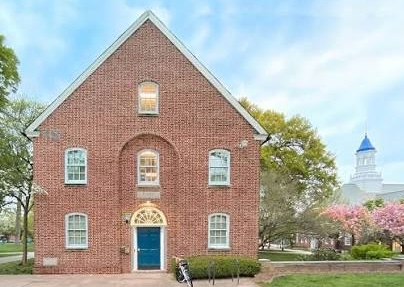
The middle window on the second floor of Dietz-Santee Hall was mine twenty-five years ago.
The door in the photograph below is the one I came out of on the morning of September 11, 2001, to attend my daily 8:00–8:50 a.m. second-year German class with Professor Bentzel.
I was a junior at Franklin & Marshall College, only weeks from my twenty-first birthday and a few months from a planned semester abroad at Stockholm University in January 2002. I would attend the Swedish Program and intern with the U.S. Commercial Service at the U.S. Embassy in Stockholm.
The moment I stepped outside, while most college students were still asleep in their beds, the September morning—dew-bright grass and birdsong—stopped me dead in my tracks.
The first thing I noticed was the sky.
The sky was an impossibly saturated blue, the very blue of the Ålandic flag.
Not merely clear. Flawless. Not a single cloud to be found.
Twenty-five years have passed, and the sky has never darkened in that memory.
I arrived barely on time, and for fifty minutes the day remained an ordinary Tuesday.
My language partner was Chris Olson, a classmate one year behind me. We did the exercises Herr Bentzel assigned us, and as class ended at 8:50, he told us that photocopied materials were waiting in the department office and could be picked up from the secretary for three dollars. I happened to have the money with me, so Chris, a few classmates, and I made our way to the department office.
The door opened into the left corner of the room. Beside it, against the wall, stood a tiny, primitive black-and-white television on metal legs, facing away from us toward the secretary’s desk. When we entered, she was sitting at her desk like a statue, with three professors crowded behind her to get a view of the screen.
They were transfixed, utterly silent. We waited for someone to notice us. No one did. After clearing our throats repeatedly, we shuffled farther into the room and turned around to see what had so transfixed them.
On the tiny black-and-white TV, through the static, the North Tower was clearly burning.
Someone then said that a plane had hit the World Trade Center. The secretary found the pile of packets and began moving her arms like a robot. She took the three singles from my hand without looking at them or counting them. Her eyes never left the television. The coverage was already trying to identify the floors that had been struck. We still understood it as a horrible accident.
Chris stared at the screen. The color drained from his face. Then, without saying anything, he simply walked out.
Then, I did not know why.
Frustrated by the crowded room and the tiny TV, I left carrying the photocopies I had been so intent on buying. I hurried back to my room and turned on my own television. Mine was also tiny, but it was in color, and it was mine. I did not own a mobile phone yet, so I used the landline in my room to try to find Keith, then my boyfriend of one year, because I wanted us together. No answer meant he was already on his way to campus. Only steps away stood the college chapel where we would eventually marry—another beautiful September day where life would change.
At 9:03, alone sitting on my bed, I watched the second plane enter the South Tower.
That was when the last possibility that the first crash had been an accident vanished. Being alone became unbearable.
I immediately went down one floor to wake my friend Sue. She was from New York, knew people who worked at the World Trade Center, and tended to sleep late. She answered the door in distress as I tried to explain what had happened, still too disoriented to make sense of the words.
Keith somehow found us.
We sat wordlessly on Sue’s bed because she had the larger television. We watched people trapped above the fire appear at windows. We watched them fall. We knew that we were watching individual human beings die, one after another, in real time.
Then we watched the towers collapse.
The College immediately canceled classes and set up televisions in classrooms and meeting rooms so that students without one would have somewhere to watch. People simply stood in front of them with tears running down their faces. An enormous number of students at F&M came from New York and Washington. Many had cars and wanted desperately to use them—some to get home to their families, some simply to go toward the crisis and help. To do anything.
President Kneedler warned us not to leave.
Three Mile Island was nearby, and if the attacks were part of something larger, nuclear facilities suddenly seemed like possible targets. The National Guard was being activated. Sending nearly 1,900 students out onto the roads could mean sending us toward danger rather than away from it. We were given instructions about a possible evacuation and asked to remain on campus until it was safe.
By that point, almost anything seemed possible.
As I held her hand and listened to Sue moving between panic and shock over the people she knew in New York, I remember thinking, with immense, selfish relief,
“For once, I am grateful to be from nowhere.”
I meant Everett. Bedford County. The middle of western Pennsylvania, where most of my family was and where no terrorist would ever have any reason to go.
Only minutes later, the television reported that another plane had gone down “somewhere in the mountains of western Pennsylvania.”
Exactly where I am from.
And that was when I truly lost it.
The place eventually acquired a name: Shanksville, just across the county line in Somerset County near the village of Lambertsville, which only narrowly escaped oblivion. The route there passed through beautiful country I knew deeply from the back seat of my parents’ car, west from Bedford on Route 30, through Schellsburg and into Somerset County, toward the roads they took when they drove me to Lutheran summer camp in Jennerstown. My paternal grandparents had kept a lake house at nearby Indian Lake until I was nine, where we had family picnics. I learned to swim in those waters. My father’s family has roots in Somerset County going back to the early 1700s.
Flight 93 came down perhaps a minute or two by air from the Bedford County line and only a few more from Everett. Small pieces of debris reached Indian Lake and were later recovered from the water.
I had called that place nowhere. I could have driven to the crash site without a map.
When classes resumed, my language partner Chris was gone.
“Where is Chris?” I asked.
That was when we were informed that his mother, Maureen “Rene” Olson, had perished in the North Tower.
Maureen was fifty years old and had been a stay-at-home mother who only three years earlier had taken a job as the business librarian for Marsh & McLennan. She loved Broadway, had a long love story with Manhattan, and had run the New York City Marathon with her husband.
The company’s offices occupied floors 93 through 100, directly in the impact zone.
Only then did the scene in the department office return to me in its full horror: the television trying to identify the floors, the color leaving Chris’s face, the way he pivoted and walked out without a single word.
While the rest of us were still struggling to understand what kind of event we were watching, Chris was realizing his mother was gone.
He took a leave of absence. I did not see him again until my senior year, after my return from Stockholm. He remained at an intermediate level in German, so we were never in the same class again. But I remember how much changed he was when he returned.
But return he did, eventually graduating in 2005.
That same October, during fall break, Keith and I drove to Shanksville to understand what had happened and to honor those who had made the ultimate sacrifice to save the Capitol.
Back then there was no national memorial, no museum, no great walls of white stone. There were local volunteers keeping watch, people bringing them bottled water and hot coffee, a tiny garden shed, and a chain-link fence. Locals and family members of the dead had pushed cups into the links and tied notes, ribbons, tokens, and children’s drawings to it.
The locals kept watch over the place around the clock and began the long, bitter fight—including years of court battles with an opportunistic landowner who tried to extract a windfall from the abandoned strip mine where the dead now rested—to secure a permanent memorial.
There is something deeply Appalachian in that sense of duty: the dead had been entrusted to the living on this ground, and neither government obstruction nor a landowner’s greed relieved the locals of their human obligation to honor courage and sacrifice.
Years later, returning with Keith and our four children, I find the completed memorial almost unbearable in its restraint and the lovingly chosen details: the long approach to the field, the path mimicking the peculiar angular cut of hemlock trees that blazed at the crash site, the path following the plane’s final course, and, inside, family photographs, melted work badges, singed drivers licenses, and last voicemails that restore forty whole human lives to a story so often reduced to its final minutes. Nothing there is accidental.
But I remember it most clearly before any of that existed: the field, the fence, the ongoing investigation, and the stubborn locals who refused to leave the dead unattended, and kept watch around the clock. Many spoke as if the dead remained there in some way.
That, too, was America: people refusing to leave the dead unattended. Americans at their absolute best.
In September 2002, back at Dietz-Santee Hall for my senior year, another memorial began to take shape outside my window. I had moved upstairs by then, from the middle window on the second floor to one on the third, and I watched the college install and commemorate it in the garden below my windowsill.
The memorial gathered around Votive K, a bronze sculpture by the German artist Fritz Koenig. Koenig had also created The Sphere, the great sculpture that stood at the foot of the World Trade Center, survived the destruction of the towers battered and torn, and became one of the attack’s most recognizable witnesses.
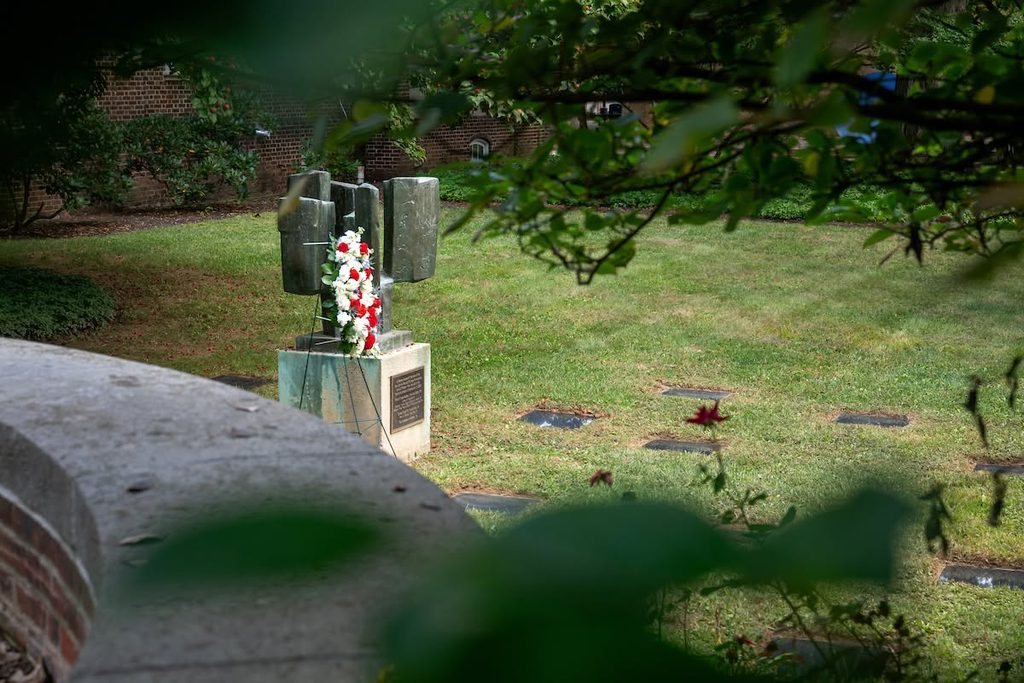
Granite stones were set into the grass for four members of the F&M community.
Jeffrey M. Chairnoff, Class of 1988, was thirty-five, a husband and father working on the 104th floor of the South Tower.
Edward J. Perrotta, father of F&M student Joseph Perrotta, was forty-three. He worked for Cantor Fitzgerald high in the North Tower. Outside work, he loved fishing, gardening, and beautiful things.
Maureen “Rene” Olson, remembered as the mother of Christopher Olson, the classmate who had stood beside me in German and then silently walked out of the room.
Mark “Mickey” Rothenberg, Class of 1970, died aboard Flight 93 in the Pennsylvania landscape I had once mistaken for nowhere.
But it was always somewhere.
Mickey is believed to be the first to have perished on Flight 93, intervening when the terrorists tried to breech the cockpit.
Today what still haunts me is how much can turn on things too small to resemble destiny: a floor number, three dollars in a pocket, a decision made in seconds, a few minutes gained or lost, all the nearly invisible turns by which one person becomes a witness, another is delayed, and another never comes home. Twelve years later, when Ali’s nap delayed us by about an hour on our way to the Boston Marathon finish line and kept us from being there when the bombs went off, I encountered that brutal arithmetic from the other side.
America changed forever, fundamentally. You could see it afterward in our laws, in our airports, in the hardening of places that had once felt ordinary, and in the disappearance of the old belief that distance meant safety.
But twenty-five years later, this is what I remember most clearly of all: the texture of the dollar bills held out to a secretary moving in a trance. The weight of the photocopied packet. A tiny black and white television. Chris’s face losing its color. Sue’s terror. Keith sitting beside me holding my hand. People wandering the campus aimlessly and suddenly bursting into tears. Human beings at windows. A subdued 21st birthday. A fence in Shanksville carrying children’s drawings. Volunteers in cold October rain comforting those coming to pay their respects. Grief counselors. A grief-softened New York bereft of its towers on a study trip that very November. A Stockholm embassy on constant high alert. Granite stones appearing beneath my window.
And the blue.
That terrible, immaculate blue.
For one brief moment that morning, the world looked untouched. Then history entered through a small black-and-white screen and taught me once and for all that there is no such place as nowhere.
Every landscape is someone’s childhood. Every building is where someone’s mother went to work. Every name cut into stone once answered when called.
Remembering is how we call them still.
Comments