

Åland’s government has offered its explanation. Inconveniently, its own correspondence contradicts it.
Author's note: For any international readers and very confused friends just tuning in: this concerns writing I was asked to contribute to a collaboration between UN-Habitat and the Government of Åland, an autonomous region of Finland where I reside. The work was shared under the conditions that Finland's Copyright Act would be respected. It was not respected. Beyond that, it is a long story and has been receiving media attention since 7 September. An oversight process is ongoing at UN-Habitat and is about to be launched here in Finland with the Parliamentary Ombudsman. I don't suffer fools, and my patience is not infinite.
Varsågoda, read the documents yourself
A note for anyone just arriving, 6 October: or later How did writing about human flourishing lead to government warnings, lawyers and a cancelled UN publication? I’ve now told the story in Now Hear It From Me, five short videos in English in total 10 minutes length, from the desk where I wrote the work that started it all.
Start there for the background, then return here to read the correspondence for yourself.
Initial publication correspondence
- 26–28 April: PDF The UN-Habitat publication and Legal Unit thread.
Government correspondence
- 29 April: PDF Eriksson’s email.
- 30 April: PDF My response.
- 20 May: PDF Eriksson’s demands.
- 27 May: PDF My lawyer’s response.
- 4 June: PDF Eriksson’s reply.
These initial UN exchanges establish what I asked before the government’s first warning and prove that I did not represent myself as a member of the Government of Åland.
Later UN legal correspondence and oversight submissions are outside this release.
I asked the Lantråd to answer for him. He answered for her.
John Eriksson’s public answer to today’s admittedly enormously long letter to the editor (note: I did offer to shorten it; but Nyan opted for the full IMAX experience, thanks for the space, guys) recasts this as a dispute over government endorsement. I did not care about its endorsement then. I certainly do not care now.
As a matter of fact, I would like my material removed from the internationally-oriented everyonecanflourish.org website. If only local use counts as fair work use, as they claim I only had a local role, publishing it to the world on an English website in a mandated Swedish-only region is a curious interpretation of “local”. I thought we were getting back to basics now? Bärkraft.ax already has an English-language section. The other website is unnecessary.
Either way, you cannot have it both ways.
I would also be interested to hear why Micke Larsson asked me to send the work to UN-Habitat. I do have quite a few emails and other Teams screenshots proving the request, plus he was copied on transmissions, so…

In short, what Eriksson conveniently left out in the newspaper is that his emails also demanded that I take the work down entirely and obtain permission even to associate myself with it.
He is both defending a smaller demand than he made and omitting the solutions we offered.
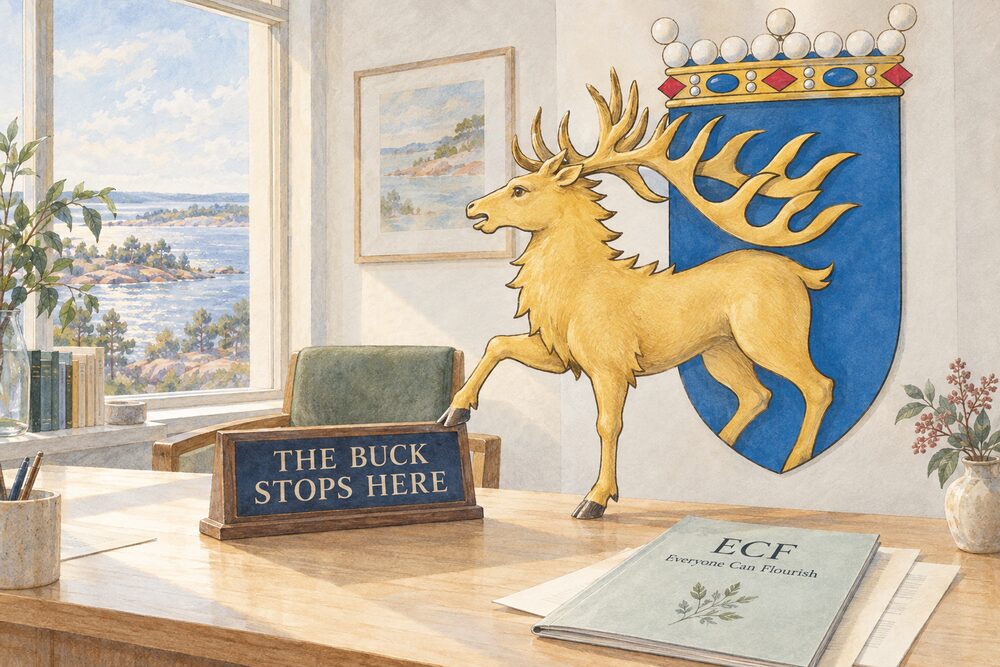
AI-generated political satire.
Today’s letter to the editor asked Katrin Sjögren whether she stood behind her government’s treatment of me. Instead it is John Eriksson, the official whose conduct I asked her to address, who supplied the published response. Read the exchange in Nya Åland.
This move is beginning to look like a Katrin Sjögren trademark. For the second time in less than six months, concerns I raised with the Lantråd have come back through the chain of command whose own handling is the one under question. Rather like asking the fox to investigate the missing chickens, then publishing his assurances about poultry welfare. Nor, must I remind everyone, is this a new problem.
In mid-May, my lawyer’s requests for documents were also handled personally by someone implicated centrally in the matters they concerned. Apparently, at the Government of Åland everyone just gets to supervise themselves. Anything goes. The fox has reviewed the security arrangements and recommends retaining the fox.
On 26 April, Sjögren explicitly forwarded my concerns to the förvaltningschef. In September, my public question about his conduct received his own defence.
I asked whether she stood behind him. The published response put him in front of her.
I addressed Katrin Sjögren directly because setting the tone and standards at the top is her responsibility and she made categorical assertions that there is no tystnadskultur at the Government of Åland concerning sustainability work. (For reference, I have never spoken to John Holmberg, so whomever he referred to in his 7 September Plenum remarks are other individuals entirely.)
And sure, her government’s most senior administrator CAN explain his actions.
But he cannot answer the political question of whether she stands behind them.
So the question I asked did not get an answer. Curiouser and curiouser.
Having raised the subject of gagging, perhaps the Lantråd could reassure us that she, too, is truly free to speak.
Blink twice, Katrin.
The Lantråd can delegate the preparation of a reply.
But the Lantråd cannot delegate her political responsibility for the answer. Yet that is precisely what she did, and that says a lot.
The documents show the government’s demands and my answers. Readers should not need to make a public-document request to understand a public controversy. Since Eriksson has utilized a method of selective quotation, I am publishing these exchanges in full for all.
Because this is basic governance hygiene. Washing your hands of responsibility does not count.
And now you can judge for yourself whose account survives the context.
How a request became a warning
On 26 April, I asked UN-Habitat who was responsible for the publication, whether my name appeared, how my work had been used, and whether I could review it. I requested a pause pending answers and if necessary, a resolution. I expressly wrote:
This is not a request to block responsible publication.
Only four hours later on a Sunday, UN-Habitat asked me to identify its responsible contact. That was one of the questions I had, in fact, just asked them. I explained, followed up, and referred the unresolved questions to its Legal Unit on 28 April.
The documents are explicit: I was writing in my personal capacity as the author and rights holder of material I had created. Which is precisely what I am under Finnish law as copyright always starts with the creator.
The government’s first warning arrived the very next day.
29 April: Eriksson disputed my role and told me I had no right to contact UN-Habitat or the lead author about matters connected with the government or my former assignment, or make statements referring to that assignment which harmed government interests. Read the email. He was kind enough to actually put it in writing.
30 April: I corrected the record, supplied copious documentary evidence and explicitly stated that I was acting personally as an author and rights holder. Which I was. It was also Valborg: his assertions made excellent kindling. Friends, family and I have been laughing at its deadpan delivery for months. Read it. You can also read its bigger sibling, “Good question. I don’t know.” on this website which has the same ironic deadpan tone.
20 May: He demanded removal of my published work, alleged unauthorised sharing, and attributed costs and reputational harm to my actions. Even my own association with the material was to require permission. In healthy democracies, one does not need the government’s permission to say what one writes. Yet he claimed authority over both whether my work could remain public and whether I could even identify myself with it. Or identify myself with my prior workplace. That is an attempt to silence me, complete with an official signature. Read the email.
27 May: My lawyer, Kukka Tommila, brought no-fuss Finnish common sense to proceedings that had become conspicuously short of it. She patiently answered Eriksson’s assertions with documentation, legal analysis and proposed solutions. At my instruction, UN-Habitat and Sjögren herself also received Kukka’s letter and his 20 May email with it. Her letter is long but well worth reading. She gave his assertions, now dramatically expanded to several legal areas, the courtesy of examining them individually. Sadly, they did not benefit from the attention.
4 June: Having received factual corrections, documentary evidence and an explicit warning against repeating allegations contradicted by the record, Eriksson tripled down on his previous positions and demands. We did appreciate the reference to Swedish. My lawyer kan faktiskt svenska. However, UN-Habitat does not have Swedish as an official language. We kept the correspondence in English so UN-Habitat could read the entire exchange, without my paying for every letter twice. I trust English had proved equally serviceable in his own dealings with Nairobi on 11 May, where records show a conversation took place.
On my lawyer’s advice and as we had warned him in our 27 May letter, we stopped replying. We had answered his allegations. Kukka, my wallet and I were not obliged to keep him company while he repeated them over and over to himself.
So by early June, the government had received factual corrections, a detailed legal answer and explicit references to its very own records. UN-Habitat had been copied on Eriksson’s demands and the rebuttal and had their own internal records to compare to the correspondence. And again, Katrin Sjögren was also copied on that correspondence.
Unwisely, Eriksson maintained those demands without answering the documented contradictions placed in front of both him and UN-Habitat. This was his active choice, done in Åland’s name, made after correction with documenation and 100% visible after open disclosure to an international partner. He ironically accused me of damaging Åland’s reputation all while continuing to supply UN-Habitat with written categorical assertions that would naturally have them questioning his own government’s account as they had their own records to rely on as well.
An incredibly stupid and reckless position, especially to put in writing, in my opinion. Your mileage may vary.
And that was when I directed my lawyer Kukka to write to UN-Habitat on 10 June to inform them that the Government of Åland was blatantly an adverse party, who was also clearly adverse to reality, and that there could be no productive discussions with its förvaltingschef. So I directed my lawyer to give UN-Habitat a 3 July 17.00 deadline to bring this show to a close. The farce had run long enough.

The demands were his. The assertions contradicted by the written record were his. The official signature on my employment papers was his. On 27 May, I made sure UN-Habitat could read them and compare his emails to me with their own staff’s records.
If the documents and his correspondence damaged Åland’s reputation, the first question is why did he write what he wrote. Perhaps the Lagting should ask?
As I predicted, UN-Habitat pulled the plug that month and notified me through my lawyer on 1 July. Obviously, I do not blame them. I would not pay good money to an expert consultant to lead a report, then set aside her 30 years of professional judgement and my own global publishing standards to indulge a political temper tantrum. There are many regions. There is only one UN.
Eriksson’s public reputation for ahem being a bit overzealous and *cough* forceful obviously did not begin with me and long precedes my arrival on these islands. He supplied the correspondence. I am supplying the readership. If he expected exhaustion or social pressure to finish the job, as I suspect it may have before, I have been quite a disappointment.
What his public answer leaves unexplained
Inconveniently for him, the role he disputes was confirmed by the lead author herself. Eriksson says government representatives were never intended to be co-authors, medförfattare. My insändare says the correct term medverkande författare: contributing author. Earlier reporting used the wrong term and the Government is choosing to capitalize on the confusion in a few media outlets.
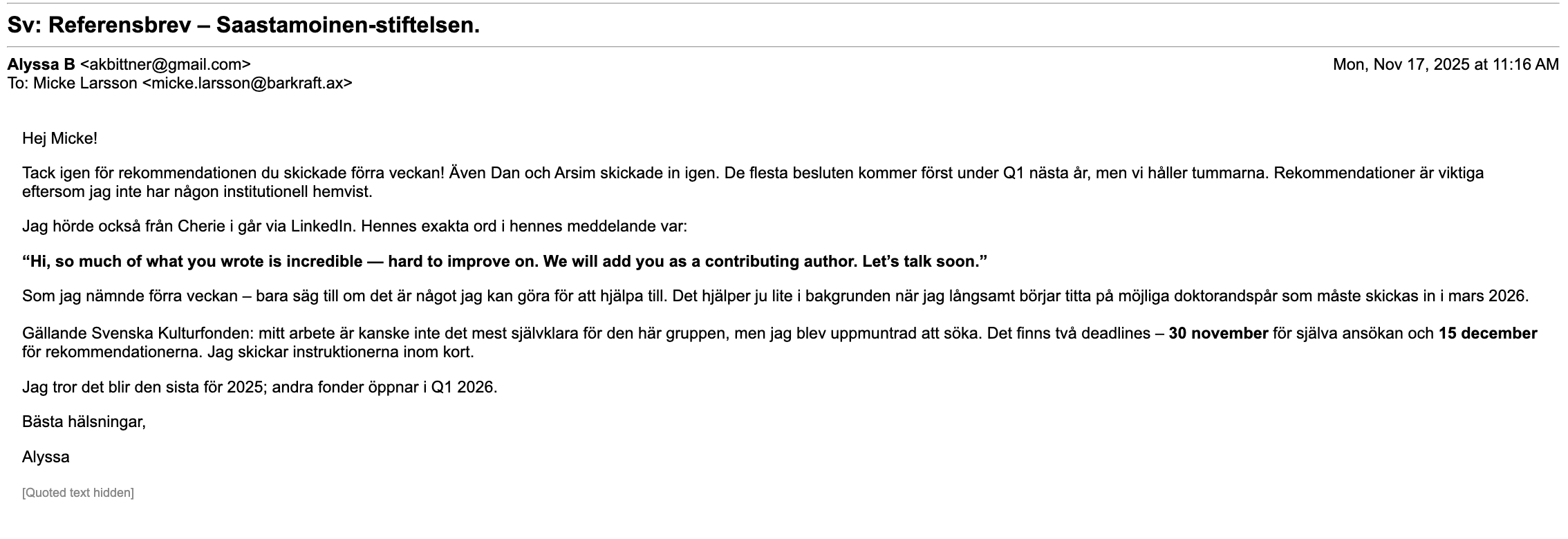
Moreover, Chérie Enns confirmed that role four times, three in writing. Her first confirmation was verbal, in front of my supervisor, Micke Larsson, and another government employee who I will leave unnamed. Larsson recorded her decision in the meeting protocol which was circulated to all attendees at 17.11 on 20 August 2025, after our final meeting during her visit. I left my role in September 2025. In November 2025, Enns wrote to me unprompted on LinkedIn:
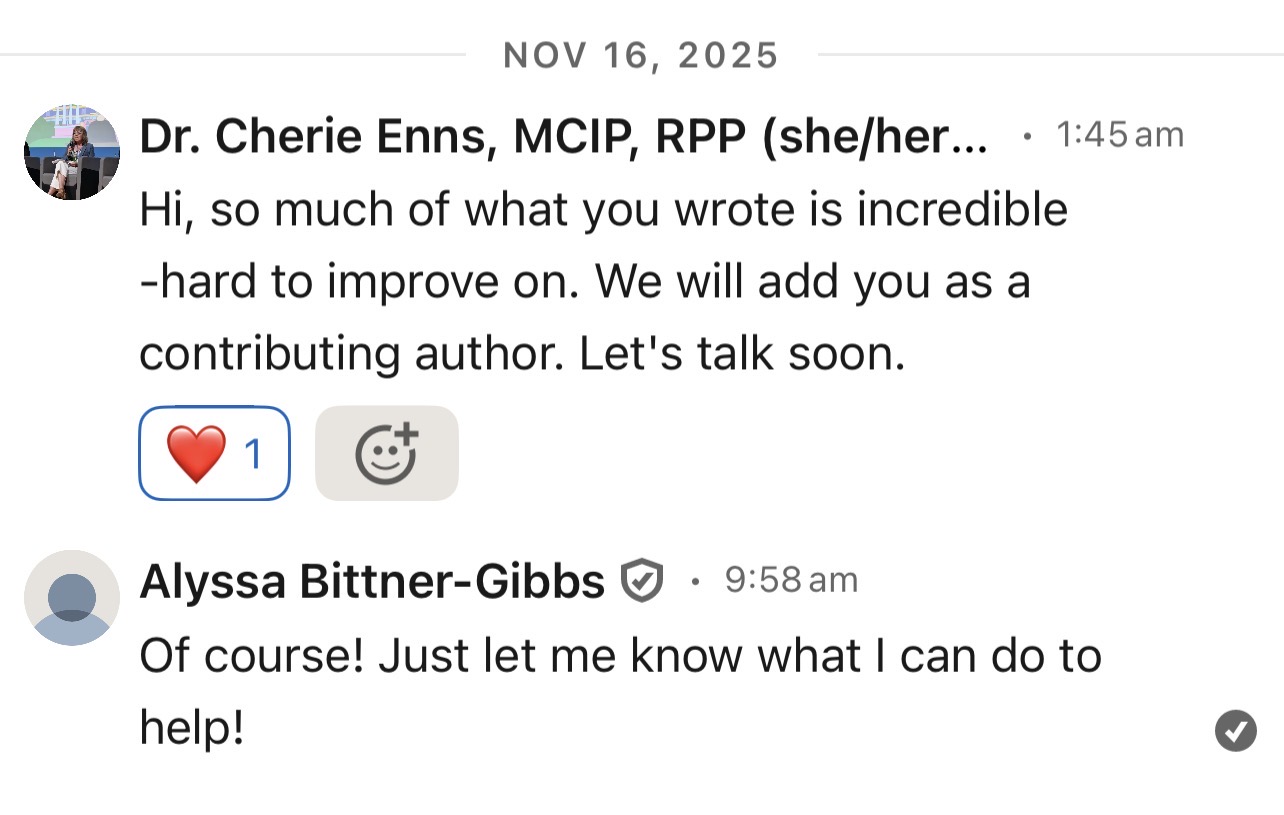
We will add you as a contributing author.
I even took the trouble to forward that confirmation to Micke Larsson on 17 November. He chose not to respond. Cherie followed up with confirmations in March 2026 twice.
What the government “intended” for its representatives does not erase what the lead author confirmed to a contributor. Authority as an official spokesperson for the government, an employee carrying out a supervisor’s instructions while working and enaging with external parties he indicates, and asserting one’s own rights as an author are three entirely different things. You would think a trained jurist would know the difference. Documents my lawyer reviewed show I attended meetings and sent material at my supervisor’s direction and she put her name on letters that stated that fact. Emails shared here clearly show I contacted UN-Habitat in my own capacity about my own work. Denying me a mandate as a spokesperson for the government answers neither point. I am still the author of what I wrote which has nothing to do with employment, status, or job title. The legal requirement to attribute the protected expression in my work exists in all cases. But nice try.
Calling Åland a research object does not make writing that I was asked to share disappear. Nor does describing material as “provided” explain who wrote it, Micke. Authorship does not evaporate in an email attachment. Only a signed agreement can alter the requirements ordained by law. Nor does intellectual work materialise out of thin air. It always has an author.
If UN-Habitat controlled the publication, its procedures and its lead author’s judgement deserved more than passing consideration. I would argue they were the only consideration where the author’s page was concerned. Åland has repeatedly insisted this was UN-Habitat’s publication and process. Then the lead author’s confirmations require an answer, not another recital of what Åland intended or wished.
The UN has publication procedures addressing content, copyright and licensing. A participating government’s preferences or official contacts cannot substitute for examining who contributed what, how that contribution should be credited and what permissions are needed to use it. That is the UN-consultant/lead author’s role and anyone else is outside their lane. For good reason. Getting those questions wrong carries reputational risks and can expose other partners using material without the necessary rights to legal claims. A preferred “look” or a government’s curated list is not a publishing standard. Authorship is about who wrote what.
The denial of authority ignores who gave the instructions to me. Eriksson says I was neither interviewed nor authorised to represent the government. My replies identified the schedules and meeting notes documenting my participation, arranged and directed by my supervisor, Micke Larsson. Perhaps he and John should have a conversation. Pages 7–8 of my lawyer’s letter set out the instructions to translate and share materials, communications copied to my supervisor, and his arrangements for my participation during official visits. I retain the meeting invitations, emails, Teams messages and official schedules bearing my name. My involvement left a substantial paper trail that UN-Habitat also would be in possession of.
If those instructions were improper, the government needs to explain why its manager gave them. It cannot account for my conduct while omitting the person who directed it. Today’s newspaper assertions continue to leave that question unanswered. My later contacts were expressly in my personal capacity, as the April UN emails and my 30 April reply make clear.
Today’s defence omits the proposed solution. He presents his demand as removing government associations from work it did not endorse. On pages 11–12 of her 27 May letter, my lawyer offered a disclaimer explicitly stating independent authorship and the absence of government or UN-Habitat endorsement. The documents never bore any government letterhead, logo or official publisher line at any point. Micke Larsson had written the provenance note in the back of the work himself which I agreed to, which is the same note that Eriksson later objected to.
After 4 June, when Eriksson maintained his earlier demands, my lawyer advised that those demands had no legal basis; however, changing the provenance note and adding disclaimers remained my personal choice. As a courtesy, I did so on 7 June, clarifying very clearly the absence of government endorsement. That did not change the fact that a government employee had asked me to submit the work, John.
So why was the offered disclaimer insufficient? Why did the work itself have to disappear, John?
So we need to talk about what he wanted to take down. The “website” he refers to is Zenodo, a research repository that assigns a DOI and provides a public, citable record of the work’s provenance. That is the material he demanded I take down.
More bad news for the government: even if I had agreed, I can restrict downloads, but CERN’s Zenodo retains the DOI and citation even after withdrawal if you do not remove within 30 days. I posted this over a year ago. Taking down the work does not make its publication history disappear. Research repositories are inconveniently good at remembering. It is permanent.
Finally, government association definitely does not explain why my source material had to disappear while the UN report was still intended for publication at the time. If the report used the same material, what made it reputationally damaging under my name but suitable for publication under the UN’s? Taking down the source would not resolve the rights in material reproduced from it. Was the problem the work, or perhaps it was the DOI and public record showing who wrote it?
What do you think UN-Habitat might have thought? It looks as it looks.
Where the buck travels
So on 1 July, UN-Habitat notified me that it would not proceed. That decision leaves an obvious question that no one seems to pick up on.
If my material was truly absent, why was my rights claim an obstacle to publication?
If it was present, why could its use not be agreed, properly credited or removed so publication could proceed?
If I never participated and my stuff was not there, we would have a publication. We do not.
The Government says that it was UN-Habitat’s report. UN-Habitat’s consultant made her professional judgement known. Repeatedly. Why was this not respected? Are you a bigger expert than her and her 30 plus years of experience in international development?
What mattered was what the report actually contained. Cherie wrote it so only Cherie can answer what came from where. She made an authorship determination.
But if there was no violation, why not demonstrate that the work was not there and proceed?
I raised questions about authorship and the use of my work. UN-Habitat made the publication decision, but I suspect that Åland was surprised at the decision they made rather than to publish anyway.
Finally, if a woman in Finland randomly sending an email gave her a veto over UN publications, I have oceanfront property in Switzerland to sell you. You all should be smarter than that.
Åland had its salaried lawyers. The UN had an entire legal apparatus. I had one lawyer. I would love to believe I was this consequential. But before anyone convenes the Security Council, perhaps we should consider whether several well-staffed offices simply managed to make a spectacular mess of publishing a report over what was ultimately two words. My first name. My last name.
Cancelling the report did not resolve the allegations, legal costs or either institution’s conduct. Again, the wider absurdity is funnily documented in “Good question, I don’t know.”
The government points to UN-Habitat’s publication process and claims limited insight. UN-Habitat sends reporters back to Åland. Apparently, accountability is an international forwarding service.
The government needs no insight into somebody else’s organisation to explain its own emails. UN-Habitat must explain how authorship, permissions and provenance were handled between the consultant’s handover around the turn of the year and the planned publication on 28 April. The launch had a date. My questions still had no answers.
The repository supplied a public provenance record against which use of my work could be checked. Taking the work down would have made scrutiny harder. It would not have changed who wrote it.
In international-relations theory, buck passing concerns leaving other states to bear the burden of confronting a threat. I recognise an institutional version here: responsibility travels between organisations while the consequences stay with the individual and the press are not given answers.
However, a channel does remain open at UN-Habitat thanks to me. Its purpose, however, is accountability for what happened, not resuscitating a broken publishing process.
On 18 August, the UN’s internal watchdog, the Office of Internal Oversight Services (OIOS) in New York, confirmed that it had referred my 9 July complete report and supplementary materials to the desk of none other than Anacláudia Rossbach, the head of UN-Habitat. She holds the rank of UN Under-Secretary-General and was appointed by the General Assembly following nomination by the Secretary-General. She answers to one person, Antonio Guterres himself.
OIOS also specified copies to the UN’s Office of Legal Affairs in New York and the management officials responsible for monitoring such complaints and institutional waste. It specifically selected the Executive Director at the very top of UN-Habitat’s organisation as the appropriate authority for further handling and told me to expect contact from a designated UN-Habitat official after an initial internal review.
The agency’s leadership now has the complete record and responsibility for the response and I am prepared to provide even more documentation upon request. Describing this as an “internal process” does not explain what happened. That process is precisely what requires an explanation.
It should probably also be obvious that people sending random reports to UN offices in New York do not get referred to the desk of an Under-Secretary-General if there is not some reason to ask questions.
Åland’s responsibility has not travelled to Nairobi with the paperwork. It remains with the people who wrote the demands, received the evidence and maintained their position and continue to double down against the documents.
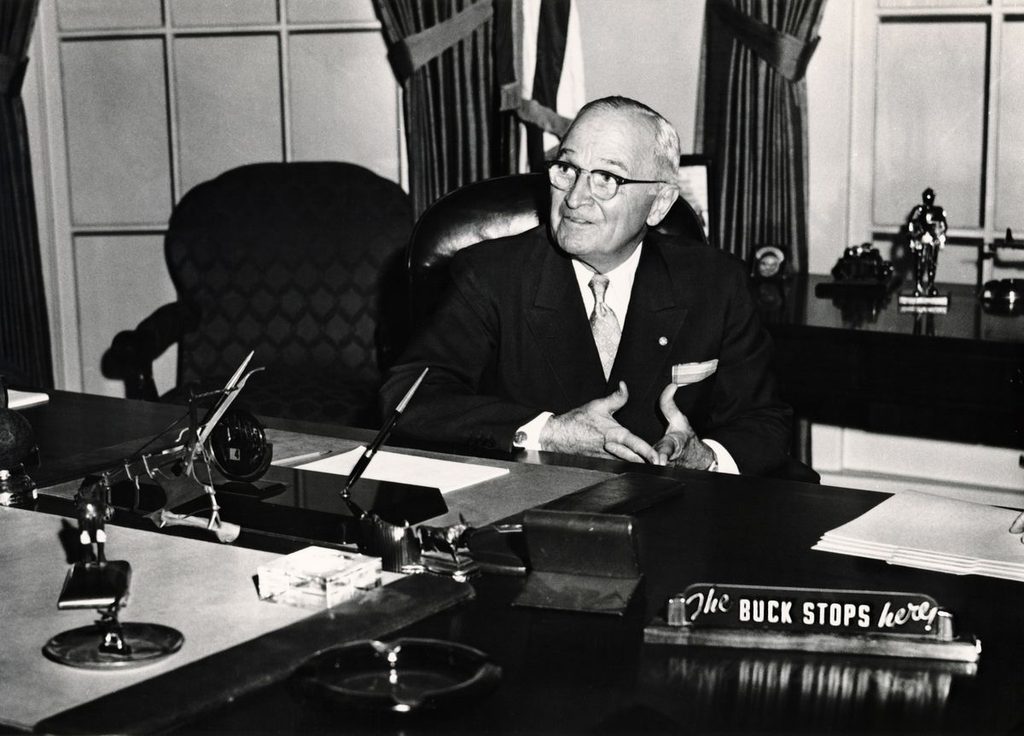
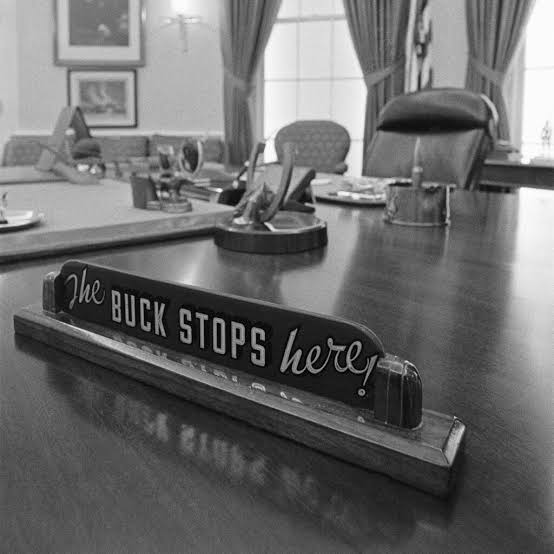
Harry Truman kept “The buck stops here” on his desk. Åland already has a buck on its coat of arms. We all seem to be still looking for somewhere it stops.
Where is Truman when you need him?
A project called Everyone Can Flourish should be able to explain how it treated an actual person. Our government here on Åland cannot even honestly manage that simple task.
The law comes first
Finland’s Constitution places the requirement that public power rest on law in section 2. Åland’s own Lagtingsordning repeats it. Official embarrassment or a preferred political narrative supplies no additional legal authority.
The democratic standards
- §2: Public power requires a legal basis.
- §12: Freedom of expression and access to public documents, subject to lawful restrictions.
- §21: Proper handling, reasons and review.
- §22: Public authorities must secure fundamental and human rights.
Link: Constitution of Finland.
If these demands were binding, under what power, and how could I challenge them? If they were a party’s position in a dispute, what justified telling me whom I had no right to contact? What did Micke Larsson mean when he stated on the Radio that the Government took no position? Do the emails look like to you that no position was taken? Or was it just position-vibes?
My lawyer explained another basic distinction: access to a public document does not itself establish permission to use copyrighted work. Government endorsement is a separate question again. An official title cannot settle those rights by assertion.
Many people would have fallen silent. My refusal to be silenced does not establish that nobody tried. They certainly tried. There was pressure from financial pressure to civic pressure, to even rumors that continue to reach me since the spring.
I did not care then and I still do not care now.
Our suddenly missing-in-action Lantråd
Katrin Sjögren received Eriksson’s 29 April email, my 30 April reply and my lawyer’s 27 May response. Does she stand behind those demands? If so, on what basis? If not, what will she do to withdraw them and address the consequences?
She is hiding behind the förvaltningschef who put his attempt to censor me and my work in black and white. Her government is obliged to protect my freedom of expression. Whose conduct is she protecting instead and not for the first time?
The allegations he maintained after receiving documentary corrections raise a separate question of defamation which I have been strongly advised to legally pursue.
Her office represents Åland, including when its correspondence reaches an international partner. If these messages are considered ordinary public administration here, people outside Åland should know that too. I certainly do not accept this as a democratic norm. Nor should you.
Familiarity makes scrutiny all the more necessary. The legal arguments deserve their own post. But no legal argument on Earth makes this an acceptable way for a government to behave or conduct itself. I found the coercive and abusive language shocking coming from a public authority. UN-Habitat could now read how the most senior administrator of a government promoting human flourishing treated an author who asserted her personal rights that the same government is obliged to not only respect, but protect. Is this really Åland’s standard for the job?
Then there was the inconvenient matter of the records. UN-Habitat actually did not have to take my word for my participation. It could check with its own staff and consult its own correspondence. My supervisor arranged my participation, included me in project emails and instructed me to send material. A curious kind of infiltration, organised by my own supervisor, eller hur?
That discrepancy creates a credibility problem. An international partner has reason to question a government’s account when it can check the assertions against records of its own and they don’t match up. Categorical denials become rather less impressive when the recipient can open the calendar invitation.
Finally, the Lagting, Åland’s parliament, also has a job. Its Lagtingsordning assigns it scrutiny of public power (§4), requires members to act as right and truth demand (§11), and provides mechanisms for questions and information (§§38 and 44). It can examine these demands, the evidence, and the handling of my reported workplace concerns while other legal processes continue.
I will file a complaint with Finland’s Parliamentary Ombudsman, JO, this week. The office aims to resolve complaints in under a year, which could put a decision before voters as Åland approaches its next election. Our elected representatives already have enough before them to ask questions now.
Whatever version circulates in the Landskapsregering’s open corridors courtesy of one indignant förvaltingschef and a few ministers, so I am told, the government’s letters are made public here. So are my answers. A story does not become evidence by making another desperate lap of the building. The Lagting has a duty to scrutinise the government’s conduct.
Scapegoating or enabling scapegoating of the whistleblowing citizen who exposed it would make that failure their own.
The political question I put to the Lantråd is still hers to answer. Does she stand behind the demands Eriksson’s public answer conveniently omitted? If so, on what basis in Finnish law? Does she consider this an acceptable standard of conduct for the Government of Åland regardless of the legal facts? How does Sjögren think these emails read to governments whose senior officials do not confuse intimidation with administration?
When an international partner can contradict Åland’s official assertions simply by consulting its own records, it has reason to question the reliability of the government making them.
Larsson stated on the Radio that the government took no position on copyright. Eriksson’s emails are a curious way of having no position: they asserted that I had no right to publish my work and demanded its removal. The government can advance a legal claim. It cannot adjudicate my copyright by email. Presenting its disputed position as an order to obey was absolutely inappropriate. If the approach was “solution-oriented”, why did it begin with demands to remove the work rather than an effort to resolve the rights?
The buck stops with you, Katrin.
Comments