
What do we do with the life we get to keep?
Author’s note: I first shared this reflection on social media on 15 April 2026, the thirteenth anniversary of the Boston Marathon bombing. I am now bringing it into the collection of writing on this site.
Among the things I had carried across the Atlantic were Martha Stewart recipe clippings about “Swedish food.”
I was spring cleaning our home office a few weeks ago, sorting through the accumulated evidence of two international moves, four moves, four children and forty-five years of living. There were articles about the notorious cost of Boston childcare, now reading like dispatches from another existence.
Some of Ali’s earliest toddler art.
Things I had once considered important enough to pack into a shipping container, send across the sea, and carry through several more moves besides.
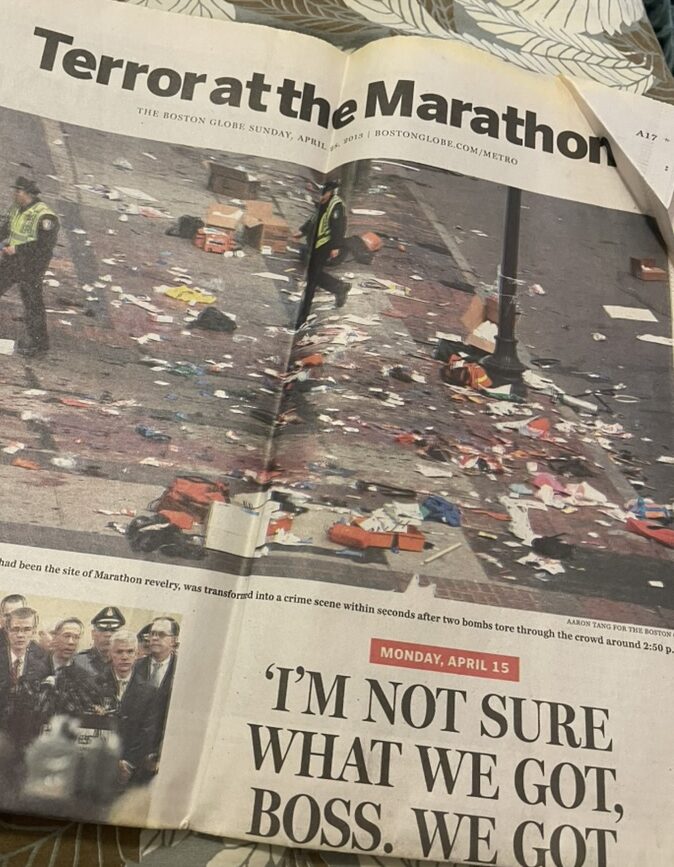
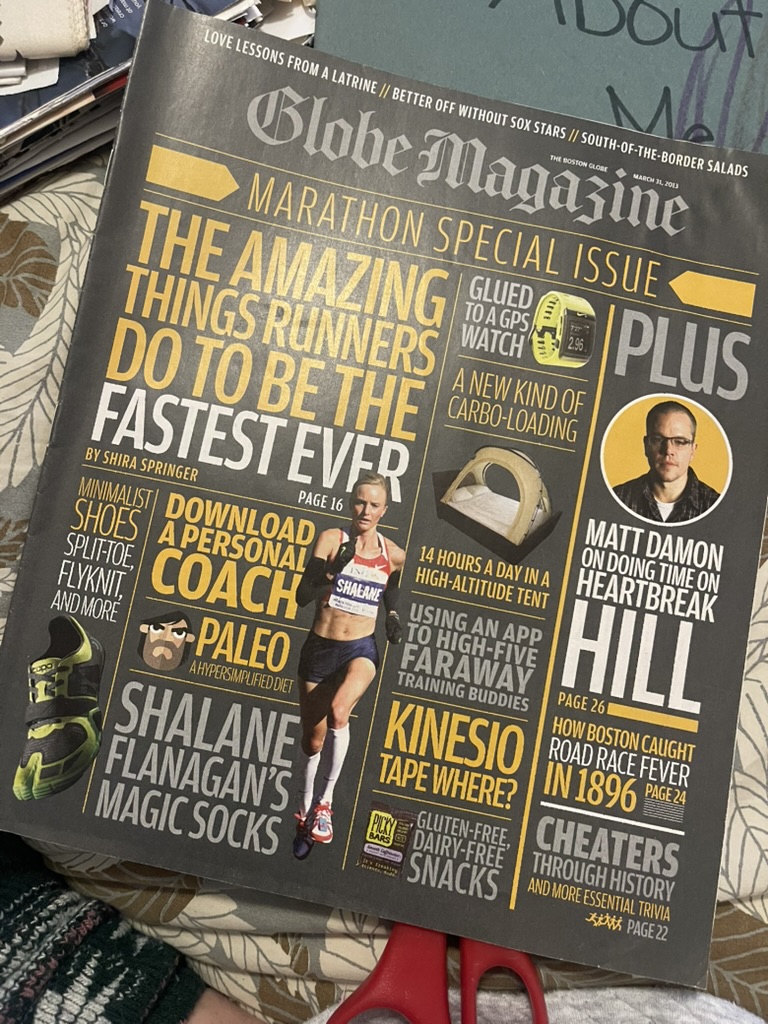
I was still smiling when I saw the headline.
Terror at the Marathon
And just like that, I was back.
April 15, 2013.
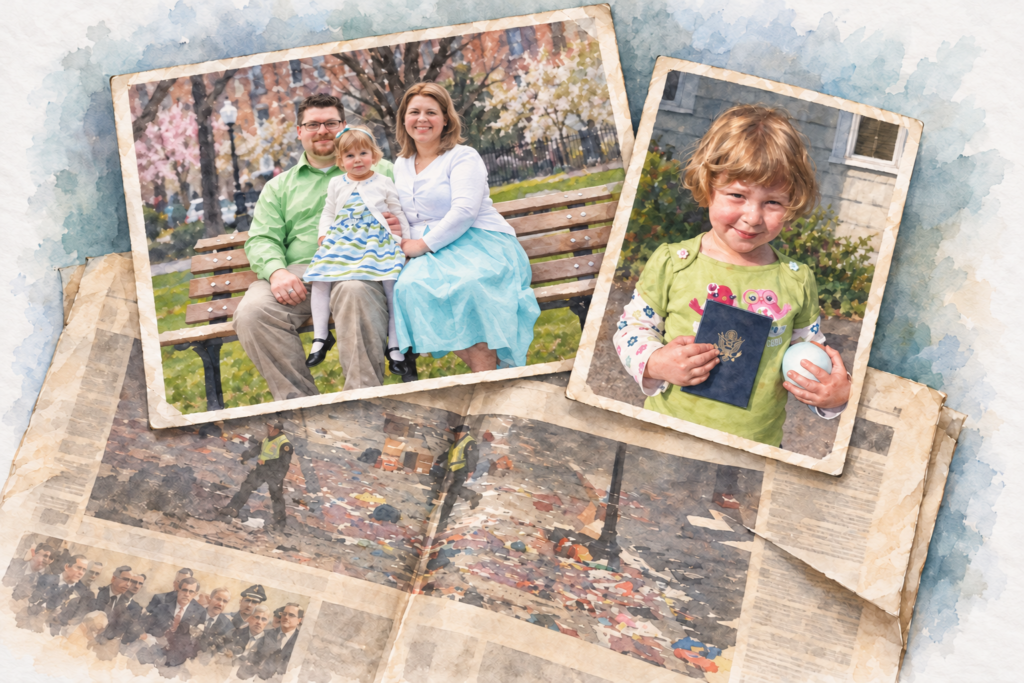
We would be leaving Boston for Sweden later that year, and I had an idea about how to say goodbye. On Patriots’ Day, we could go down to Boylston one last time, just as we had during our first Boston spring in 2004. We had been newly engaged then, young and excited and full of plans, standing among those friendly crowds at the finish line of the Boston Marathon.
Nine years later, I was ready for Sweden. But Boston held my twenties, and I was sentimental about leaving. I thought we might close the circle.
First, though, we had to get Ali her first passport. Keith, who worked at the Federal Reserve Bank of Boston, had the day off. The post office was open. We could both be there without using another of his precious vacation or personal days.
The plan was simple: go early, get it done, then head to Boylston.
Ali had other plans. Despite the early hour and her normally pleasant disposition, she was fussy in that very specific way where nothing is technically wrong but the whole day goes sideways anyway. After the queue and the paperwork, I suggested we go home. Miss the elite runners. Feed her lunch early. Put her down for a nap. We could watch the charity runners come in afterward.
I was sentimental, but braving a crowd with an angry toddler strapped into a stroller is not how happy family memories are made.
She ate, slept and woke in a better mood. We were getting ready to leave. As we climbed into our Kia Soul, our phones went off.
Explosions near the finish line. Avoid the area. Stay indoors.
We had friends running that day, as so many Bostonians do, for charities and causes they care about. We started calling. Nothing. Calls would not connect.
The elite runners had finished long before. But the marathon stretches across the day, and for much of it Boston becomes one long block party. Friends cheering friends. Families waiting for someone they love to come around the corner.
Then the images started coming in.
I had worked on Boylston once, transferring from my college job to the LensCrafters there before getting my first real job. Now I was looking at photographs of the blown-out windows. The blood. The ashen shock on people’s faces. Limbs gone. People using their hands to keep strangers alive.
In the days that followed came the manhunt, the shootouts, the instruction to shelter in place. Draw the curtains. Stay inside. Places where I bought groceries or made Target runs appeared in the news. The familiar geography of errands had become the geography of terror.
A week later, at my mothers’ circle, someone asked where another mother was.
Her parents were in it. Her dad lost his left leg, her mother, her right.
We did not talk about childcare tips that day.
It was our city, our street, almost our afternoon.
There is a whole genre of story about the person who almost went. The missed flight. The delayed departure. The ordinary inconvenience that becomes, afterward, the hinge on which an entire life appears to have turned.
I understand why we tell those stories. I have one too.
But other people were there.
Martin Richard was eight. He would be twenty-two now. Lingzi Lu was twenty-three, a graduate student from China studying at Boston University. Krystle Campbell was twenty-nine, a restaurant manager. Three days later, Sean Collier, a twenty-six-year-old MIT police officer, was murdered in his patrol car.
All young. All with lives still opening before them.
When I think about how much life I have lived in the thirteen years since, the scale of what was taken becomes harder to comprehend. Whole futures fit inside that time. Children grow up. People meet. They leave countries, build homes, become people they could not yet have imagined.
Much of the life through which you may know me was still ahead of me that afternoon.
I am grateful that we were spared. But what has stayed with me is also the people who were there when others were not.
The people who ran toward, not away, from the horror. Who stayed beside someone bleeding on the pavement. Who held pressure on wounds. The emergency workers and medical teams whose training became somebody else’s chance to live.
And then the people who organized vigils and delivered casseroles, the clergy who worked around the clock, the neighbors who provided childcare, rides and money without waiting to be told. People doing what they could, with what they had, while someone else’s world had come apart.
Even some of the help needed that afternoon had arrived before the bombs. The Red Cross reported that there was enough blood on the shelves to meet patients’ needs because people had already donated it. They could not have known whose life would need it, or when.
I think about that, too. The care given before there is a headline. The contribution made without knowing whether you will ever see what it made possible.
Disaster makes our dependence on one another impossible to overlook. It does not create that dependence.
We look at the world and sometimes see one long disaster, too large to fix. We tell ourselves that history turns on the big decisions, made somewhere else by people with more power. Sometimes it does. But we can also use that truth to excuse ourselves from the part that belongs to us. To leave it to someone else. To protect our comfort from the inconvenience of another person’s need.
A call returned. A person who notices. A promise kept when keeping it becomes inconvenient.
Someone who knows what to do and does it.
Such things can look small from the outside. Their size changes considerably when you are the person depending on them.
The people who helped in Boston were the reason some lived. They were part of how a city came together, and how people began to imagine going on. What they did remains an example worth carrying into days when there is no siren to tell us that somebody needs us.
The lesson is not just to be relieved it wasn’t you. That you got to go on living.
It is to become the kind of person whose five percent more courage, steadiness, competence, presence or care might mean the world to somebody else.
Don’t ever separate your private survival from your public responsibility.
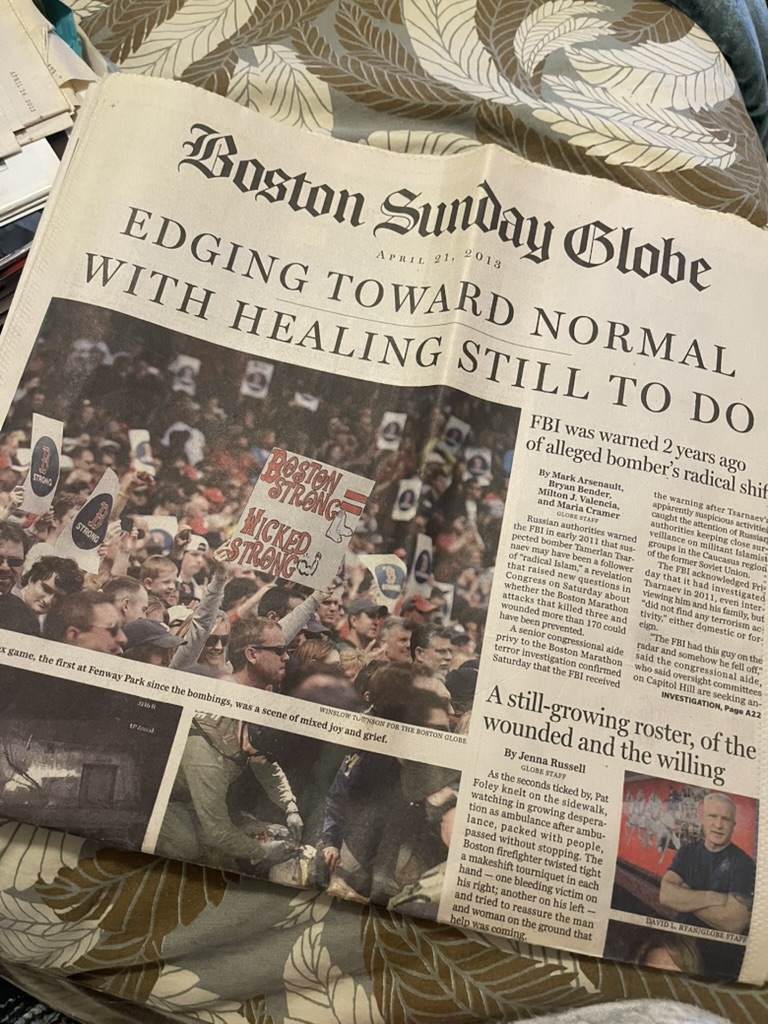
As a reminder, I kept the newspapers.
Comments