


What exactly goes into the good life, and who gets to write the recipe?
Making a meal of the abstract
After cows, committees and coffee, I thought we might linger in the kitchen and give the concrete a rest. The abstract has been getting a rather bad press.
Something is abstract, we are told, and apparently that settles it. Economic growth is abstract. So is productivity. Both seem to get invited to meetings.
So, while we have spent some time discussing whether anything is getting done, I am rather more interested in what we think we are making.
When a few people sent me the recent Nya Åland interview this week, I was glad to read that sustainability coordinator Petra Granholm makes the case for a philosophical approach to social transformation.
I am with her on that.
A society attempting to change needs some understanding of what would make the change worthwhile. That is, in fact, philosophical. Without that understanding, we could become extremely busy in a direction nobody particularly wanted to go.
Imagine you are standing in a kitchen and are asked to contribute a recipe for the good life.
I would want room for interesting work, people I love, and enough time to become absorbed in something enjoyable without feeling that I ought to be doing something else. Someone else might begin with security. Another with freedom. Already, we would need to discuss whether we meant freedom from interference, freedom from fear, or enough freedom from the dishes to finish a thought.
Then somebody would ask who was going to do the dishes.
We have scarcely begun, and as you will see, philosophy has made itself quite at home.
Different ingredients
But first things first, a small kitchen accident needs clearing up. We seem to have tipped “abstract” and “vague” into the same jar.
They are different ingredients.
Abstract thinking allows us to consider qualities, principles and relationships beyond a particular instance. We can think about freedom across different lives, or fairness across different decisions. We can ask what these things mean, whether our arrangements support them, and what we have mistaken for a natural fact simply because it has been around for a long time.
But vagueness concerns how clearly we have said what we mean and how precisely its boundaries have been specified. It is a different question.
An abstract principle can be clear. A description of something concrete can be hopelessly nebulous.
Allow me to illustrate the difference:
| What are we describing? | Clear | Vague |
| Abstract: A general principle | Applicants should be judged by the same published job criteria. | We aim for a better approach to recruitment. |
| Concrete: A particular action | Six applicants took a 30-minute skills test on Monday. | We did some work with a few applicants recently. |
The distinctions matter. “Be more concrete” might mean give me an example, explain your meaning, name an action, or show that something works.
Please note that they are four different requests, people. A good example can clarify an idea without proving it. A completed activity does not establish that it achieved its purpose.
Everyone affected by a decision should have an opportunity to influence it
This gives us an abstract principle. Naming a specific meeting makes a proposal more concrete, but still leaves us with the question of whether anyone attending can influence anything.
So before we can cook anything together, we need to agree on what the labels on the jars mean.
If I ask for flour and you pass me sugar, “they’re both white” will not rescue the bread. If one person means “I don’t understand the idea” and another hears “I want a timetable”, we can produce an impressive amount of activity without ever answering the question. “Abstract”, “vague” and “impractical” cannot be substituted for one another simply because we find them on the same shelf. They are different words because they mean different things.
A debate that keeps muddling them again and again, as I keep witnessing on Åland, should be rather careful about lecturing anyone on clarity. Precision matters from those asking the questions as well, especially as they sit in a place of power and influence. Otherwise, we will keep stirring different problems into the same pot and wondering why the result is slop.
A better future, from scratch
So what goes into a recipe for sustainability?
The recipe for a better society begins before the list of projects. First, we need some belief that our choices can make a worthwhile difference. Then some account of what better would look like. And, an explanation of why these particular actions might help us get there, and some understanding of what stands in the way. We also need to consider who gets a say, who bears the costs, and what would make us reconsider.
Savoury and sweet can both be delicious. It generally helps to know which we are in the mood for before we begin cooking. If we are feeding other people, it also helps to ask what they would like and whether anyone has an allergy. A preference for pudding and a nut allergy ask rather different things of the cook. We should probably establish which we are dealing with before we begin congratulating ourselves on the menu.
I generally picture the recipe something like this.
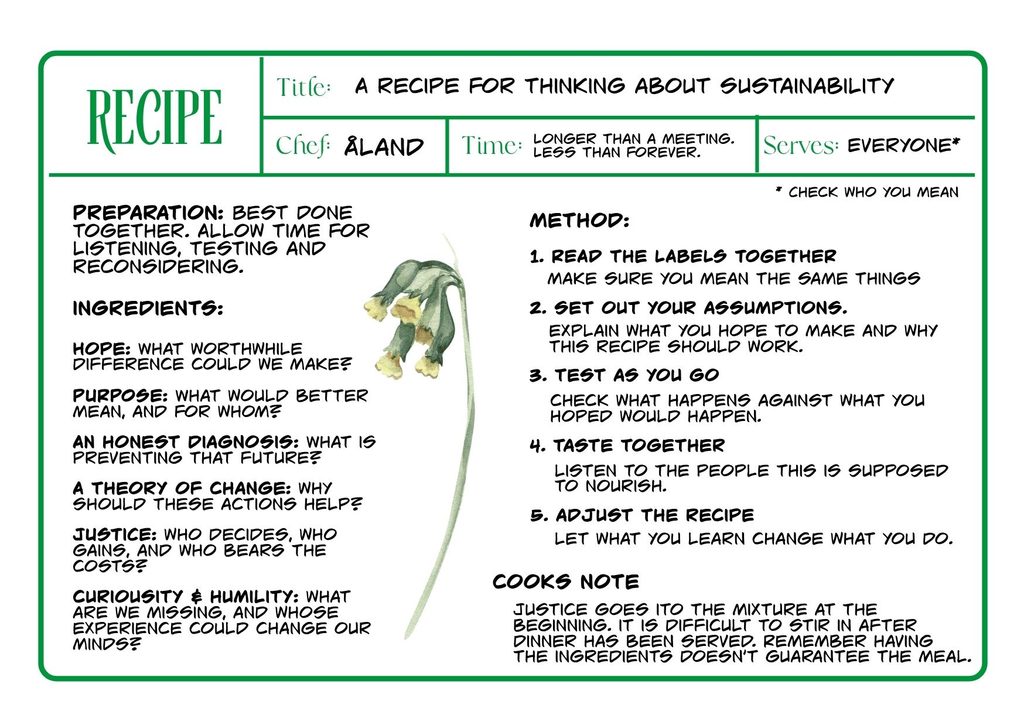
These ingredients do different jobs. Hope cannot substitute for evidence that a project will work. A worthwhile purpose does not excuse an ineffective method or explain how to achieve it. Evidence that something works cannot tell us, by itself, whether its purpose is worth pursuing. The real work begins in the mixing bowl where we combine them.
Hope, purpose and a carefully considered plan can take us a long way. But they can never supply justice, curiosity and humility on everyone else’s behalf. There is a particular sadness in discovering that the missing ingredients were never things you could bring alone.
Petra explicitly brings long-term thinking, cultural change and a shared direction to the recipe. She also points to goals, indicators and roadmaps. The philosophical question runs through all of this, because deciding which accomplishments matter is itself a judgement about value.
Would you like the house special?
Some recipes become so familiar that we no longer need to read them. They usually go by the name
the way things are done.
The risk is that we forget they contain choices at all: somebody chose these ingredients, in these proportions, to suit particular tastes. Familiarity and comfort quietly becomes authority. Before long,
Why do we make it this way?
sounds like an attack on civilisation rather than a perfectly reasonable question about the soup.
Here on Åland, consider autonomy. What are we trying to preserve, and what do we want self-government to make possible? Language and collective agency? Particular institutions? Familiar ways of deciding whose ideas count? Which things must remain and what could be better?
Preserving a language, sustaining a community and retaining the capacity to shape our future are substantial ambitions. But none requires every single existing arrangement to remain untouched. Which changes would help us preserve what matters? Which familiar habits might eventually make that harder? Preserving a community through changing circumstances may require changing some of its habits.
These are philosophical questions about something we already take very seriously on Åland. Self-government has a concrete form in our laws and institutions. But deciding what it should protect, whose voice should count and what future it should make possible requires thinking about principles and purposes. The discussion of a new Self-Government Act brings these questions together. We can attend to the recipe and still ask what we want it to nourish.
The preference for expert planning, measurable performance and administratively workable solutions has a name: a technocratic approach. There is much to value in it. We need people who understand the figures, can organise services and notice when a project is going nowhere.
A technocratic approach can help us organise the kitchen very well. It can calculate nutritional needs, balance the budget and have dinner ready at six. A nutritionally impeccable dinner can still be a thoroughly miserable evening. Eating together can be about belonging, hospitality, memory or celebration. Understanding what the meal means to people helps us understand what counts as getting it right.
Technical competence alone cannot settle what everyone ought to be eating, whose preferences matter, or who always ends up washing up. Those questions ask what we value, what we owe one another and what kind of life we are trying to share.
Technocracy, too, rests on ideas about knowledge, authority and what counts as a good decision. Familiarity can make those ideas look like plain common sense, while alternatives are asked to defend themselves as philosophy.
Does any of this sound familiar, yet?
The house recipe always enjoys certain advantages: everybody recognises it, the ingredients are already ordered, and suggesting a different dinner creates work. None of this makes it a bad recipe. It does mean that “the way we do things” is also a way of thinking, and deserves to be examined as one.
A spreadsheet, something seen as concrete, is actually an abstraction with gridlines.
It selects features of reality, puts them into categories and shows relationships between them. That can be enormously useful.
It also means somebody has decided what belongs in the columns.
The figures may be exact, but deciding what to fund, what can wait and who must manage with less involves judgements about what matters. Some are made now. Others arrive through earlier budgets, contracts and legal commitments, narrowing the choices available to the person currently doing the sums. The accountant may be working within priorities they had little say in choosing.
The arithmetic can be impeccable. The judgements behind it still deserve a conversation.
Many want to and can resist that kind of conversation. That is what we call power.
Flourishing, according to whom?
Now take human flourishing. It can sound considerably more radical than autonomy on Åland, although both ask us to consider how we should live together. Granholm expressed surprise that the words “everyone can flourish” were perceived as so provocative. They are gentle words for a radical ambition: making the possibility of a good life for every person a measure of how we organise society.
But what would we need to know before saying that somebody flourishes?
My idea of a good life may not be yours. Yours might not appeal to me at all. That is not necessarily a defect in your life nor in my taste. We can share needs for security, dignity and belonging while finding meaning in quite different ways. How much can I understand from the outside, and what must I learn by listening? When does helping you flourish become appointing myself the authority on how you ought to live?
An employment rate tells us something important. It does not, by itself, tell us whether people have security, use their abilities or find meaning in their work. Adding further measures may help. We still have to explain why those dimensions matter and whose experience our account might miss.
The limitation arises when we treat the purpose of a system as settled and ask only how to run it better. We can become extraordinarily proficient at following a recipe without asking whether it suits the people now coming to dinner. A measure begins as a way of learning about life and gradually acquires the authority to tell life how it is doing.
You have a job. You have a home. The relevant boxes are ticked.
Why are you not flourishing? We have done the paperwork.
Most of us would hear the problem immediately if we said this to a friend. We might know very little about the job, what happens inside the home, or whether there is anyone our friend can call when things become difficult. A secure income, education and meaningful relationships might help someone flourish. Their presence does not automatically establish that the person flourishes. We need to examine the relationships between these conditions and the life being lived.
There is also a distinction between something that helps produce a good life and something that belongs to its goodness. Friendship can support our health, but loving and being loved can also be part of what makes life worth living. I would be sorry to discover that a friend regarded our conversations principally as preventive medicine, with me cast as a particularly sociable vitamin supplement.
Thinking belongs in this discussion too. Understanding something, following a question, encountering an idea that rearranges the furniture in your mind: these can be part of a good life. This is why the constitutive value of thought interests me. Understanding, wondering and questioning may themselves belong to flourishing. We need not insist that every conversation produce an action plan before we allow ourselves to enjoy having had it.
I would like us to leave a little room for thoughts that have not arrived wearing an apron.
Philosophers Polly Mitchell and Anna Alexandrova argue for keeping different concepts and methods in well-being research. Different approaches can reveal different aspects of how life is going. Choosing a convenient measure does not settle what a good life means.
These are questions I want to research. What helps make a good life possible? What belongs to the goodness of the life itself? How do we recognise the difference without deciding in advance what everybody ought to want?
Everyone, in particular
A society in which “Everyone Can Flourish” must surely leave people some room to surprise the people designing it.
That room becomes especially important when the people change. ÅSUB’s 2025 projection anticipates that the number of residents aged 80 or over will nearly double by 2045. Its scenario without migration would see the population shrink by roughly 1,000 people per decade. These are projections under stated assumptions, rather than instructions from fate.
They demand serious work on staffing, housing, finance and services. They also ask what a good later life consists of, how care should be shared, and what belonging means for the people we hope will come here.
A population model can estimate arrivals. Understanding what might make somebody want to build a life here requires listening to people, including those whose experience complicates our preferred picture of the place.
There is, however, another very good reason we need to understand abstraction.
Because sometimes we find it wonderfully useful when it suits us.
For example, take migration and attractionskraft.
The abstract newcomer brings skills, tax revenue and fresh energy. They are an agreeable person: talented, energetic, conveniently of working age. Someone who will contribute to our common future, and the tax base.
But the concrete newcomer also needs a home and a job, and has an opinion about how something might be done. We say we need competence and new ideas. Accordingly, the concrete newcomer competes for opportunities and expects their knowledge to count. The person we imagined adding to our resources has arrived with a claim on them.
Sometimes I fear the result sounds rather like this:
Everyone should flourish, obviously, but I would rather my cousin get the job. They are a better “cultural fit.” The new arrival will surely get the next one.
There is a recognisable human difficulty here. We can sincerely value fairness and sincerely want to help someone we love. Abstract thought lets us examine what should govern the decision beyond our attachment to the people immediately in front of us.
Would we defend the same arrangement if it were somebody else’s cousin?
Abstraction always leaves something out. Setting aside family connections can help us assess qualifications fairly. Setting aside a newcomer’s needs can help us imagine a welcome that costs us nothing. The question is what our simplification reveals and what it conceals.
“Everyone” is also an abstraction.
Its meaning only becomes clearer when we encounter someone we had not quite included.
Sometimes a principle is difficult because its implications are unclear.
Sometimes we understand the implications only too well.
Which is why Everyone Can Flourish can be the cause of much consternation.
And this is where being driven to abstraction can become a form of distraction. We can spend so long disputing the language of a vision that we never examine its demands. Sometimes the distraction is not innocent. We can also become so attached to our own explanation of the good life that we shut our eyes and cover our ears to the lives it is supposed to describe.
The politics of washing up
In my very first conversation about this work on Åland, I looked across the table and stated rather directly, and dare I say a bit insistently, that for a flourishing society, people would have to give up their privilege. Their comfort. Much of the ambition impressed me. I wanted to believe in it.
I still do.
But making room for a different future would mean making room inside arrangements that were already comfortable for somebody, perhaps ourselves. I think of that conversation sometimes: how much I liked the future being imagined, and how much it would ask of the present.
Giving something up is easier to contemplate when we know what it makes possible, when the burden is fairly shared, and when we can trust others to take part. Otherwise, each of us can have an entirely understandable reason for waiting, while together we remain exactly where we are.
This is where game theory and the study of collective action become useful. What I am willing to do depends partly on what I expect you to do. Shared intentions need arrangements that make cooperation credible. Trust, reciprocity and the rules people work under matter, as Elinor Ostrom’s research explores.
Alongside the cousin problem, there is another possibility: a community wants newcomers to find work, while each employer assumes somebody else will provide the opportunity.
Everyone may approve the menu in the abstract while waiting for somebody else to supply the genuine ingredients.
Some disagreements, of course, are about what we ought to make in the first place. Others concern who gets a say or who can afford to contribute. A fairer division of the work will not settle a disagreement about what the work is for. We need to find out which question we are trying to answer.
And this is where being driven to abstraction can become a useful journey. We step back far enough to see the assumptions inside our recipe, then return to the lives it is supposed to nourish. Perhaps the method needs changing. Perhaps our understanding of a good life was too narrow. Perhaps somebody has been doing rather more of the washing up than we noticed.
Philosophical thought helps us imagine beyond present arrangements and examine the values inside them. When we bring it into public life, we must also be willing to be changed by what we discover.
The recipe will ask something of all of us.
I would like us to be curious enough to keep asking. To take ideas seriously enough to examine them, and other people seriously enough to let their answers matter.
My recipe would still include the pleasure of getting lost in a question. Yours might include something I have not thought of yet.
I would like to hear it.
Comments