



I have decided to vote. Massachusetts supplies the questions; my family has supplied a few more.
A small matter of conscience
I have spent months agonising over whether I should vote in the American midterms.
You can bet I never miss a presidential election. It would be unthinkable. Living outside the United States does very little to diminish your understanding of how much an American president matters. If anything, the view from abroad makes the reach of that power rather difficult to overlook.
But the further down the ballot I go, the more complicated my feelings become.
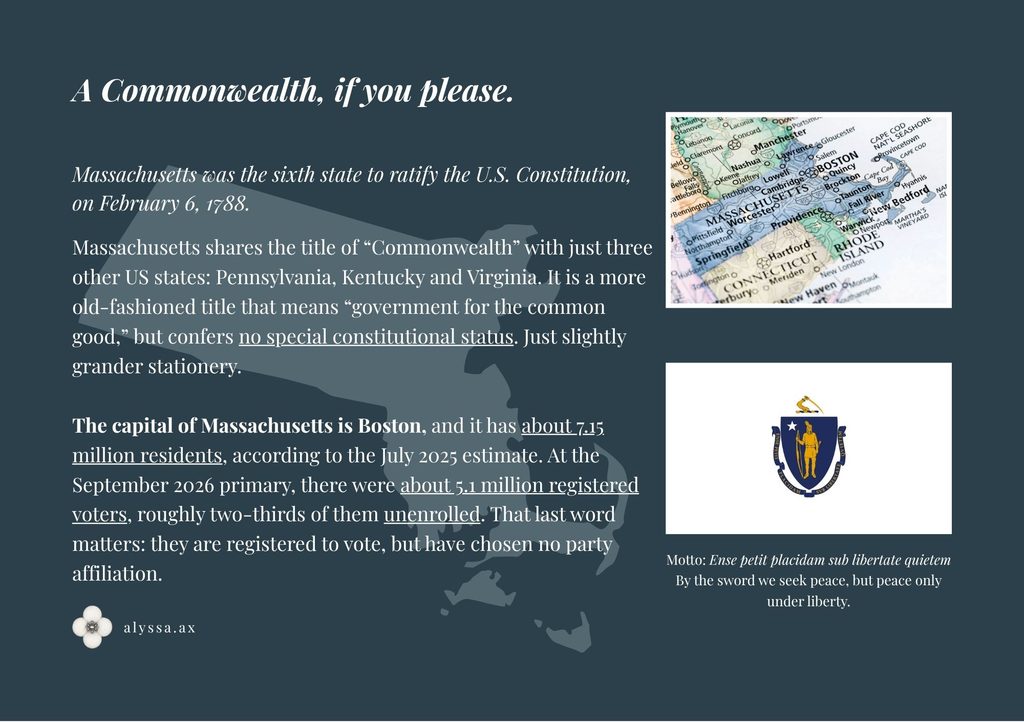
I have lived abroad for thirteen years. As my last state of residence, the Commonwealth of Massachusetts is the place from which I still vote, although I may never live there again. At what point does helping to govern a place require a kind of local responsibility that distance makes harder to fulfil? I can possess the formal right and still ask what I owe the people who will live with my decisions.
I may never live there again.
That sentence deserves a moment. Thirteen years have happened to me, and thirteen years have happened to the place I left. I cannot expect Massachusetts to remain faithful to my memories while I have been allowed to change. Next month makes it four years since I even last stepped foot in Massachusetts.
At the same time, my claim to representation in the United States Senate and House of Representatives has not evaporated somewhere over the Atlantic. Massachusetts explicitly allows its eligible military and overseas citizens to vote in all elections. My absence has a place in the democratic arrangements. It is anticipated. There is a procedure for it.
There is something almost comforting about that. Somewhere in the machinery of the Commonwealth, the possibility that a person might leave and still belong has already been considered.
Unfortunately, the machinery cannot do my soul-searching for me.
I have decided to vote. But I think the agonising deserves to remain in the story.
The address outlives the life
An overseas voter lives with a peculiar geography. There is the place where you make your life, and there is the address through which another country continues to recognise your political existence.
I live in Mariehamn, on Åland. My life here is a whole life. It has responsibilities, relationships, arguments, attachments. It does not spend its days waiting for my American life to resume.
And yet.
I am still American. The word has become more complicated with distance, but it has not become empty.
The American writer Randolph Bourne offered some company for this condition in his 1916 essay “Trans-National America”:
The American who lives abroad may be the least expatriate of men.
Bourne was interested in an America whose cultural attachments could extend across borders, whose people did not have to become less themselves to become part of something shared.
I find room to breathe in that thought. Belonging can acquire another language, another landscape, another set of daily obligations. The earlier belonging does not necessarily disappear. Sometimes the two illuminate each other. Sometimes they argue.
Mine have been arguing over a ballot.
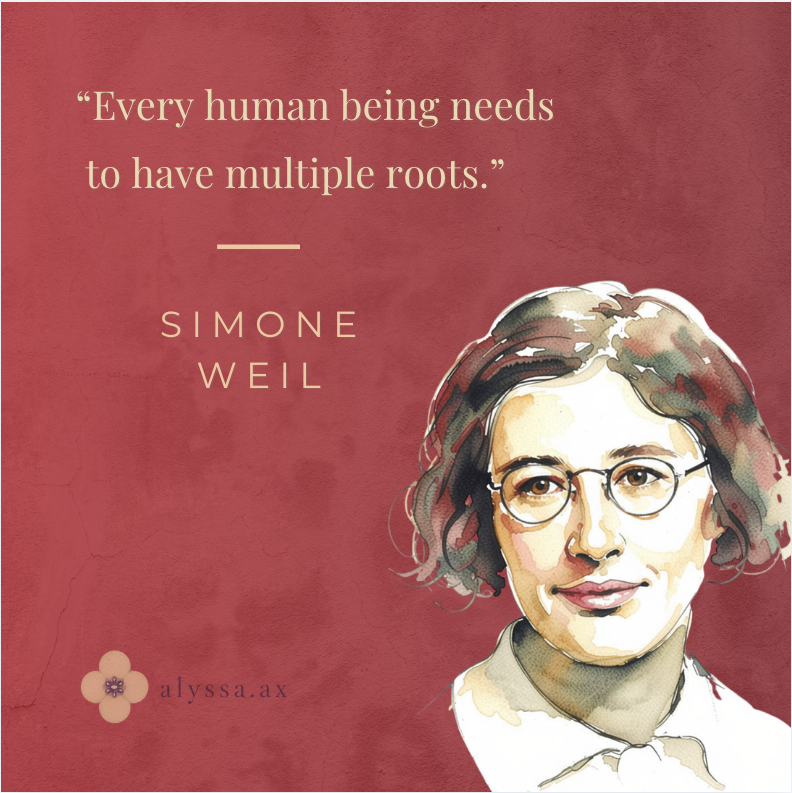
I hold the right to one of the most powerful ballots on Earth, in the sense that American political decisions reach into lives far beyond the people permitted to make them. My individual share of that power is very small. In Massachusetts, a notoriously “blue” or progressive state, I am unlikely to provide the intervention that leaves election analysts breathless.
I know this. I am not sitting here in Åland imagining that the Commonwealth of Massachusetts is anxiously awaiting my instructions.
But the smallness of my share does not make the shared power small. Nor does the likelihood of a predictable result quite answer the question of whether I should participate.
It is possible to be statistically unremarkable and yet, morally implicated.
That, among other things, is citizenship.
A Commonwealth of acquaintances
This November, the Senate choices include Ed Markey, the Democratic incumbent; Republican John Deaton; independent Shiva Ayyadurai; and Joe Tache of Socialism and Liberation. Four names, rather than two from the familiar parties that tend to dominate America’s presentation of itself to the world. Markey entered the Senate in 2013, the year I moved abroad. He has spent my entire expatriate life in that office.
For the House of Representatives, in Massachusetts’s Fourth District, Democratic incumbent Jake Auchincloss faces Republican Thomas Stalcup. I also remember Auchincloss as someone who used to spam my email. I think that perhaps at some point I unsubscribed? Whatever questions I might have about my continued connection to Massachusetts, he was quite determined to maintain his connection to my inbox and tell me what he was up to.
His family biography takes us through a considerable number of American institutions. His mother, Laurie Glimcher, led Dana-Farber Cancer Institute from 2016 to 2024. His father, Hugh Auchincloss, was Anthony Fauci’s longtime deputy. There is a distant family connection through Jacqueline Kennedy’s stepfather, another Hugh Auchincloss. And Jake’s great-uncle, McGeorge Bundy, was Kennedy’s national security adviser, the man who alerted the president to the Soviet missiles in Cuba.
Here I am, thinking about the reach of American power, and there it is, folded into the family tree.
Massachusetts can make democracy feel remarkably well acquainted with its own relations.
Living on Åland, I recognise a certain family resemblance.
Massachusetts will, however, occasionally tell a Kennedy no.
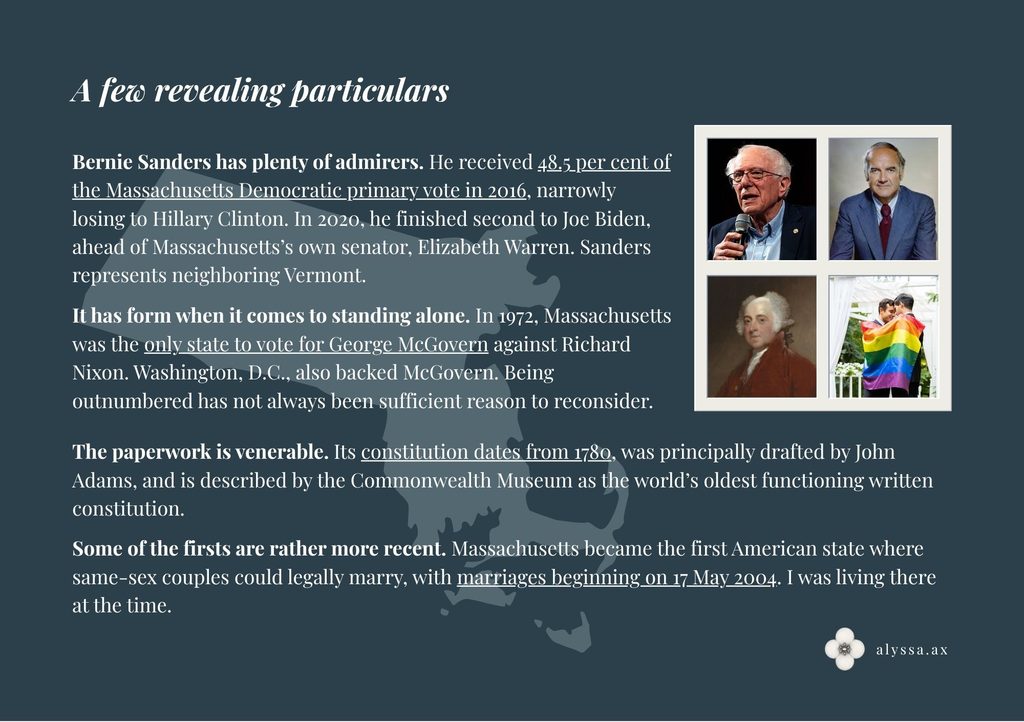
In 2020, Joe Kennedy III left this House seat to challenge Markey for the Democratic Senate nomination. Markey beat him. Auchincloss won the crowded Democratic primary for Kennedy’s old seat with 22.4 per cent of the vote. Fewer than one in four votes cast for a candidate in that primary went to the man who would become the district’s representative.
Which helps explain something about Massachusetts that the television map does a poor job of showing.
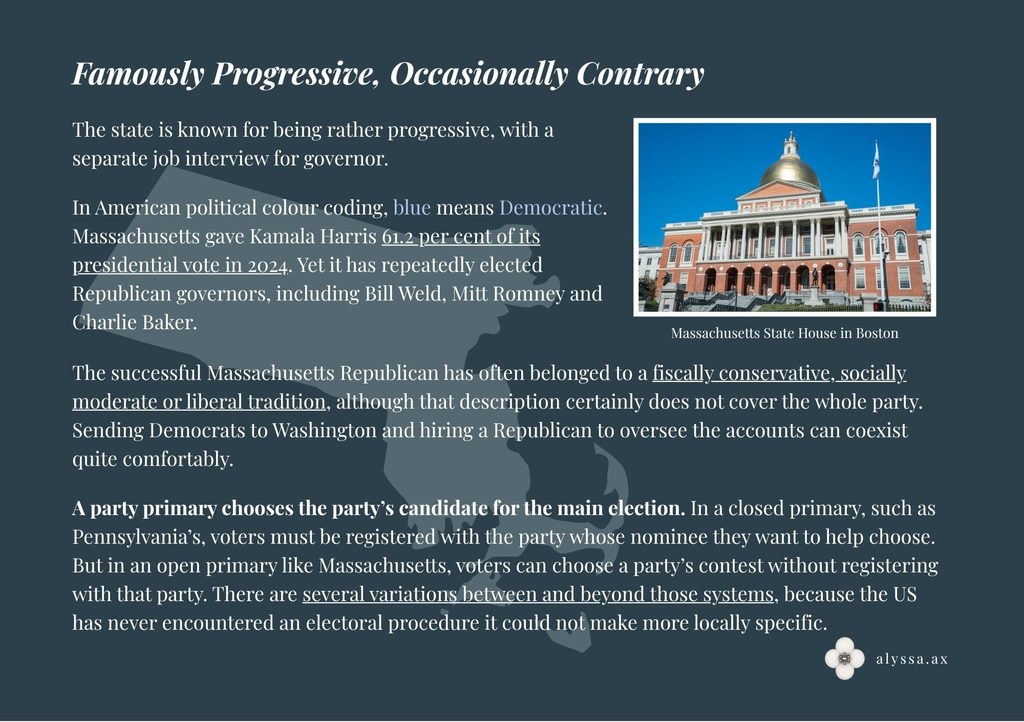
The state gets coloured blue, and the colour begins to stand in for an explanation. But a great deal can happen before November delivers its apparently familiar answer. In a strongly Democratic district, the primary can carry much of the consequential argument: which Democrat, with whose support, committed to what? A party label can accommodate people who disagree quite profoundly about what government owes us.
Massachusetts has also repeatedly elected Republican governors. Bill Weld. Mitt Romney. Charlie Baker. Auchincloss himself briefly registered as a Republican and worked to elect Baker in 2014. During his congressional campaign, he described himself as an “Obama-Baker” voter. That combination makes rather more sense once you stop expecting Massachusetts to behave like its colour on a map.
Even the registrations tell a less tidy story. In the state’s February 2025 count, nearly two thirds of registered voters were unenrolled. About a quarter were registered Democrats. Unenrolled voters can choose a party’s primary ballot without joining that party. The registration tells you which formal affiliation they have declined; it does not tell you how fiercely they might believe in something.
I find that distinction rather appealing. Belonging and agreement already occupy enough difficult territory in this essay.
For governor and lieutenant governor, this year’s printed tickets are Democratic incumbents Maura Healey and Kim Driscoll; Republicans Mike Minogue and Shawn Oliver; and independents James and Kittredge. Massachusetts chooses the two party nominees separately in the primary, then pairs them in November. The voters can effectively supply a gubernatorial candidate with a running mate.
This year, the arrangement has become especially awkward. Oliver suspended his campaign after a drunk-driving arrest, and Minogue says he would ask him to resign if they were elected. Oliver, who has pleaded not guilty, remains on the printed ballot.
The paper is, for the moment, more committed to the ticket than the actual ticket is.
There are also contests for attorney general, secretary of state, treasurer and auditor. The Democratic incumbents are Andrea Campbell, William Galvin, Deborah Goldberg and Diana DiZoglio. Campbell faces Republican Michael Walsh; Galvin faces Republican Anne Brensley; Goldberg faces Republican Elizabeth Dionne; and DiZoglio faces Libertarian Al Ozonoff.
The titles become less glamorous as you move down the page, but government does have to be administered, defended, financed and examined.
Even devotion to democracy requires someone to examine the receipts.
Democracy comes with homework
For readers accustomed to the elections one might participate in in Sweden or Finland, this is already quite a collection of decisions.

To an outsider, an American ballot can look like an invitation to help staff the entire government. There is a reason Americans joke about electing everyone down to the local dogcatcher. You arrive prepared to exercise your democratic rights and discover that you are also on the recruitment committee.
Massachusetts, mercifully, appoints its animal-control officers. I am allowed to remain a citizen without developing a coherent political philosophy of stray dogs.
But the joke captures something about the scope of the invitation. A Nordic voter generally chooses representatives for assemblies through which governing authority is organised. Massachusetts keeps handing me another office and asking what I think.
I have spent months wondering whether I should have an opinion from this far away. The ballot appears to assume I have several dozen.
In Sweden’s general elections, voters choose the national parliament, regional assembly and municipal council on the very same day. The ballot papers have different colours: yellow for parliament, blue for the region, white for the municipality. You vote for a party and can also indicate a preferred candidate.
In Finland’s parliamentary and municipal elections, you vote for a candidate, whose vote also contributes to the party or electoral list’s result. The president is elected separately. Here on Åland, the Lagting and municipal councils are elected together, and the Lagting elects the lantråd, the head of the Åland Government.
The parliamentary systems give voters choices about the assemblies from which governing authority is organised. Massachusetts keeps returning the question to me, office by office, candidate by candidate. And then, having asked me to help choose the people who will govern, it even asks me to do some of the legislating myself.
There are nine binding statewide ballot questions.
I began with a philosophical concern about belonging. The Commonwealth has responded with homework.
Question 1 asks whether the governor’s office and legislature should become subject to public-records requirements, with specified exceptions.
I must confess that asking powerful public institutions whether we might be allowed to see their documents has a certain transatlantic resonance given recent events.
Question 2 concerns collective bargaining for employees of the Committee for Public Counsel Services, the state’s public-defence agency. Question 3 would replace the separate party primaries with a single primary containing all candidates, with the top two advancing to November. Those two could belong to the same party. It would also require governor and lieutenant governor candidates to run together in the primary.
Even the shape of the choice itself is up for election this go around.
Question 4 would allow eligible citizens to register or update their registration address on Election Day, beginning in 2028. Question 5 would change the state’s revenue limit and the rules requiring excess revenue to be refunded to taxpayers, including the treatment of the surtax on incomes above a million dollars.
These are questions about who can organise, who can participate, and how much money government can retain to do its work. Beneath the administrative language are rather substantial ideas about the relationship between people and power.
Then comes Question 6, which would create a Nature for All Fund using revenue from certain existing sales taxes, including those connected to sporting goods, recreational vehicles and golf. The connection between a golf purchase and our collective ecological future is apparently another matter requiring my attention.
And Question 7 brings the whole thing down to earth with considerable precision: single-family homes on qualifying residential lots of at least 5,000 square feet, roughly 465 square metres, with requirements including public water and sewer access.
There is my unease, suddenly given dimensions.
Someone will live beside that house. Someone might finally be able to live in it. Someone will experience the change as opportunity, someone else as loss, and I will be in Åland.
Distance does not prevent me from understanding a housing argument. It does require me to remember that other people inhabit it.
Question 8 would repeal the regulated recreational cannabis retail system, while retaining medical access and limited adult possession. This one returns me to a decision I helped make ten years ago.
In 2016, already abroad and living in Sweden, I voted yes to legalise and regulate the use and sale of cannabis for adults in Massachusetts.
My reasons came from my years of work as a college administrator in residence life. Student welfare had been part of my working experience. I wanted cannabis controlled and regulated. I wanted young people protected from getting hold of something laced with other chemicals, from buying what they thought was cannabis and putting God knows what else into their bodies. I have responded to situations in college dorms that would be hard for you to imagine.
I wanted somebody answerable for what was in the bag.
That concern came with me to the ballot. There are responsibilities you continue to feel long after you have left the job in which you first carried them. Perhaps places work something like that, too.
But concern does not settle every question about our authority to act on it.
I helped choose a law for a place where I no longer lived. Other people would live with whatever we had got right, and whatever we had got wrong. What fitted inside a little oval on my ballot would become part of their ordinary lives.
I knew the formal answer. I was asking the other question, the one that has followed me into this election: what does it mean to help choose the conditions of a place when you will not be there to experience them?
Finally, Question 9 asks whether to retain or repeal the state’s 2024 firearms law. A yes keeps that law; a no repeals it. On the cannabis question, a yes would dismantle the existing retail system.
Even agreement requires attention to the verbs.
This is where calling Massachusetts “safe” begins to feel inadequate to what I am actually being asked to do. I may have a reasonable expectation about the party that will win a particular office. There are still judgments inside that expectation, and there are questions further down the ballot whose consequences will become someone’s ordinary life.
A house that can be built. A law that stays. A right that becomes easier to exercise.
People will wake up inside these decisions long after the election maps have disappeared.
After thirteen years away, I owe Bay Staters the attention required to see it as a place that is still happening.
Its reputation cannot do my thinking for me. Neither can my memories.
Liberty, subject to family approval
Some members of my family, who do not live in Massachusetts and do not share my political beliefs, think I should not have the right to vote since I chose to leave the United States.
Something tells me that if I were planning to vote the way they wanted, they would be rather keen for me to get that ballot in.
That should disturb us. It certainly disturbs me.
A principle about residence ought to survive discovering how the absent person intends to vote. If distance becomes acceptable when the politics become agreeable, geography is doing a very convenient impression of principle. The actual condition is agreement.
And making another person’s rights conditional on their willingness to agree with you is authoritarian, anti-democratic nonsense.
It is especially remarkable when the argument comes wrapped in enthusiasm for small government and individual liberty. There seems to be an expansive interest in governing other people’s choices, other people’s bodies, other people’s rights. Government should apparently leave people alone, provided someone has first established that they are the right sort of people, exercising the right sort of freedom.
Of course, they are entitled to dislike my politics. They can argue with every choice I make. Democracy gives us plenty of room to find one another profoundly mistaken. What it asks of us is the willingness to share political power with people whose conclusions we cannot stand.
Thomas Paine had something useful to say about the reciprocity involved here. In his 1795 Dissertation on First Principles of Government, he wrote:
The right which I enjoy becomes my duty to guarantee it to another.
That sentence becomes demanding at precisely the point where the other person is likely to use the right in a way we dislike. It asks whether we can tolerate their standing as an equal when their judgment frustrates ours. Whether we can continue to defend the arrangements that allow them to oppose us. Whether democracy remains valuable when it produces an answer we would rather not hear.
There is an authoritarian logic in making legitimate participation conditional on acceptable beliefs. The other person’s argument gradually becomes less interesting than finding a reason they should not be allowed to make it. Their presence becomes the problem.
That logic has a particular resonance in the United States now. V-Dem’s 2026 assessment documented a steep deterioration in American democracy during 2025, including the concentration of presidential power and pressure on institutions that should constrain it. The institutional story matters. So do the everyday habits through which people become comfortable with some voices counting less.
I have spent months asking what I owe the people who still live in Massachusetts. I take that question very seriously. My willingness to examine my own responsibility does not give family members jurisdiction over my rights.
I owe the people affected by my vote the effort of making an informed decision.
I do not owe my family an obedient one.
A democracy needs more than people who want their own votes counted.
It needs people who can bear other people counting too.
I would like the people questioning my right as an American citizen to spend a little time asking what they owe me.
Ordinary did not come easily
I am also voting as a woman.
That should be an entirely ordinary sentence. The fact that it can now seem ordinary is part of what deserves our attention.
Just weeks before Finland became a free republic, on 14 November 1917, thirty-three women imprisoned for peacefully demanding the right to vote endured what became known as the Night of Terror at the Occoquan Workhouse. Acting on the prison superintendent’s orders, guards beat, dragged and terrorized the women.
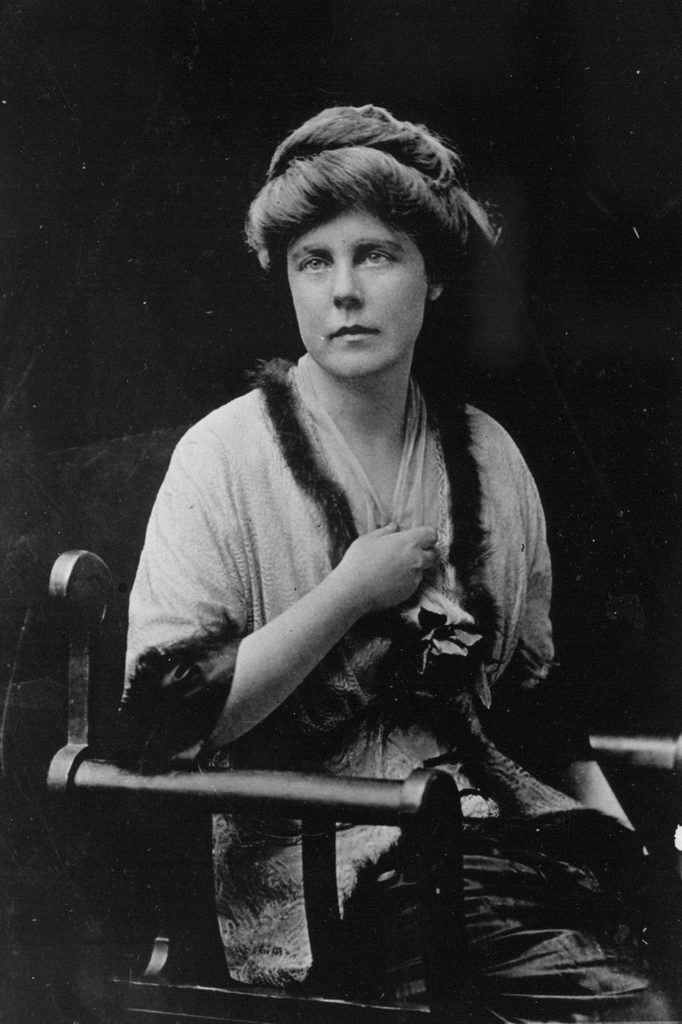
Lucy Burns was shackled to the bars of her cell with her arms stretched above her head, forced to remain standing through the night. Dora Lewis was thrown against an iron bedframe with such force that she lost consciousness. Dorothy Day was lifted and slammed twice across a metal bench. Another prisoner suffered a heart attack. Guards refused pleas for medical assistance.
And when the women protested their treatment by refusing food, prison officials restrained them and forced tubes through their noses or down their throats, pumping raw eggs into their stomachs.
Their supposed crime? Standing outside the White House with signs demanding a voice in their own government in 1917.
The government brutally tortured women who insisted on a voice in its decisions.
There is a very bodily history beneath my apparently abstract right to make a choice.
Sadly, the story cannot be closed neatly in 1920. The Nineteenth Amendment did not end the laws, intimidation and violence that kept many Black women from voting. Nor was that violence confined to the ballot box.
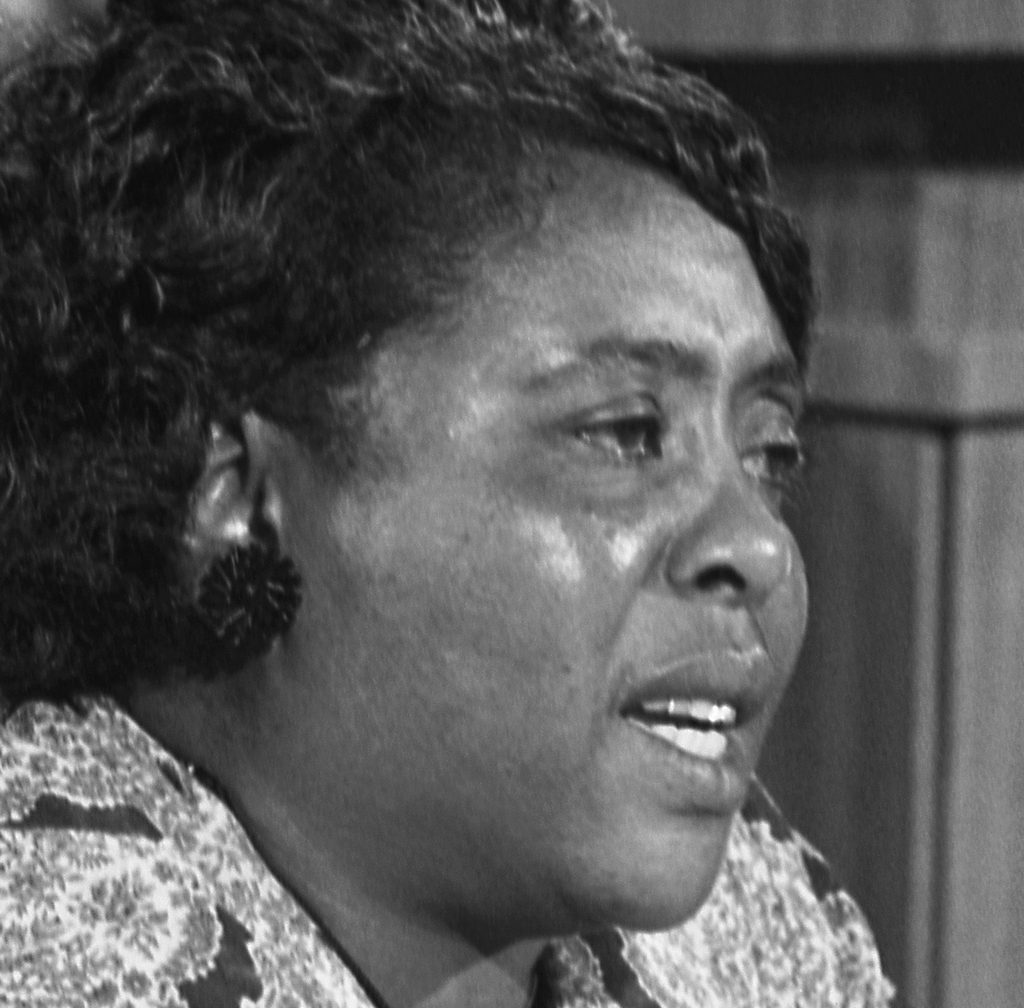
Fannie Lou Hamer and her husband desperately wanted children. In 1961, while undergoing surgery to remove a uterine tumor, a white doctor removed her uterus without her knowledge or consent. She had been forcibly sterilized. The practice was so widespread among poor Black women in Mississippi that it had acquired a grotesque nickname: the Mississippi appendectomy. Hamer was denied even the right to decide what happened to her own body.
In 1962, when she attempted to register to vote, the plantation owner demanded that she withdraw her application. She refused and was forced from her home. In 1963, she was arrested and brutally beaten in a Mississippi jail. Police officers ordered two prisoners to beat her in turns, leaving her with permanent kidney damage and impaired vision.
Her testimony to the 1964 Democratic National Convention described both the violence and her determination to register. Recalling her response to the plantation owner who objected, she said:
I didn’t try to register for you. I tried to register for myself.
For myself.
That is an extraordinary amount of political philosophy in just two words.
The insistence that a woman’s judgment belongs to her. That citizenship does not require her to borrow someone else’s conscience. That her political existence cannot be reduced to the approval of a man, an employer, a family, a local hierarchy.
And the cruelty did not end there. In 1967, Hamer’s adopted daughter Dorothy Jean died at just twenty-two. According to the National Endowment for the Humanities, hospitals had refused to treat her because of her mother’s civil rights activism.
A woman could be punished for claiming her own political voice. Apparently, even her children could be made to pay for it.
Here on Åland, a different image waits.
In June 1906, around fifty women gathered in a grove beside the school in Ytternäs, south of Mariehamn. There was singing and coffee. Of course there was coffee.
Emmy Karlsson, chair of the newly formed Åland women’s association, spoke about the responsibilities that women’s new political rights would bring. Historian Anna Sundelin recounts the gathering through the contemporary record.
I live in Mariehamn now. This history is here, too.
Women with coffee, considering what it would mean to become political equals. Women in prison, punished for insisting on it. Different circumstances, different struggles, different forms of resistance.
The contrast with the American suffragists is striking, particularly in the violence women endured at the hands of the state. But an absence of comparable brutality does not mean an absence of struggle. Nor did an early victory at the ballot box mean equality had been won. When Åland established its own parliament in 1922, just one of its thirty members was a woman. More than four decades later, the parliament would again be entirely male. It still has not achieved parity.
The right to vote is but a beginning, not a conclusion.
A right does not become less precious because its acquisition involved fewer broken bones. Nor does it become more legitimate because its defenders were tortured. I do not need to turn the Atlantic into a competition over suffering to understand that these histories make a claim on my attention.
The right I exercise so ordinarily was once something other women had to demand that the world imagine.
Neither can my respect for them mean reproducing all their opinions. They were people, with convictions and limitations of their own. What I inherit is the possibility of exercising judgment.
My judgment. For myself.
There would be something rather strange about honouring that inheritance by allowing other people to decide which opinions make me worthy of it.
I have read this essay so many times now that I ought to be seeing nothing but misplaced commas and awkward sentences. Instead, every time I come back to the women, I find myself weeping.
I know their stories. I know what happens next. I wrote these words, after all.
But familiarity does nothing to diminish what they endured, or the extraordinary courage it took to insist that their voices belonged to them. I sit down to proofread an essay about voting and find myself crying over the price other women paid for that right.
Their stories put my own struggles for democratic accountability into perspective—not by diminishing them, but by reminding me why they matter so damn much.
Faith, with questions
Voting can be a form of devotion.
I mean the kind of devotion that attends. That returns. That continues to take something seriously even after familiarity has removed the comfort of idealisation.
Walt Whitman found something remarkable in the ordinary electoral act. In “Election Day, November, 1884”, he wrote of
the peaceful choice of all.
The word all carried a promise the country had not fulfilled. American women were still excluded from that choice. The poem’s reach exceeded the electorate’s boundaries.
Perhaps part of democratic devotion is attending to that gap: the distance between the people a country claims to include and those it actually allows to speak.
But I also want someone in the room who will refuse to let me become too pleased with the moral significance of completing a ballot.
One of Massachuetts’ most famous sons, Henry David Thoreau is available for this purpose.
In Civil Disobedience, he wrote:
Even voting for the right is doing nothing for it.
Writing against complicity in slavery and war, he was deeply suspicious of the idea that registering a preference discharged one’s obligations. He demanded more:
Cast your whole vote, not a strip of paper merely, but your whole influence.
He is inconvenient company for an essay about deciding to vote.
I think that is a reason to keep him.
A ballot can become a little certificate of innocence if I expect it to absolve everything else. I can vote for a society I am unwilling to help sustain. I can endorse a principle and make no room for it in the way I treat another person. I can celebrate democratic participation and become remarkably impatient when someone else participates against me.
That devotion has to reach further than the moment of choosing.
It has to enter the reading, the listening, the willingness to revise a judgment. It has to survive disappointment. It has to leave room for the political standing of people who will never thank me for defending it.
And it has to allow me to be fallible.
I am not the font of all wisdom. There are things I do not know, things I have misunderstood, things thirteen years of distance may have made harder to see. Educating myself is a responsibility I can take seriously without pretending I will finish the task of becoming a person who knows enough about everything.
I can demand attention from myself without turning knowledge into an entrance examination for everyone else’s rights.
Democracy has always had to work with human beings. It is unlikely to be issued a better species before November.
The months of agonising have brought me here: I should take my distance seriously. I should take other people’s daily lives seriously. I should take the extraordinary reach of American power seriously.
And I should take seriously the fact that I am still entitled to help decide how that power is used.
Perhaps devotion is a willingness to remain answerable to something you cannot hold without questions. A country. A history. The unfinished promise that people should have a voice in the arrangements under which they live.
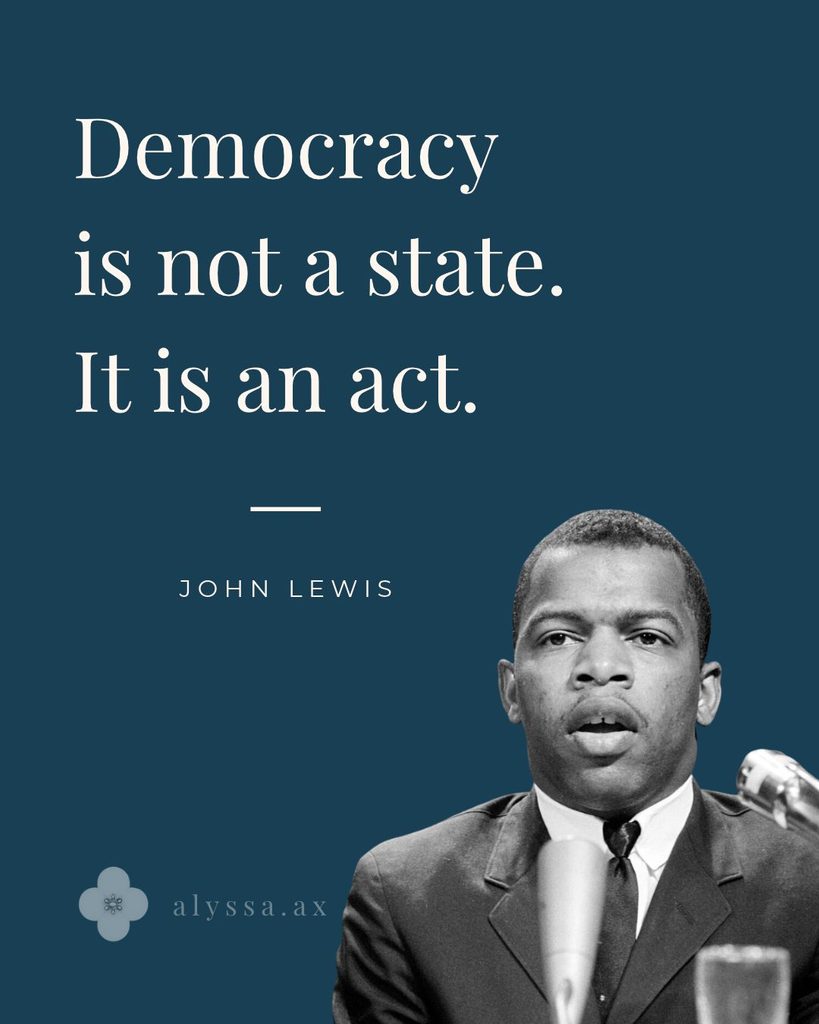
Thirteen years have changed the shape of my belonging. But they have not relieved me of the trouble of caring.
I am going to vote.
Comments