


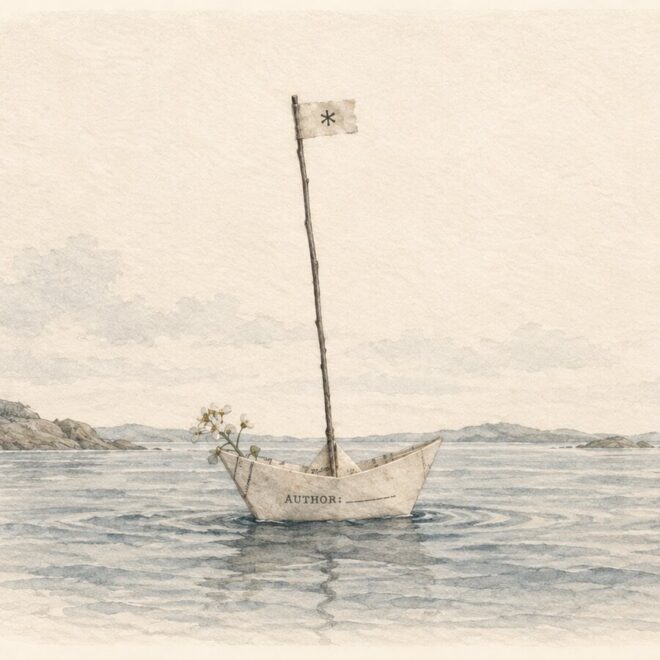
* Terms and Conditions Apply
Author’s note, added 15 September 2026: When I published this, the former employee at the centre of the story had not been publicly identified, and I had not chosen to identify myself. I therefore wrote as an observant reader of the public story, leaving unspoken my place inside it. That was not an attempt to mislead anyone or manufacture distance from the events. It was a way of preserving a boundary that still belonged to me. Gallows humour was not a disguise. It is the handrail I have held while moving through something that has not been funny at all. That boundary has since disappeared, and everyone now knows the Phantom was me. This rather spoils the mystery, but it does explain why the observer knew the opera house so well. I have left the piece otherwise untouched. The facts and the argument have not changed. Only the identity of the person chuckling in the dark with teary eyes is no longer a secret.
Apparently, the satire budget has survived the Government of Åland’s cuts.
I followed yesterday’s radio coverage and parliamentary debate about Åland’s sustainability work with the growing impression that somebody had commissioned a political comedy and forgotten to tell the participants.
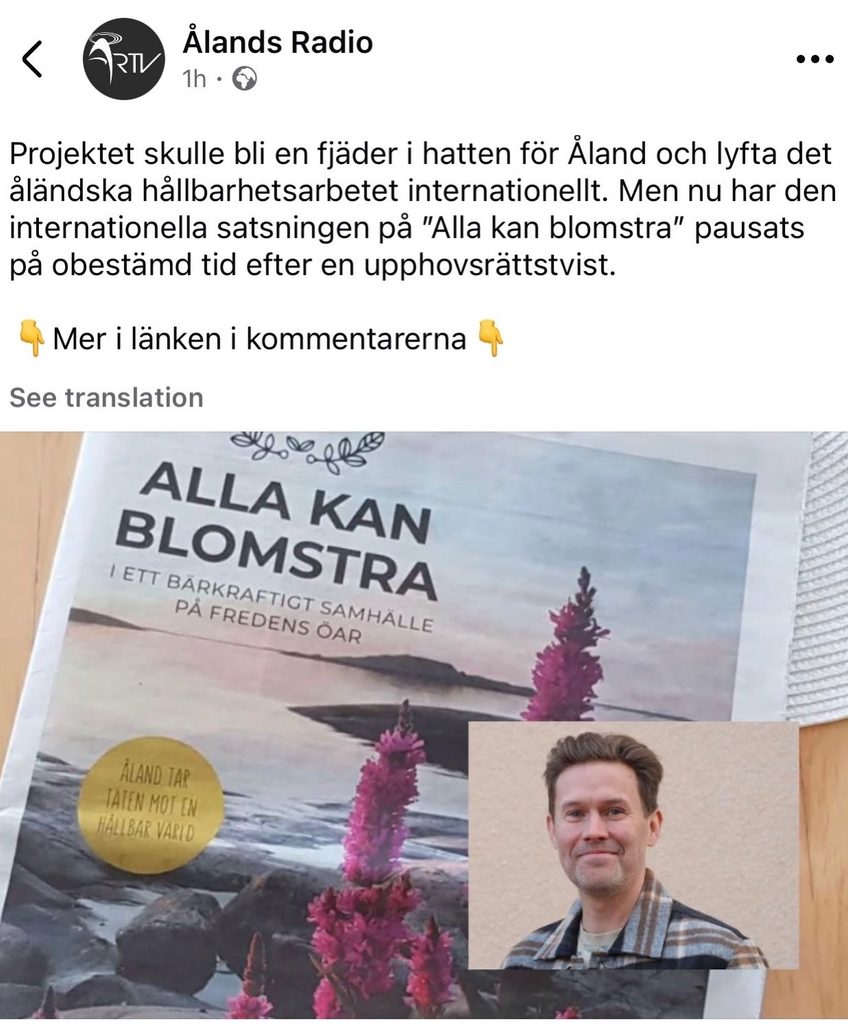
We began with an international publication that will not be published, a project described as paused, and reassurance that the contacts remain valuable.
By the afternoon, the Lagting was discussing criticism that the sustainability leadership struggles to receive criticism, while arguing about how that criticism had been presented.
For an agenda frequently accused of being too abstract, this was unusually concrete.
But let us begin with the publication.
There is something extraordinary about an initiative called Everyone Can Flourish encountering an unresolved problem over recognising the people whose work helped to make the publication possible.
The ambition extended to humanity. The byline appears to have been where capacity became an issue, as if to say:
We are creating the conditions for human flourishing. Please stop bringing a specific human into this.
The authorship problem led us towards the limits of insight into the publishing process. What is clear from several sources, the UN-Habitat’s own rules treat authorship, acknowledgement, copyright and agreed drafting responsibilities as publication requirements, rather than optional courtesies.
We can contemplate the transformation of society, what it means to flourish, and Åland’s contribution to the global future. Identifying who wrote what apparently requires a considerably more advanced civilisation.
Everyone Can Flourish. Individual cases will be considered separately.
Then there is the changing size of the international undertaking.
When international recognition was available, the project was a flagship that could help demonstrate the significance of Åland’s work. Following the loss of the publication, we heard considerably more about how small a part it was of the wider agenda.
International significance appears to be an adjustable setting.
Naturally, the whole sustainability agenda does not stand or fall with one publication, nor should it. But the importance assigned to an undertaking before it fails deserves to be remembered when assessing the explanation afterwards.
A flagship should not become a dinghy solely because somebody has asked who drew the map, or how the boat sank. This flagship appears to be one with a telescopic mast.
Meanwhile, “paused” is doing an absolutely heroic amount of work.
The publication is not proceeding. The future form of the project is uncertain. The interview supplied no concrete timetable for a restart. Yet the possibilities remain plentiful!
Could. Might. Perhaps. In another form. At some point.
The project is currently being sustained by the Ministry of Modal Verbs. There is something wonderfully bureaucratic about a project becoming less operational while its grammatical possibilities remain excellent.
But wait, we still have contacts!
Contacts can be valuable. However, their practical value becomes clearer when somebody agrees to undertake something with you.
Partnerships do not require perfection; they require trust, including the willingness to correct mistakes before they consume public money, waste other people’s time and expose participating organisations to legal risk, because refusing to do so is not a minor flaw in cooperation but rather a reason to find diplomatic excuses not to cooperate again.
Until then, an address book is being asked to carry rather a lot of institutional weight. It’s giving subtext, rendered satirically, was something like this:
We did not produce the report, the partner names disappeared from the website, and things have seemingly fallen apart, but we remain acquainted. Sometimes we may even exchange Christmas cards.
What also struck me in the radio interview was how much easier it seemed to explain the value of the collaboration than the circumstances that stopped its central publication. The relationships, the opportunities and the possible future were all available for discussion.
The result of the radio piece was that the silver lining received a considerably more thorough explanation than the cloud. And as we all know, at the end of the day an address book does not take the podium to accept the award for international cooperation.
That asymmetry is funny because it is recognisable. Institutional knowledge so often becomes remarkably specialised when responsibility enters the room. Reduced to its institutional essence:
I can explain the international significance of the undertaking. However, the events that prevented it from existing fall outside my immediate field of vision.
Then the Lagting supplied the afternoon programme.
John Holmberg started things off with a recounting of the committee’s report, featuring a selection of criticism heard by the committee, including concerns about how criticism of the sustainability leadership is received. Nina Fellman challenged the balance of his presentation.
There is a real distinction here. His sharper selection of testimony was not identical to the committee’s written assessment, which also recognised achievements. Holmberg acknowledged the agenda’s value, but gave those achievements considerably less emphasis. A committee chair’s presentation is itself open to criticism.
But the scene still acquired a remarkable degree of self-reference.
We had criticism of the presentation of criticism about the difficulty of receiving criticism.
I had expected a parliamentary debate. I had not expected a practical demonstration, complete with an afternoon matinee of Governance Inception. Very meta.
Regrettably, not a single ledamot inquired as to the specifics of “why” they were getting that kind of negative feedback. Spare a thought for those who bravely provided their feedback to the commitee, and quickly realized they were wise to use John Holmberg as a human shield.
After all this, the written report was adopted unchanged, as was expected. But while the report passed, the vibes did not.
If I were writing the minutes as satire, the entry would read:
The chamber agreed that improvements were necessary but questioned whether it had been necessary to make the necessity so noticeable. The recommendations were endorsed following an extended exchange between Ledamot Holmberg and Ledamot Fellman over the emotional experience of hearing them.
Motion carried. Messenger lightly singed.
There is a serious institutional question underneath the comedy. A body can formally accept critical recommendations while the exchange around them makes delivering uncomfortable information look like an activity requiring protective clothing.
People learn from both the decision and the reception, yet politicians seem to only note the former and not the latter.
They notice what is written into the minutes. But they take note of what happens to the person who says the awkward part aloud far, far more.
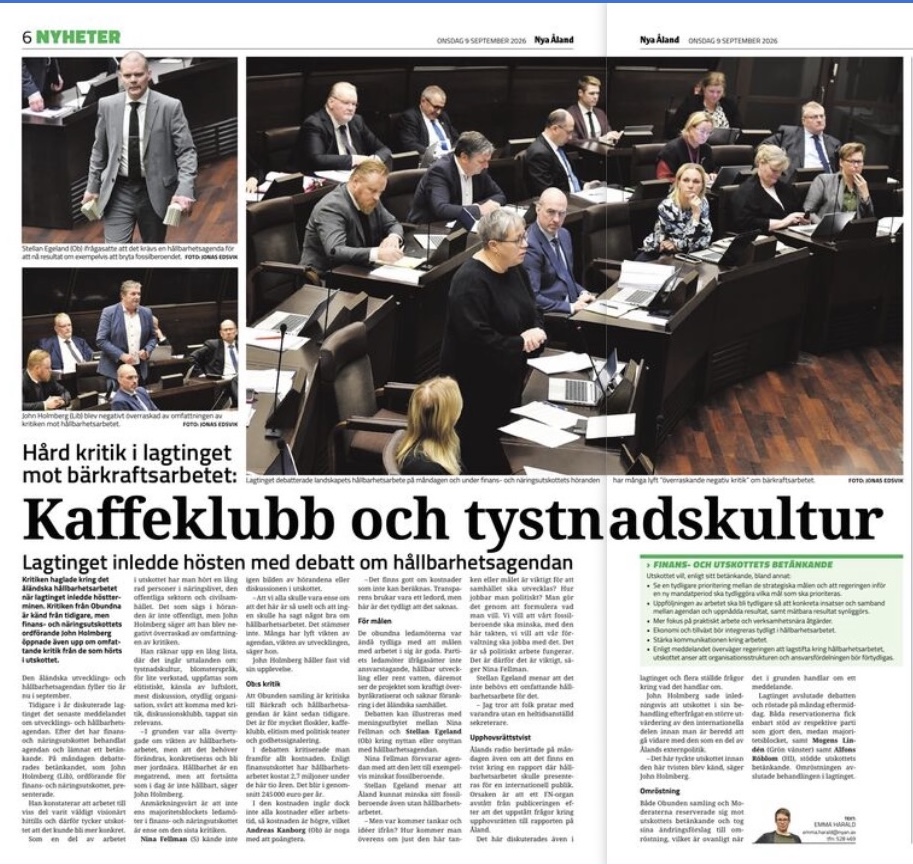
The media, meanwhile, offered three different entrances to the same day: the failed international publication from Ålands Radio, the reported organisational culture from Nya Åland, and the quarrel within the governing coalition from Ålandstidningen.
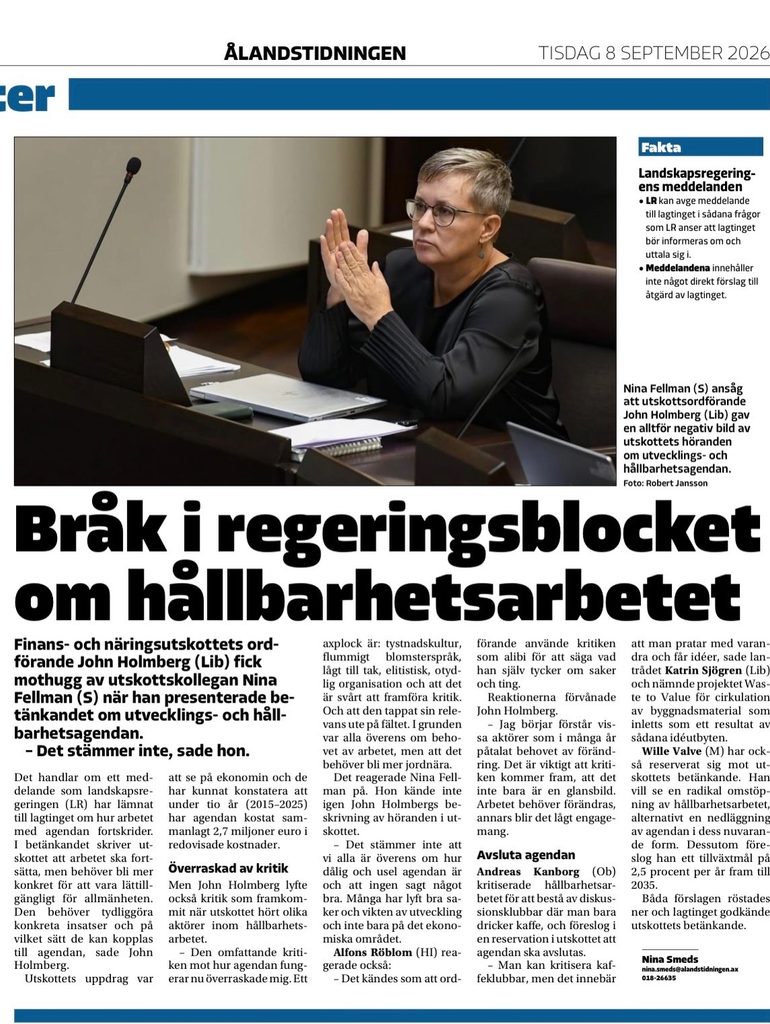
Depending on your subscription, you were following a different programme.
Frustratingly, my own online subscription to Nyan managed to recognise that I had paid while declining to provide access, which felt almost unnecessarily committed to the theme.
Recognition in principle. Practical consequences pending.
(Happily, my subscription problems were swiftly rectified this morning. Thanks Gabriella.)
Across all of this, one important pattern deserves particular attention: how broadly achievement can be shared, and how narrowly responsibility can be divided.
Success can belong to the leadership, the network, the institutions and Åland. When something goes wrong, everyone’s precise remit becomes much easier to locate.
The collective photograph is spacious. But the accountability section has limited seating.
And this is why the title Everyone Can Flourish keeps returning with such force.
Trust, participation, competence, impartiality and meaning are demanding ideas that are meant to be practised, not remain aphorisms. They ask something of institutions when a particular person brings an inconvenient contribution, criticism or claim into the room.
A vision acquires its very credibility through those encounters, human to human. People discover what participation means when they disagree. They discover what recognition means when giving it requires an institution to revise its own account. They discover what learning means when the lesson is uncomfortable for the leadership.
These are truly the ordinary situations through which enormous public promises become real. And it perhaps explains quite well why the sustainability agenda has been having a hard time for some time now.
Because the Ålanders, for all their cultural peculiarities, are exceptionally good bullshit detectors.
Surely an agenda ambitious enough to offer something to the world can manage the basic questions at home: who did the work, how were decisions made, what went wrong, and what will change?
Monday offered ample evidence that those questions remain quite useful, but little evidence that any real answers are forthcoming.
The proposed publication was meant to explain something about the conditions for human flourishing. Its absence, and the public discussion around it, have now supplied a case study of their own.
They couldn’t publish the case for better governance, so they staged it instead.
Note: AI-generated illustration created under the author’s guidance.
Comments