


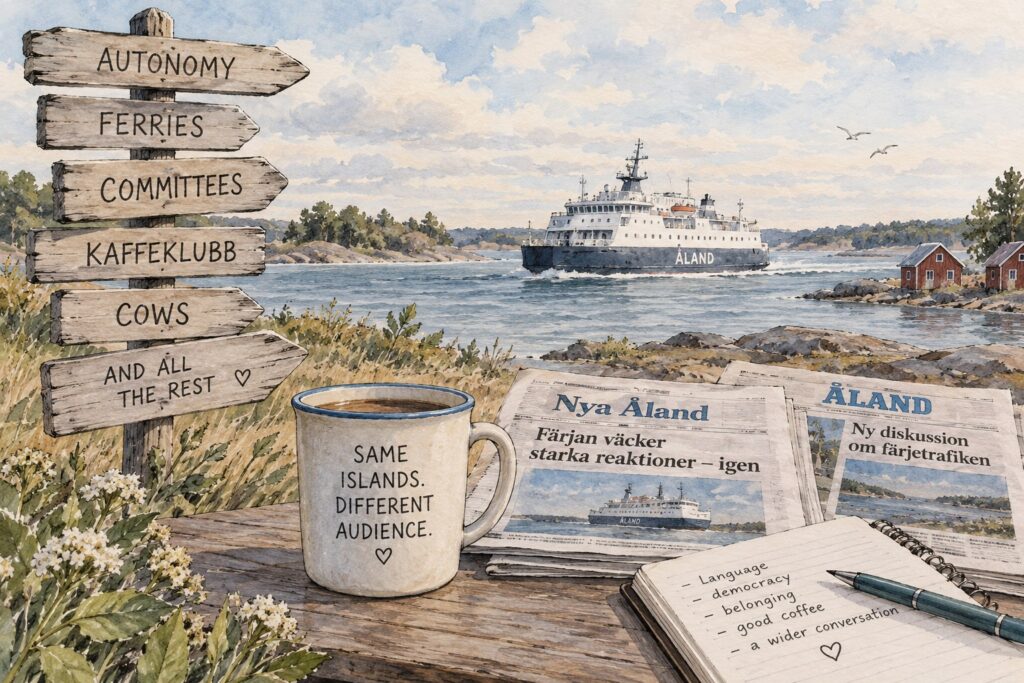
On the English language, belonging, politics, and writing Åland outward
You have surely noticed by now that alyssa.ax is almost entirely in English.
This is, admittedly, a bold and mildly eccentric choice for a website operating under an .ax domain from the only autonomously Swedish-speaking region of Finland.
I have not yet been summoned before a language tribunal. Yet.
To be really honest, nobody has complained at all.
Hell, a sizeable portion of the local political who’s-who appears to be stalking my Facebook stories at present, and I can only imagine some of them are responsible for the rather interesting numbers I keep seeing in my server records for unique visits and repeat visits.
But language on Åland is not merely language. It comes trailing approximately a century of history behind it: constitutional arrangements, minority protection, identity, Finland, Sweden, autonomy, and the possibility that an otherwise innocent noun may unexpectedly require a seminar. Swedish is Åland’s sole official language, and its protection is bound up with the autonomy settlement itself. That is not some quaint regional preference.
It matters more existentially here than it matters in Sweden, actually.
I respect that. More than I can say. I moved here simply because of the Swedish, without even seeing this place first.
Which is why I feel I should make one thing clear before anyone starts polishing the pitchforks.
This website is not about Åland.
It is about me or my vantage point.
The domain name was perhaps a clue.
Åland appears frequently because I live here, have lived here for six years and counting, work here, raise children here, participate in civic life here, occasionally become involved in political arguments here, and possess the unfortunate character defect of becoming extremely interested in how systems work.
Or fail to work.
Or claim to work.
Or refer you to another department. Or UN-Habitat.
But Åland is not the sole editorial mandate. I write about whatever wanders across my field of vision and refuses to leave: Appalachia, migration, marriage, books, poems, motherhood, identity, human flourishing, democracy, sustainability, belonging, bureaucracy, death, possibility, flowers, coffee, cinnamon buns, cows.
There is no editorial meeting.
I tried convening one once, but attendance was poor.
It’s just me.
So the first reason alyssa.ax is in English is spectacularly mundane: English is my native language. I can formulate myself extremely quickly in English, and pretty quickly in Swedish.
I can argue in Swedish. Just ask my political buddies.
I can write formal correspondence in Swedish. Just ask John Eriksson.
The evidence on that point is, if anything, becoming excessive.
But there is a difference between functioning in a language and owning all the sharp objects and the four-dollar words. It is the difference between knowing what you want to say and knowing the exact peculiar way a snarky, sardonic American would say it.
There are things I can do in English that I cannot reliably do anywhere else: the half-beat before a punchline, the sentence that appears to be walking in one direction and suddenly takes a hard left, the exact degree of understatement required when reality has already become so ridiculous that exaggeration would actually weaken it.
English is where I know when a sentence needs another clause.
It is also where I know when to stop. Usually.
(Okay, not really.)
There are jokes I cannot translate because the joke lives in the construction rather than the information. There are phrases whose rhythm arrives before I have consciously decided what they mean. There are tiny tonal distinctions between irritation, contempt, bewilderment and are you people seriously doing this in public? that English has spent forty-five years teaching me to calibrate.
Swedish is a language I know quite well, despite an almost complete lack of formal education in it.
Whereas English is the language in which I can make trouble with precision.
And this site has to remain sustainable. I have four children, civic commitments, a life, and apparently enough institutional correspondence to establish a small regional archive. If every idea had to pass through an additional linguistic production stage before I was allowed to publish it, alyssa.ax would rapidly become one of those websites whose final entry begins, Sorry I haven’t posted since 2027.
Swedish will come.
Eventually. I promise. Pinky swear.
This is not a hostage situation.
But another reason has been emerging as I write: English lets things travel beyond the Nordics.
I have been advised these past five months, in the aftermath of ECF-gate, that I should consider writing for North American and British audiences, which is not exactly compatible with carefully hiding all my English prose until somebody discovers me through telepathy.
So I write in English first. Radical publishing strategy, I know.
But something else has happened that I did not entirely anticipate. People outside Åland can follow along. And you Nordic people have better English than a lot of native speakers, so I know perfectly well that plenty of you can too, should you feel so inclined.
More importantly, some people on Åland who do not read Swedish particularly well can follow along too.
That has made me think more seriously about something I had already noticed in ordinary life: you can live inside a society without having very much access to the conversation that society is having with itself.
For evidence, I submit my husband of twenty-one years.
Keith.

I love this man. Truly.
We have been together for twenty-six big ones in total. We have four children. We have crossed countries and continents together. We know literally everything there is to know about each other.
And I have discovered on repeated occasions that I can write an enormous letter to the editor, occupying what appears to be approximately half the available landmass of Nya Åland, and Keith will somehow be literally the last person to find out.
Not metaphorically.
Literally.
On a random day, I can walk into the kitchen and say:
Apparently shit has completely blown up about the ferry.
And Keith will look at me with the fresh, unburdened expression of a man to whom the ferry has done absolutely nothing.
What ferry?
The ferry, Keith.
The ferry everyone has been arguing about.
The ferry that has occupied three newspaper front pages, two political parties, seventeen Facebook threads and possibly a parliamentary question.
That ferry.
News to him.
Do you know how many times somebody has said some variation of this to him?
Keith, your wife is a total badass. She wrote that amazing thing about so-and-so in the newspaper.
Also news to him.
He is not a huge news consumer in any language, to be fair. This is a man with genuine talent for protecting his peace. He prefers tabletop games, geek news and blissful oblivion.
You know the type.
But the local newspapers being in Swedish certainly does not increase the odds that he will wake up one morning seized by an uncontrollable desire to log into our ÅT and Nyan subscriptions and work his way through regional transport policy over breakfast.
And this man votes, people.
Of course he votes.
He is married to me. He better vote. Or else.
I have explained that voting is among the minimum contractual obligations of continued participation in this household and society. I cannot remember whether this clause appeared explicitly in our vows, but constitutional traditions develop over time.
The important point is that Keith has political rights here at the municipal level. Decisions made here affect him. He pays taxes, uses public services, has children in the school system and lives with the consequences of whatever the ferries are doing this week.
But large portions of the daily conversation about those things pass straight by him, God bless him.
Over time, once I started talking about this with other foreigners living here — native English speakers, certainly, but also people whose first languages are neither English nor Swedish — I have realised how familiar the pattern was. Among the foreigners I know, newspaper subscriptions do not exactly seem to be spreading like wildfire.
This should not be astonishing.
Reading political journalism in a second or third language is not the same thing as successfully buying cheese or ordering drinks at a bar. Vocabulary is only the entrance fee. You also need accumulated context: who these people are, what happened last time, why everyone is suddenly furious with a ministry, why a perfectly harmless-looking word carries political dynamite, why something from 2017 has just re-entered the bloodstream, and why, somehow, another committee has appeared.
Why is there always a committee? And what exactly do they have against kaffeklubb?
At some point language proficiency stops being the only barrier. You are trying to enter a television series in season nine and everyone else already knows the characters.
Occasionally one of those looks at something in the news and says:
Jesus Christ, Alyssa, what is going on now?
And then I have to explain the basics, at least.
You want these people to vote. They usually do not.
Sweden discovered this broader problem rather famously.
When Paul Rapacioli moved there from Britain, he found that conversation became much harder when people began discussing Swedish news and current affairs. His Swedish was still developing, and the missing news context left him outside part of ordinary social life.
So in April 2004 he sent an English-language Swedish news roundup to twelve people, several from his SFI class.
Twelve.
Not twelve thousand.
That experiment became The Local, which now operates across nine European countries.
There is something lovely about that origin story because it begins not with a grand business plan but with a basic democratic and human observation:
I live here. I would quite like to know what the hell everyone is talking about. And learning a language takes some time.
Finland itself has long recognised a similar need through Yle’s English-language news.
Åland is different. It is much smaller, its linguistic history is different, its obligations are different, and its need to hold the line is very, very different.
I genuinely do not think Åland’s taxpayers are required to finance a complete shadow media ecosystem so that every immigrant can follow every twist in municipal politics without learning Swedish.
Swedish is kind of the point on Åland. That would be a rather odd interpretation of integration and, frankly, not particularly consistent with the whole point of Åland’s language protections.
I have spent years learning it by reading subtitles and making stupid mistakes in conversations. I chose to move here sight unseen in no small part because you all speak Swedish. Given the choice, I would have chosen Norway over Helsinki. I can understand the Norwegians. Forget the Danes.
But respecting the language does not magically erase the information gap that exists while people are learning it, or among people who will probably never read Swedish political prose for pleasure because, frankly, a significant number of native speakers do not appear to regard that as recreational activity either.
Many of them wouldn’t even in English.
Which brings us back to alyssa.ax.
I am not starting an English-language newspaper.
Absolutely not.
Have you seen newspapers?
They have deadlines.
Responsibilities.
But I have become rather enchanted by the idea that somebody might arrive here because they know me, because somebody sent them an essay, or because Google has done something mysterious, and leave understanding Åland slightly better than they did before.
Not brochure Åland.
Real Åland.
Textured Åland.
There is already perfectly good English-language material explaining that Åland is autonomous, demilitarised, Swedish-speaking and composed of islands. Excellent. People should know those things.
But that only gets you so far when you want to build a life here.
There is more here than a constitutional arrangement surrounded by water. There are political arguments and municipal dramas and institutions and civic organisations and peculiar social arrangements that locals understand instinctively because they grew up watching them operate.
Sometimes there are cows invoked in the Lagting.
There are coffee clubs, apparently.
There are ferries, repeatedly.
Good God, there are ferries. That sucker just won’t die, will it?
There are committees whose precise function I occasionally suspect is known only to the committee, and even there I would like independent verification.
And underneath what can look like very small disputes are often very large questions about power, identity, belonging, responsibility and trust.
That stuff is fascinating.
Some Ålanders also find it faintly hilarious or refreshing to encounter their own society in English when nobody is trying to convince them to visit it.
I understand this.
English-language Åland usually arrives dressed for company.
- Look at our beautiful archipelago.
- Here is autonomy.
- Here is demilitarisation.
- Here is a lovely midsummer pole.
- Here is a photograph taken at golden hour from approximately eleven centimetres above sea level.
- Would you like to rent a bicycle? Here is a lovely cycling route.
Then you arrive on my website and someone is arguing about administrative responsibility while a cow wanders through the intellectual framework.
No bicycle is forthcoming.
There is something inherently worthwhile about treating perfectly ordinary Ålandic life as material worthy of international commentary.
Small places are not small intellectually. Their arguments are not miniature because fewer people are having them; sometimes the scale merely makes the machinery underneath them even easier to see.
And explaining a place to someone who does not already understand it can have the unexpected effect of making the people who do understand it see it again.
Why do we do it this way?
Why is that person responsible?
Why is that word important?
Why did everyone in the room immediately understand something an outsider would completely miss?
Why is the same person suddenly wearing a different institutional hat?
How many different hats does this person own?
Do we have a hat registry?
Writing outward creates distance.
And distance can make the familiar visible.
Which may explain why the English has not bothered people as much as I might once have expected.
Of course the reaction would be different if the entire site were in Finnish.
Nobody needs me to pretend that language floats here in a historical vacuum. Finnish and English do not occupy the same symbolic position on Åland, and pretending otherwise would require us to misplace approximately the entire twentieth century, possibly through very heavy drinking.
English is not trying to become the administrative language of Åland. It does not threaten the constitutional position of Swedish. It is simply a language through which things here can travel elsewhere to the wider world.
Admittedly, it might be a bigger practical threat than Finnish, though. I have talked with many about this, including in the context of my own children’s language development. It is a real problem that people keep speaking English to them, because every time someone switches languages, they lose an opportunity to hear and use the Swedish they need to acquire and cannot acquire at home.
For now, English appreciation and its lack of “foreignness” seems to leave room for a rather relaxed coexistence, although I admit the distinction is not especially fair to the native Finnish speakers who also live here, within the boundaries of the country of Finland.
Then there is politics.
A few people have told me that if I wanted to get elected, the website would need to be in Swedish.
No one is going to read this in English.
Possibly.
If my primary ambition becomes maximising votes, I will take that under advisement. But there is an assumption tucked inside the observation that fascinates me.
Whoever said getting elected was my main priority?
Not everyone in politics is power-hungry, people.
I realise this may come as unsettling news. I just like to talk about politics. Anything else is extra. If someone does not appreciate the site, they are probably not the audience I am looking to attract. An author cannot appeal to all audiences.
Then, there are people who care more about changing the conversation than acquiring the chair. Sometimes I would like the chair. It looks comfortable. But political influence has never begun and ended with holding office, and writers have been interfering with public life from outside government for a very long time.
You can expose the premise everyone else in society has quietly accepted. You can put language around an experience people had not yet known how to name. You can preserve the thing somebody would rather let become foggy to avoid accountability. You can make an institution explain itself or its failure to explain conspicuous.
You can introduce an idea that turns up six months later in a room you never entered.
You can make something ridiculous look ridiculous, which is an underrated political service because power benefits enormously from everyone agreeing to keep a straight face.
You can write one sentence that travels farther than you do.
Pens and swords. You have probably heard the line.
I have no particular desire to surrender the pen because somebody thinks I should be campaigning for the sword. I like my pen.
And English enlarges the room in which that writing can move. Something written here can remain recognisably of Åland without remaining confined to Åland. It can reach somebody in London or Pennsylvania, a researcher elsewhere in Europe, a journalist who has never heard of the person at the centre of a local argument, or a friend who has spent years understanding only vaguely that I live on some islands somewhere between Sweden and Finland.
That last part has been one of the unexpected pleasures of this website.
People who have known me for decades are suddenly seeing the society in which much of my adult life has unfolded. Before, they got photographs: the sea, snow, children, a Viking festival, possibly a cake. They also get a bit better at geography.
But now they can see something of what I see — what I love, what I find strange, what makes me laugh, what I think works beautifully, and what occasionally makes me want to take an institution gently by the shoulders and ask what, precisely, it believes it is doing.
That does not feel like turning away from Åland.
It feels like opening a window so others can see it too.
And this is where the question of respect turns back on itself.
Quite the opposite.
If I did not find this place interesting, there would be no reason to write about it.
And I mean actually interesting — not charming for its size, not a picturesque administrative curiosity, not an autonomous footnote surrounded by water.
Interesting enough that its ordinary life can illuminate much larger questions. Interesting enough that a ferry argument can become a story about institutions, that a coffee club can become a story about belonging, that some tiny procedural absurdity can expose an entire theory of power.
Interesting enough that I want to explain what I see here to people who have never stood in the room.
That is what I mean when I say English can be a form of respect.
I learned Swedish because I wanted to come inward: to live here, participate here, understand what people were saying when they stopped translating for me, and encounter Åland on its own terms.
I write in English because I want some of what I find here to travel outward.
Those are not opposing impulses.
They are the same gesture facing in two directions.
Sometimes what travels will be autonomy.
Sometimes it will be a ferry scandal.
Sometimes it will be cow milking invoked in the Lagting.
That, too, is Åland.
And I think more people should know what the hell goes on here.
Because you are fascinating, Åland.
I genuinely wish more people knew it.
Comments