



Mr Eriksson has kindly agreed to let you discuss it. It will look excellent in the minutes.
Please Do Not Apply
So, I turned forty-six on Saturday and slept in a bit.
Just after 8:00 am I opened my eyes, ny hubby brought me my bagel, a tea, and a good morning birthday kiss. I then reached for my phone and opened Facebook. Only minutes prior, the local newspaper had apparently gift-wrapped an awkward public examination of my former boss’s employment arrangements.
With the price tag still attached.
Now, I know this will surprise quite a few people, but I might be the only person on Åland entirely untroubled by the absence of an open recruitment process.
Apart, of course, from Mr Eriksson and Mr Larsson themselves.
Applying for jobs takes considerable time and effort. There is the CV to update, the cover letter to write, the delicate task of explaining why your entire life has apparently been leading towards this particularly exciting professional opportunity.
There may be an interview. You put on respectable shoes and real pants and explain your commitment to transparency to people who have more than likely already decided who they would prefer to explain transparency for them.
The suspense, on an island this small, can be just unbearable.
So before we all become terribly moved by the sanctity of open recruitment, tell me about the time the inside candidate didn’t get the job on Åland.
Just one. I enjoy a surprise ending.
An advertised vacancy can still be an occupied chair with a deadline attached. Inviting the public to apply does not, by itself, establish that anyone was actually prepared to change their mind. So if the outcome is settled, dispensing with the application process saves everyone considerable trouble.
It also spares us the pretence of fairness.
As a rule, I have little appetite for asking qualified strangers to spend their evenings competing with a decision that has already been made. And as someone who has been brought in as the new, outside “diversity candidate” on more than one occasion, I have some experience of this particular production.
Inviting me to an interview for a job that I have no meaningful chance of getting is not a favour. I don’t need the interview practice. It is asking me or another jobseeker to spend my time making your pre-made decision look inclusive, while said jobseeker has to file obligatory applications for their a-kassa and has no choice but to show up and participate in the farce.
My CV and my background is not a prop. My time has value, people.
So I do have some questions for the people clutching their pearls about recruitment, too. Are we defending a genuine opportunity, or simply insisting that the institution hire a supporting cast before announcing the lead?
Please sit and reflect upon what I have shared for a moment.
What I suspect really offends you is not the opportunity some hypothetical better candidate may have lost. It is that the Government of Åland did not even bother to stage the little exercise in which others’ opinions were supposed to matter.
An advertisement. A deadline. A respectable interval during which everyone pretends the outcome remains uncertain. Yet anyone in the know knows that it is a waste of time to apply. Which means usually it is an even more vulnerable outsider who gets their time wasted.
I strongly suspect you could have lived with the same decision, but you simply expected LR to show you the feigned courtesy of pretending it had not already been made.
Under those circumstances, the missing advertisement may, in fact, be the most honest document in this entire file.
Scrutiny, but Not of Anyone We Know
Of course, the missing advertisement is the wonderfully comfortable thing to be angry about. It has no friends, no party colleagues and no seat at the next dinner.
You can criticise its absence without anyone explaining that it is actually a very nice person.
The person already in the job presents a more delicate problem. Asking what he produces, what expertise the work requires and how that expertise has been demonstrated brings us uncomfortably close to forming a judgement.
On Åland, a judgement may have to be encountered again in the supermarket.
There is a certain social elegance to demanding an open recruitment process. You can stand up for fairness, transparency and the rights of entirely hypothetical applicants without having to explain what you actually think of the very real person already occupying the chair.
The hypothetical applicants are particularly convenient. Nobody knows them. Nobody has to invite them anywhere. They can serve their brief purpose in the argument, have their time wasted, their hopes crushed, and disappear.
But the incumbent has relationships.
And this is where the temperature changes. A question about the quality of someone’s work begins to sound like a question about the quality of the person. Asking what justifies their salary becomes an apparent failure to appreciate their efforts. Asking what qualifies them for the responsibilities becomes unpleasantly personal.
We were having such a civilised discussion about an advertisement!
People want to be fair. They also want to be kind, loyal and welcome at things. These ambitions can coexist quite happily until fairness requires an uncomfortable assessment of somebody familiar.
At that point, a “neutral” procedure would be lovely. A panel, perhaps. Some criteria on a list. A process capable of arriving at a conclusion for which nobody has to feel individually responsible.
There are excellent reasons to have all of these things. But in the end, they become rather decorative if we are unwilling to ask the questions they are supposed to answer.
What does the job require? How do we know the person can do it? What has the work achieved? What would count as a reason to choose differently?
An interview panel will struggle to assess competence if mentioning competence is considered a breach of etiquette.
There is another difficulty. Scrutiny can spread.
Ask sufficiently concrete questions about someone’s performance and you may eventually have questions for the people who supervised it. Or praised it. Or approved another four years of it. Or approved it the last time.
What did they assess? What persuaded them? What did they ask to see?
This is considerably less comfortable than agreeing that somebody should have placed an advertisement. An advertisement can be missing without anyone having to reconsider years of confidence.
It is also easier to recognise. Most people know what a recruitment notice looks like. Assessing the intellectual substance of a sustainability programme requires rather a great deal more work. You may actually have to read it, for heaven’s sake. You may have to actually ask what its concepts mean, how they connect to decisions and what has happened because of them. Herregud.
There is always the unsettling possibility of a follow-up question.
So the discussion settles somewhere familiar. One side explains why an advertisement was unnecessary. The other insists that an advertisement was essential.
Both can spend a considerable amount of time there without examining the work.
Meanwhile, we become exquisitely sensitive to the dignity of the person already in the chair. But the dignity of the abstract, invisible people who might be invited to compete for it is apparently robust enough to withstand a little theatre. They can update their CVs, rearrange their lives and explain their aspirations to a panel. That is simply how recruitment works.
Asking the incumbent to demonstrate why he should continue is where we must remember that people have feelings.
People do have feelings. Public employers should be capable of conducting a professional assessment without humiliating anyone. One might even consider that part of the job.
But a public salary cannot come with an agreement that its recipient’s performance will only be discussed in terms they find reassuring. We can care about someone’s dignity and still expect an account of their work. We can recognise their effort and examine its results. We can like them and ask whether they have the expertise the role requires.
The uncomfortable part of accountability is that, eventually, it reaches somebody.
Otherwise, we are simply requesting better stationery.
Four More Years. Explanation Not Included.
According to Ålandstidningen’s article of 3 October, Mikael “Micke” Larsson’s appointment as chief secretary of the Development and Sustainability Council now runs from March 2026 to February 2030. The employment period was increased from two years to four without the position being advertised.
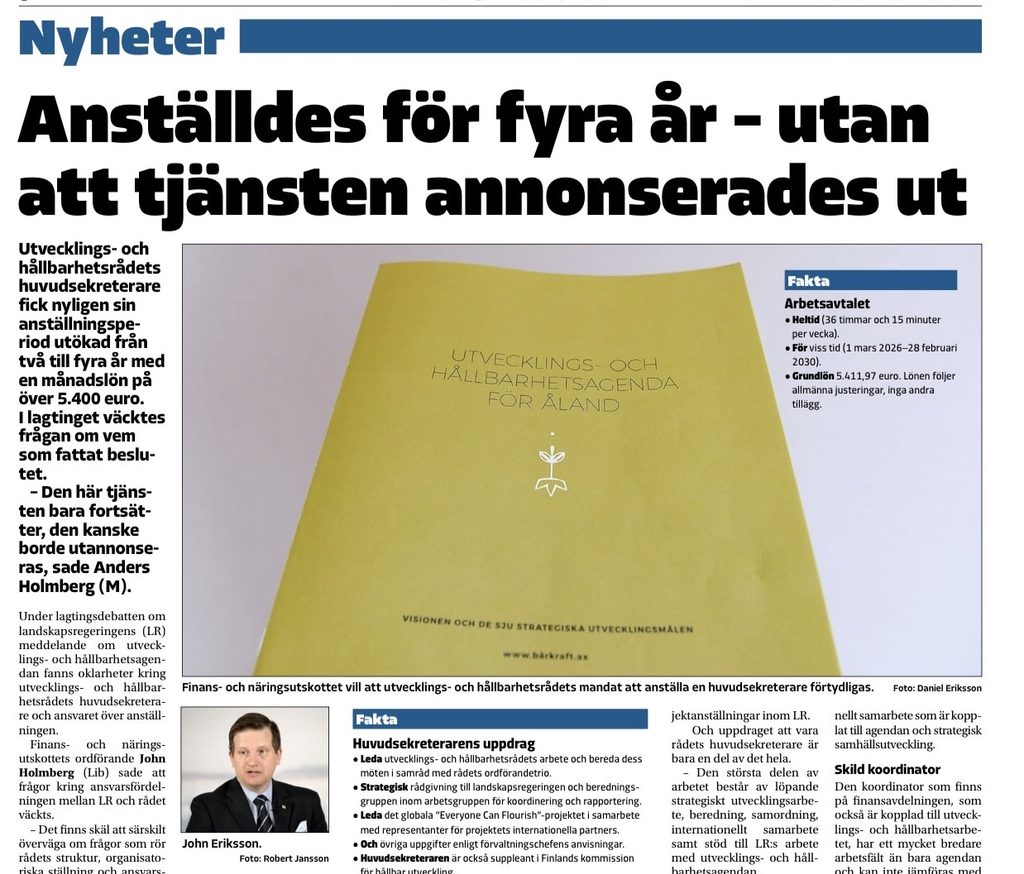
The monthly basic salary is €5,411.97, for a contractual full-time working week of 36 hours and 15 minutes. For reference, an ordinary lagtingsledamot’s published basic remuneration is €4,900 a month.
At the reported rate, four years amounts to just under €260,000 in basic salary, before employer costs and subsequent increases.
That is a substantial public commitment. One would hope the budget stretches to an explanation.
The government’s administrative chief, John Eriksson, one of my absolute favourite people in the world, explains that advertising was unnecessary because this was fixed-term project employment.
Very well. John has explained why he believes he was allowed to proceed.
On dispensing with the recruitment theatre, I am actually prepared to give Mr Eriksson some credit. There is no particular virtue in making applicants donate their evenings to a decision that has already been made.
But having dispensed with the performance, he still needed to supply the substance.
The questions surrounding Åland’s sustainability work, its organisation, its results and its accountability did not begin with my “incident” nor even just this year. Mr Eriksson was making this decision in the middle of a multi-year ongoing discussion.
He might have considered noticing it.
In those circumstances, another four years for the person already in the chair deserved an explanation capable of addressing the concerns. Explaining why an advertisement was unnecessary is an impressively narrow response to a considerably larger issue.
I must point out that I have encountered this particular talent at rather close range.
If people are questioning whether the sustainability apparatus adequately demonstrates its value, announcing that its existing arrangements can continue without further competition is unlikely to settle their curiosity.
However, it may assist them with their illustrations. And that’s the really dangerous part for sustainability on Åland.
Mr Eriksson appears to have understood how to secure the continuity of the employment. I am less convinced that he understood what was needed to sustain confidence in the work.
He quite rightly states he was under no obligation to flatter the audience with a performance, but he might nevertheless have troubled himself to understand why it was asking questions in the first place. Emotional intelligence has uses in public administration beyond remembering to thank everyone for coming. It might, for example, help an official recognise when people are asking for reasons to trust his judgement and he keeps replying with reasons he did not need their permission.
There is a considerable distance between what an official can get away with doing and what he ought to do. Ask me how I know.
A chief administrator is paid very well to exercise judgment across that distance.
A schoolchild can ask whether something is allowed. A leader determines whether it is wise.
Regrettably, Ethics Has Questions
Now, ethics tends to arrive at precisely this point in the discussion, usually without having been invited. It asks why something was done when everyone would prefer to celebrate having established that it could have been.
This can be irritating. Somebody has gone to the trouble of finding the applicable provision, and now some inconsiderate parliamentarian or heaven forbid, a taxpayer expects responsibility to be included in the price.
A loophole is an opening in a rule. Nor does discretion arrive with an instruction to use all of it. Eriksson’s office exists to exercise public responsibility. An explanation of the room available to him tells us something about his authority. It tells us very little about the quality of his choices.
For an institution promoting human flourishing, avoiding an explicit prohibition would seem a rather modest ambition.
Fortunately, the article also clarifies who made the decision.
On 11 February, the Development and Sustainability Council of Åland decided to extend the employment period from two years to four. The following day, Eriksson signed the employment agreement. He subsequently explained that the council’s decision could be regarded as advisory. The actual employment decision was his.
That is useful clarity.
We should resist making responsibility more complicated than he does.
The council may be advisory. His signature is not.
If Eriksson wishes to emphasise that he exercised the employer’s authority, the questions about the exercise of that authority belong at his desk. What assessment supported four years? What alternatives did he consider? What standards did he apply? Why did he conclude that this arrangement served the public interest?
These questions do not become unreasonable because he can answer a different one about whether advertising was compulsory.
He has explained the extent of his discretion. The quality of his judgment remains to be explained.
The Conclave Will Now Have Fika
The Council’s involvement deserves an explanation too.
An advisory council can do serious work without being the employer. It can examine performance, assess what the organisation needs, question the proposed duration and recommend a different arrangement.
It can, presumably, say no.
That last possibility would be particularly useful to establish.
Because if the outcome was beyond its influence, the Council was being asked to perform much the same service as those hypothetical job applicants. Applicants lend their qualifications to the appearance of competition.
Council members lend their standing to the appearance of collective judgment.
Both make somebody else’s decision look better attended. The council members do, at least, get fika.
Their emotional assignment is also rather different. Applicants must explain why they deserve the job. Council members with reservations may find themselves having to explain why the familiar person already doing it does not.
And should the candidate happen to be in the room sitting next to the Lantråd, the independent assessment can take place under the reassuring supervision of the person being independently assessed.
One begins to appreciate the coffee. It gives people somewhere else to look.
I would like to know what would hypothetically have happened if everyone had simply kept their hands in their laps and stared.
No speeches. No objections. Just a room full of accomplished people waiting to discover whether anything actually depended on their judgement. Would the proposal have been reconsidered? Or would the question simply have been repeated, with slightly more emphasis? Was there a quorum to establish?
A minimum number of raised hands before green smoke could emerge from the building and the renewal of the sustainability papacy be announced?
Four more years! His Continuity remains among us!
While the Catholic cardinals are physically locked in, one can achieve quite a lot without even touching the door on a small archipelago. This conclave gets fed too, incidentally. Refreshments do not, by themselves, establish that participation is voluntary.
Everyone knows everyone. Everyone would just like to get through the agenda. And whoever asks the difficult question gets to become the reason this can no longer be a pleasant formality and the meeting drags on past the scheduled time.
Would you like another kanelbulle?
There is a peculiar kind of meeting in which everyone has been invited for their judgement, but exercising it would be considered rather disruptive. A very Nordic meeting. Everyone is encouraged to speak. Everyone is expected to know better.
Consensus is generally reached when the last person with a reservation remembers they would like to be invited back.
A raised hand can indicate confidence. It can also indicate that someone has identified the quickest route to the next agenda item. An “oh for fucks sake” eye-roll is regrettably difficult to enter into the official record. Nor will the publicly posted minutes generally distinguish between “I consider this an excellent appointment” and “Dear God, just shoot me.”
Both can look remarkably unanimous. I, personally, have been in a lot of these kinds of meetings.
Please Flourish Within Your Pay Grade
Mr Eriksson should be able to explain what advice he received, what employee review was conducted, what he did with it and what advice would have persuaded him to choose differently. After all, the value of an advisory body depends on somebody being interested in its advice before knowing what that judgement will be.
Otherwise, we have assembled a considerable amount of expertise for a task traditionally performed by a small rubber object and an inkpad.
People invited to contribute their judgment are entitled to ask whether anything beyond their names was required. A room full of people with their hands up is not, by itself, evidence of enthusiastic consent.
Advisory status does not make responsibility evaporate.
It tells us where the decision actually remained.
A Decade of What, Exactly?
Then there is the work for which the appointment was made.
The job description includes strategic advice and responsibility for leading the global Everyone Can Flourish project in cooperation with international partners.
These are substantial responsibilities. They suggest a substantial command of the subject.
In early 2025, I remember being proud of work I had developed independently and very quickly, in my own time, without direction or a mandate. I had given it that time because I believed it could contribute something useful. The work had received praise. One even admitted they were a little jealous, which showed self-awareness and maturity.
I would like to share here that the incumbent in the role responded to my pride in myself, my education and my work ethic by reminding me that they were there eight years before I came along.
That is the revealing contradiction for a project about flourishing. Someone else gaining confidence and recognition becomes something to contain, rather than a result to welcome.
As those who know me well know, I had spent years on the margins of the Nordic labour market. Then, I had completed a master’s degree in Stockholm, only to find a global pandemic waiting just beyond graduation. An unplanned move to Åland on top of that and a need to rebuild networks while everyone was isolating and wearing masks. Then, even an unplanned twin pregnancy. Being able to use my abilities, contribute something valuable and have that work recognised meant something after all that. So did allowing myself to feel pleased about it.
Here was someone giving freely of her time and abilities, finding a way to contribute and recovering some confidence after years of marginalisation. Participation was beginning to mean something in an actual life. Is not Trust and Participation one of our sustainable development goals on Åland?
I had thought that this was precisely the sort of thing a project about human flourishing might wish to encourage. Perhaps even recognise as a modest instance of what it was supposed to be for.
That would also require recognising the power involved. He was my boss. I was a temporary employee whose working life he had authority over. I could not freely tell him how inappropriate his comment was or defend my contribution without considering the consequences. He could put me in my place. I had to consider my position. A project concerned with participation ought to understand what that does to a person’s ability to speak.
But apparently there was only so much flourishing to go around.
Eight years then, now ten years, is an interesting thing to offer as evidence of expertise. It also provides a useful period over which to assess it.
What conceptual work or additional developments had those years produced? What had been developed beyond the vision itself? How did the ideas around flourishing connect philosophically to public decisions, institutional responsibilities and the actual conditions of people’s lives?
A public vision needs enough intellectual structure to survive being asked what it means.
Preferably before it travels abroad.
A decade ought to be visible somewhere other than in the order in which people are allowed to speak or feel proud of their accomplishments. There is a difference between having worked with a subject for a long time and being able to do the intellectual work it requires. The first can be established with a calendar. The second generally involves follow-up questions.
At €5,411.97 a month, I think we can afford a few.
Leadership really involves recognising what expertise is missing, bringing it in and understanding what has been contributed. It means understanding that we have different words for different roles. An architect, an intellectual, a steward, a facilitator, a contact, or a official are all different roles. Years of preparation should leave a project equipped to work with researchers and civic collaborators, distinguish original contributions and manage an international cooperation without discovering the law and ordinary professional standards as an unexpected complication.
International cooperation does, unfortunately, tend to involve other people.
Experience should have helped with that. At the local level, with a local author, one might have expected the training wheels to be off by now.
So if the years are offered as a reason to trust the judgement, the judgement should be available for inspection. An anniversary is not a peer review.
A decade is not the answer to what has been produced. It is merely the period covered by the question.
The Questioner Is Now Under Review
These are also matters for the employer. Eriksson is committing public money to particular responsibilities, and familiarity with the employee cannot constitute the entire assessment of whether they are being fulfilled. Otherwise, having the job becomes the principal qualification for keeping it.
An admirably efficient recruitment policy, provided one already has the job.
Looking at public comments under Anders Holmberg’s public profile, one encounters some impressive supporting material. International praise for the project apparently travels home with it and covers the employment arrangements. The contract has excellent references: sustainability, respect and several important people who were praising something else.
If an employee has performed well and the work remains necessary, renewing their contract may be sensible. The word if is doing a considerable amount of work there. It would be helpful to see its supporting documents. Being told that the minutes are publicly available does not quite settle the matter.
A filing cabinet is not an explanation, however transparent the door.
Nor does it help to explain that such arrangements are not usually scrutinised. That would give every unexamined arrangement an excellent defence: its previous success in avoiding examination.
An impressively renewable resource.
Eventually, your persistence becomes the subject. Asking how an appointment was assessed is translated into “wanting to get rid of a hardworking person.” You must now demonstrate respect for dedication, sustainability and long-term thinking, while the decision sits quietly in the corner, enjoying the protection of several admirable principles it has yet to demonstrate. At some point, “peace” enters the room.
By then, asking again about the four-year contract feels almost geopolitically irresponsible.
At the same time, some of the critics are unexpectedly helpful to this arrangement. Calling the whole undertaking a pretend job saves everyone the trouble of distinguishing a serious conceptual framework from an attractive slogan.
Yet public institutions make real decisions from ideas about fairness, rights and what a good society owes its people. The quality of those ideas matters. Between the defenders applauding the intentions and the detractors dismissing the vocabulary, the actual work can remain almost entirely undisturbed. Neither response requires much reading.
Eriksson has been quite clear that the appointment was his decision.
An explanation of how he exercised that authority should be at least as readily available as an explanation of how much authority he had. The principles are aspirational. The payments are scheduled.
I would like to see the principles acquire comparable administrative reliability.
The salary has been specified to the cent, the employment period to the day and the working week to the quarter-hour.
Perhaps we could now achieve comparable precision about competence, purpose and responsibility.
Fortunately, taking responsibility for this decision requires no new recruitment process.
Until 2030, Eriksson–and Larsson–already have their job.
Comments