
On authorship, Everyone Can Flourish and the governance art of sinking an international project to avoid writing two words
Author's Note: The original Swedish language Facebook post is found here.
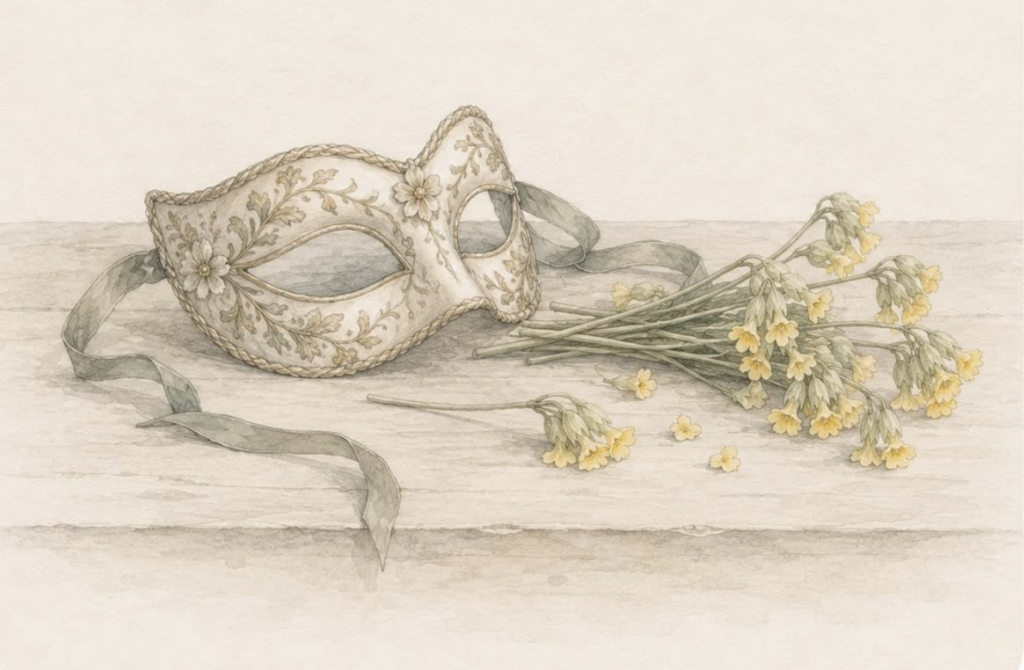
Reading about an anonymous “former government employee” in a news article about my own work is starting to feel a little like The Phantom of the Opera. 🎭
So now I’m taking off the mask.
The former government employee Ålands Radio is writing about is me.
And since the situation has changed dramatically over the past twenty-four hours, after four and a half months of silence, it is time for me to speak publicly on my own terms.
I am therefore confirming that it is my authorship and my specific material that are at the heart of the copyright and authorship issue now receiving attention in connection with the international initiative Everyone Can Flourish.
What I have wanted all along is for the UN report to be published with proper credit reflecting each person’s contribution. Several of those who contributed were from Åland.
“Everyone” means exactly that. Everyone.
My simple request was that questions about sources, attribution, authorship and rights be resolved before publication. That is why I asked questions by email at the end of April.
Read that again. Before publication.
The basic principle of Finnish copyright law is clear: copyright belongs in the first instance to the person who creates the work. An employment relationship can affect the economic rights and the employer’s right to use the material. It does not change who created it, nor does it in itself remove the right to be named in accordance with good practice. I have not signed any agreement, nor will I ever sign such an agreement, waiving that right. Nor does a translation or adaptation extinguish the copyright in the original work, even if it is produced in the course of someone’s employment.
But I was also open to other solutions, including the removal of at least my planned two- to three-page chapter to avoid incorrect attribution, since I am building a research programme around the work I brought into the process. Then at least I would not have to spend decades citing my own work under someone else’s name, or face doubts from other academics about whether I actually wrote what I wrote.
It all began during a gap between my periods of employment from 1-15 January 2025, when I took the initiative to develop the first draft of a framework for how societies can help people flourish. The idea was to give visions such as Everyone Can Flourish concrete substance: how do we translate such ambitions into decisions and action, and how do we assess progress on issues that are important but harder to measure? As the deadline for the 2030 Agenda approaches, this question is becoming increasingly central to the global sustainability debate.
Later that year, at my supervisor’s written request, the work was translated into English for use and onward sharing within the international project ahead of the planned UN report. Like all previous versions, the material bore my name and a Creative Commons licence (then CC NC BY SA, now CC NC BY ND) that expressly required attribution or citation. Furthermore, even before it was shared with UN-Habitat, I had clarified the requirements for attribution or citation, and my relevant rights under Finnish law, with my supervisor.
From the time work on the letter of intent began until my employment ended, I regularly took part in discussions with the ECF project group. Following a meeting in early July, I also contributed directly to the report through a chapter submitted 17 July 2025, which we discussed together during UN-Habitat’s visit 18-20 August 2025. After I had left my position, the lead author contacted me in November via LinkedIn and wrote that the material was “hard to improve upon”, that it would be used and that I would be named as a contributing author. I also took the time to share this via email with my former supervisor, even though I had left the role two months earlier. This was confirmed again in writing as recently as March 2026, also via LinkedIn, just six weeks before the planned publication.
It should also be mentioned that this was confirmed on the Åland side during the visit on 20 August 2025. After our final planning meeting during the ECF visit with the consultant/lead author, we all received meeting notes by email listing my name alongside the other “contributors”. This was therefore not an anonymous institutional report, but one with named contributors. Nor is proper attribution at odds with a shared vision.
I would also like to point out that, when I was an AMS intern at the Government of Åland in the spring of 2024 and was due to leave just a few weeks later, I was properly credited for the language editing of the Voluntary Local Review that received attention within the UN. It is therefore natural to ask: what happened after that? What was different? My name remains listed as the language editor.
Moving forward to 15 April, I submitted a doctoral application in which I referred to the forthcoming publication and the authorship that had been confirmed to me. On 24 April, I learned through the Human Flourishing Program’s social media that the report would be published on 28 April. By then, I could no longer amend my application.
After three written confirmations, I had every reason to expect information ahead of publication and an opportunity to check how my name and contribution appeared in the final version.
If I had misunderstood, a clear answer could have cleared things up. I asked for one. It never came.
Thus, it is not my expectation that needs explaining. It is the absence of a clear answer about what actually happened.
In an email dated 1 July 2026, UN-Habitat informed me and my legal counsel that the organisation would not proceed with the publication, dissemination or use of the material in question. UN-Habitat further stated that this had been confirmed by the Government of Åland.
I have it in black and white, and in the metadata.
I can respect UN-Habitat’s decision not to proceed, for several reasons that are not solely about me. But the handling of questions about sources, attribution and authorship during the publication process still needs to be examined. That is where I would like to see serious journalistic attention.
On Monday, Larsson confirmed on Åland Radio that the entire Everyone Can Flourish project has been put on ice, with no clarity about whether, when or in what form it might resume. I can confirm here that the partners’ names had already disappeared from the website between 21 and 25 June. I have dated documentation of the website and subsequent changes, including from early August.
Concerns that parts of the website also adapt my work remain unanswered, despite my having generously provided a concrete list of points that need to be examined. At the same time, this week’s reporting suggests that the Parliament of Åland was informed only recently. I agree that this is troubling from a democratic perspective.
But this is the immediate human consequence: when the publication failed to materialise, I also lost the academic credential I had cited in my application in order to continue work I had found meaningful after the Government of Åland’s cuts.
I had provided this information to the admissions committee in good faith, supported by repeated written confirmations. It was my name on the application. It was my academic and professional future that was affected, and continues to be affected.
An author’s name binds her to what she has created. For someone establishing herself academically, that connection carries through to the next application, the next collaboration and the next opportunity to research, write and fulfil her potential. That is why I cannot treat this as a question of prestige or “a few bumps in the road”.
It goes without saying that these are very serious consequences. They raise concrete questions about the Government of Åland’s obligations and responsibilities as my former employer.
Since April, the process has required legal assistance and enormous amounts of time, money and energy. My family has lived with the consequences during what should have been our summer holiday. I have largely dealt with this alone, with the legal assistance I could afford and an occasional hug from a few close friends.
Of course, all of this affects whether we can continue building our lives in Åland, and whether and how I remain involved in Åland’s civic life. Flourishing feels like a very distant dream.
Is this a sustainable outcome, or one consistent with Åland’s sustainability goal 5 Attraktionskraft? For a “co-creator” who contributed on her own initiative?
My silence has never meant that what happened did not matter. Nor did I want to become the whole story. I wanted the work to have a future. And although the Government of Åland has its contacts, the bright spot is that my work is still mine and can still make a difference.
I have devoted a large part of my life to sustainable societies, human flourishing, democratic institutions and long-term responsibility towards society. I believe that we can create better conditions for people to live, contribute and belong. That is why I worked beyond the scope of my position, at home and between periods of employment, as the first draft of the work that later entered the international process took shape. I wanted my education and ideas to be put to use. The lead author for UN-Habitat recognised the value of the work, including in a letter of recommendation.
But that conviction also brings obligations when someone says that something has gone wrong. Here, I believe many may have failed in their responsibilities, long before I needed to familiarise myself with Finnish copyright law.
When public institutions build their work on trust, transparency, participation and human flourishing, those values must shape how a real person is treated. Even when her questions are uncomfortable. Even when the answers require their own decisions to be examined.
That is where the grand words must be able to bear the weight of a real life. And as I said not so long ago: trust is society’s memory.
I have not stopped believing in sustainability, and I never will. But sustainability is bigger than an organisation, a network, an agenda, a preferred narrative or any particular leadership. It is carried across generations and across borders.
To reduce this to a copyright dispute that can be considered by the Market Court or the Copyright Council therefore means, in my view, missing the broader responsibility: to respect the boundaries of those who do the work, take their contributions and advice seriously, and listen when they describe a culture of silence.
Such experiences are directly at odds with sustainability and with Goal 2 Tillit och delaktighet. You now have a named example in me, rather than anonymous accounts relayed by the chair of the Finance and Economic Affairs Committee. I hope others find the courage to share their perspectives. They are desperately needed.
This concerns all of Åland. After this spring’s committee report and Monday’s debate, we should be able to move beyond using the agenda as a political weapon and instead work towards solutions. The concerns have already been raised publicly.
Considerable criticism has been directed at the storytelling. I can only say that I would welcome a story that seriously examines whether the Government of Åland has consistently practised what it preaches over the past ten years. Nor is that a story that can be confined to a single term of office.
Finally, both my legal counsel and I consider the Government of Åland’s previous written communications to have been anything but solution-oriented, and believe that the issue now extends beyond copyright. But if its position has changed, the Government of Åland is welcome to seek a resolution through my legal counsel. They have her address.
As for my own story, other external processes are also under way or forthcoming, and I cannot comment on them at present. But I now see that it has clearly become unsustainable to keep myself out of a story that has occupied such a large place in my family’s life. My responsibility is first and foremost to my husband Keith, with whom I celebrated 21 years of marriage and 26 years together on 3 September, and our four children: Ali, Matilda, who turns ten next week, and the twins, Silas and Matthias. I want to be able to look them in the eye. I want them to see a mother who fights for what she believes in, not least her own intellectual work.
And I regret nothing, because this is what it means to live sustainability rather than merely talk about it.
“Everyone” must also include the person who asks an uncomfortable question. The person who wants her work to be recognised. The person who is trying to build a future here.
So now I am saying it. It is me.
And I can only conclude, not without a considerable dose of irony, that by appearing so disproportionately preoccupied with keeping me invisible, the Government of Åland may actually have done me a favour:
By instead making me impossible to ignore, from Mariehamn to Nairobi.
Thank you for your attention.
Comments