
A bi-continental black sheep on the rules we inherit and the ones worth keeping
Wednesday I consulted the heavens.
Today, the mountains of my native ground would like a word.
There are things about me that will not fit inside the attractively designed squares of The List. They need history and a little more landscape. A ridge behind another ridge. Somewhere for a voice to travel, and for an old story to settle before somebody tells it again.
Åland knows something about small places and long memories too.
What has surprised me was how familiar the closeness could feel, and how differently we understood what it asks of us.
When “the incident” began earlier this year, I quipped to someone that I was made of “steel, smoke and Appalachian whisky.”
Meaning, I would be all right. I could handle it.
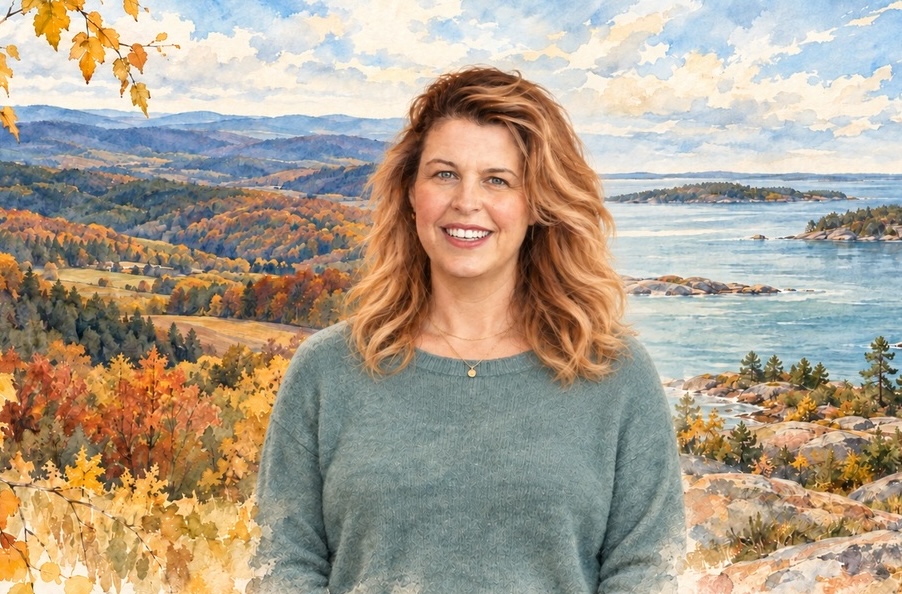
I grew up in Bedford County, Pennsylvania, among the long ridges and valleys that lead into the Alleghenies. These mountains belong to the greater Appalachians, its chain reaching from Newfoundland to Alabama.
Continents collided to raise these mountains, long before the Atlantic opened between them and the siblings they left in Morocco, Scotland and Scandinavia. Ancient rivers wind through the country between the ridges. Time has worn the heights into folds of purple, blue and green.
Hundreds of millions of years later, the horizon looks almost gentle. Ridge behind ridge, like waves of an ocean that had yet to exist when the mountains rose. My ancestors crossed it to find a new life. I crossed it back to do the same.
But in autumn the light catches on the hillsides, copper and gold, before the trees give everything back and the dark branches show. A road takes the way the land will allow. Houses disappear behind a rise; another turn brings them back.
One can be out of sight but is hardly unknown.
Familiar last names attach themselves to places. Places hold their stories. Someone is gone, but the bend in the road still knows where they lived, and the family has by no means finished discussing them.
Death does not necessarily secure your privacy. Tales will be told after your departure.
Famously and infamously, Appalachia comes with legends, some told by its people and some told about them. Moonshine, whisky and mountain music, for one. Feuds with longer lives than the people who began them for another. Then there are stories of ghosts in the hollows, haunted taverns, of guitars, fiddles and banjos carrying something the speaking voice cannot.
The people are said to be tough, loyal, suspicious of authority and capable of remembering an insult through several changes of federal administration. But then caricature arrives and mistakes a rural accent for an absence of thought.
No mountain chain so long could contain only one kind of life. But I do recognize the affection and the obstinacy, the value of family ties, the help that turns up without being asked, and the deep reluctance to let somebody else have the final word.
In Iceland in May, my friend Marvi from the Nordic Migrant Expert Forum discovered exactly where I came from and told me she followed Appalachian ghost stories online. We were soon discussing legends, the common superstitions of always closing curtains at night, not whistling in the woods nor staying out after dark, while my traveling companion Josefine regarded this colorful info connected to my origins with bemusement.
A landscape with that many folds could keep a few mysteries to itself. The thick woods supply the foreboding dark. People across generations supply the unfinished business.
I like the stories, connected to the immigrants that translated their own superstitions and beliefs into their newly adopted landscape. The pleasure of being drawn a little closer, of hearing the familiar world acquire another presence.
Affection can haunt a place too. So can a kindness.
There are people whose voices remain in the way we speak to others, long after we have stopped being able to call them.
And there are rules that remain in us after we have forgotten being taught them.
Keep your word.
Speak respectfully to your elders.
Help when you can.
You know better than that.
That last one can travel a considerable distance down a valley. Even across an ocean.
Toughness and helping can co-exist. Hard ground and hard weather teach you to manage; they also introduce you to the limits of managing alone. Some work takes more than a pair of hands. Summer thunderstorms and winter blizzards can be indifferent to your plans. Your people within reach become part of how life itself is held.
Family. Neighbors. Someone at your church who remembers you have been ill and may still need checking on after the interesting part of the illness is over.
Perhaps then you bring a meal or mind the children for a while. The need has made itself known. One does not require a constitutional amendment before answering it.
I brought that expectation with me. Someone ought to do something. If I am standing here noticing, the someone may well be me.
It can have its complications.
People who know how to help may also know, with regrettable certainty, how you ought to live. The concern can be generous. From family, the accompanying instructions can be extensive. You may discover that the person who brought assistance has also brought a view on your routines, your children, your faith, or the regrettable direction of your opinions.
A casserole might come with supervision.
Here I must share that I am the political black sheep of my family which has been staunchly Republican since the party was founded.
I have, in fact, checked the obituaries.
Today, there are plenty of Trump voters in it. My progressive, social democratic views have not become more acceptable through repetition. We have tested this, believe me.
But they still call me home.
The prodigal daughter, so to speak, if we are allowing ourselves a little biblical excess. Mostly, though, they would really like the black sheep nearer the rest of the flock. It is a question of mileage. I have not been asked to submit a revised political program before visiting.
They knew me before my opinions. The argument can be fierce without becoming a border through which nobody is allowed to return.
When I FaceTimed my mother in early May with news of how strange my life had suddenly become, I expected alarm. Perhaps admonishment. Possibly instructions to get on a plane. Or:
Now its time to end this adventure and be near family.
When I regaled the entire incredibly surreal saga ending with:
I seem to have started an international incident.
She answered totally non-plussed without a flicker:
Of course you did.
Mom knows I never go looking for trouble. But she also knows just as much that being bullied would never improve my obedience. Perhaps underneath the surface there was even a little maternal satisfaction in discovering that those people over there had now had the pleasure of meeting the rest of her daughter.
From paternal grandmother Alice, turning 98 years old this November it was:
You go girl and show them.
Apparently, two of the women who raised me recognized their own handiwork. After all, they didn’t raise a quitter.
With feet tucked under me at Snake Spring Elementary School in the early 90s, I remember being taught:
I disapprove of what you say, but I will defend to the death your right to say it.
We were taught it as Voltaire’s. But it was actually Evelyn Beatrice Hall wrote the sentence to describe his attitude. A woman supplying the memorable words while a famous man receives the credit. History has certainly found a format it enjoys.
Here, I give the words back to the lady who actually wrote them.
The words stayed. So did the demand in them. Your dislike of what someone says does not release you from defending their right to say it. This is where principle asks something of you.
The standard-issue American civic inheritance adds its own rather noisy accompaniment.
Religious dissenters. Revolutionaries. Abolitionists. Underground Railroad. Striking workers. Women demanding the vote. Black Americans refusing segregation. Vietnam draft dodging. Stonewall uprising.
We teach our children to admire people who stood up to authority, sometimes at considerable cost to themselves. Even the ultimate sacrifice. America has a peculiar habit of arresting people and later teaching children to admire them.
Failure is not shameful. Not fighting for what you want and believe in is shameful.
The lesson I took was that being a good citizen could demand telling the government no.
In a parallel with Åland, autonomy was even attempted in my own region.
Just after the United States was created, Western Pennsylvania tried a rebellion over whiskey.
This is remembered in history books across the country as the very first test of the American Constitution. Washington came with an army of 13,000 men to the heart of the rebellion, my very hometown. Our founding father remains the only sitting US President to ride into battle.
The rebellion was quelled. Sensibly hundreds of people could not fight thousands.
But neither did it inaugurate a regional love affair with national government.
That suspicion has had serious sticking power. Do you recognise it anywhere else?
I see a possible tourism slogan:
Welcome to Bedford County, where even the refreshments have a history of disputing federal authority.
At the same time, there is plenty in that inheritance I would argue with.
Suspicion can become a habit that no evidence is allowed to interrupt. Independence *cough* municipalityreform *cough* can become a performance maintained at somebody else’s expense. Usually the somebody else is someone who ends up going without.
We are not short of people who confuse the right to speak with an obligation to be listened to indefinitely. This week’s debate on health care has shown that to some degree.
Nevertheless, power has questions to answer. A title does not settle them.
My upbringing taught me the difference between a mountain and a man to look up to.
That came in quite handy this year.
This Sunday, September 27, I will have lived in the Nordics for thirteen years. There is a great deal here that feels like an answer to something I had been asking before I knew how to phrase the question.
The structures. The public provision. The possibility that a life can falter and find something already there to catch it. But it must be organised.
There is so much tenderness in making provision for someone you will never meet. In deciding that they should be cared for even if you would find them difficult, even if their family is absent or unkind, even if nobody would think to bring them supper. Even if they live in the next valley or the next island. A person should not have to be fortunate in their neighbors to survive being unfortunate in their circumstances.
I find that beautiful.
I also like the lists. We already established this. I appreciate a society that has made some arrangements before disaster arrives and asks where it should put its coat.
How much of this is Nordic and how much specifically Ålandic, I cannot neatly separate. I know I want care to have a place in the public budget and a claim that survives somebody’s bad mood.
Back home, people who depend on public benefits can still speak of government as though it were waiting outside to confiscate their freedom. I know the contradiction. I do not propose that poor people resolve it by going without dinner.
Receiving care or fair treatment should not require the surrender of an opinion about the people administering it.
In both places, I would wish for us to get better at defending both the care and the freedom as real partners.
What could we be if we cherished both?
I still miss the neighbor checking in. The welfare state has not made such attention redundant. Someone has remembered what you like. Someone has crossed the distance because you were in it. So much of what makes us human happens between us.
The state can be responsible. But so can I. So can you.
The landscape of my birth folds the horizon.
The other I adopted leaves it open: water, sky, a low shore.
Both could hold a small community closely enough that its people know who is missing from the room.
On Åland, I have loved the access. The short distance between a question and the person who might answer it. There is promise in a place small enough to reach.
Which is also why it can hurt so much.
You can see so clearly how little distance there was to cross.
I notice it in the encounters that have nothing to do with me. Five percent more effort. A little curiosity. Someone willing to think beyond the first answer. Five percent from the person making the decision can become someone else’s entire month, year or decade.
Instead, I can often find people snäv. Narrow in imagination, in the room they will make, in the fucks they are prepared to give.
A remarkable austerity in a budget nobody ever voted on.
Perhaps comfort and what one thinks one can get away with should not be the operating principle. Perhaps discovering the least you are obliged to do is an embarrassingly small moral ambition. Perhaps responsibility and role confer greater responsibility in how you work with others, instead of excusing more carelessess and utter disregard.
Where I am from, you are supposed to do the right thing even if nobody had thought to write it down. If somebody had written it down, that was generally considered a fairly strong hint.
This is where the codes of my many homes begin to rub against one another. I can learn a custom. I have more difficulty teaching my body to accept an entirely avoidable failure of care as simply the way things are done here.
“We have a service for that” does not quite answer the question of what you could do.
The closeness is familiar. Its uses can disquiet me.
I know from home how readily looking after one another can become keeping an eye on one another. How loyalty can shelter a person, then quietly extend its protection to something that person has done. Everybody knows. Everybody understands why it would be difficult to say so.
Some ghosts are the subjects around which a room has learned to arrange its furniture.
There are codes I have no intention of honouring merely because nobody thought to write them down. I do not owe either place the preservation of everything it taught me. Affection does not nor should it require that kind of obedience.
Nor should belonging. My family can want me home while wishing I would acquire a different set of opinions. Belonging should never require us to become inaudible. Åland has its own history of resisting decisions made over its head. The right to fight should be recognizable here, even for those of us who have joined it later.
Your dislike of the fight does not make the right disappear.
When I imagine shouting down a valley, there is an expectation inside the sound. Someone else knows the code. They know why the broken promise matters, why a person’s need makes a claim on us, why noticing cannot be the worst thing that happened.
You call because you believe there is someone within hearing, ready to listen.
I have to ask something of my own code too. The part that keeps going. That takes pride in managing and making do. That can look at somebody else’s reluctance and think: I would do it, even now, even feeling like this.
Perhaps I would. I have.
A woman can be so often praised for her strength when what people mean is that she made her suffering convenient for everyone else. Sometimes I have continued because something needed doing while treating the person doing it as if she could be replaced when she wore out.
She could not.
There remain the burdens I cannot see in other people. I know I must leave grace for that. But I also need to stop offering my own health as evidence of what a decent person ought to manage.
The mountains can take their slow and tender time wearing themselves down, century after century.
I have other plans.
The long memory stays.
My upbringing gave me the ability to keep a kindness warm for a lifetime. I can remember a wrong for just as long. If someone puts something right, I will remember that too.
The story is allowed to go on.
I have learned to love the quiet here. The space a few words can leave around themselves. I would like to keep that too.
The mountains remain in my voice.
Yet, there is also room for the sea.
I would wish for both.
Comments