



On Wendell Berry, enoughness, and the life we mean to protect
Wendell Berry has been waiting patiently in the margins of my writing for months. This week, I finally turned to him—only to discover that his obituary had arrived before I did.
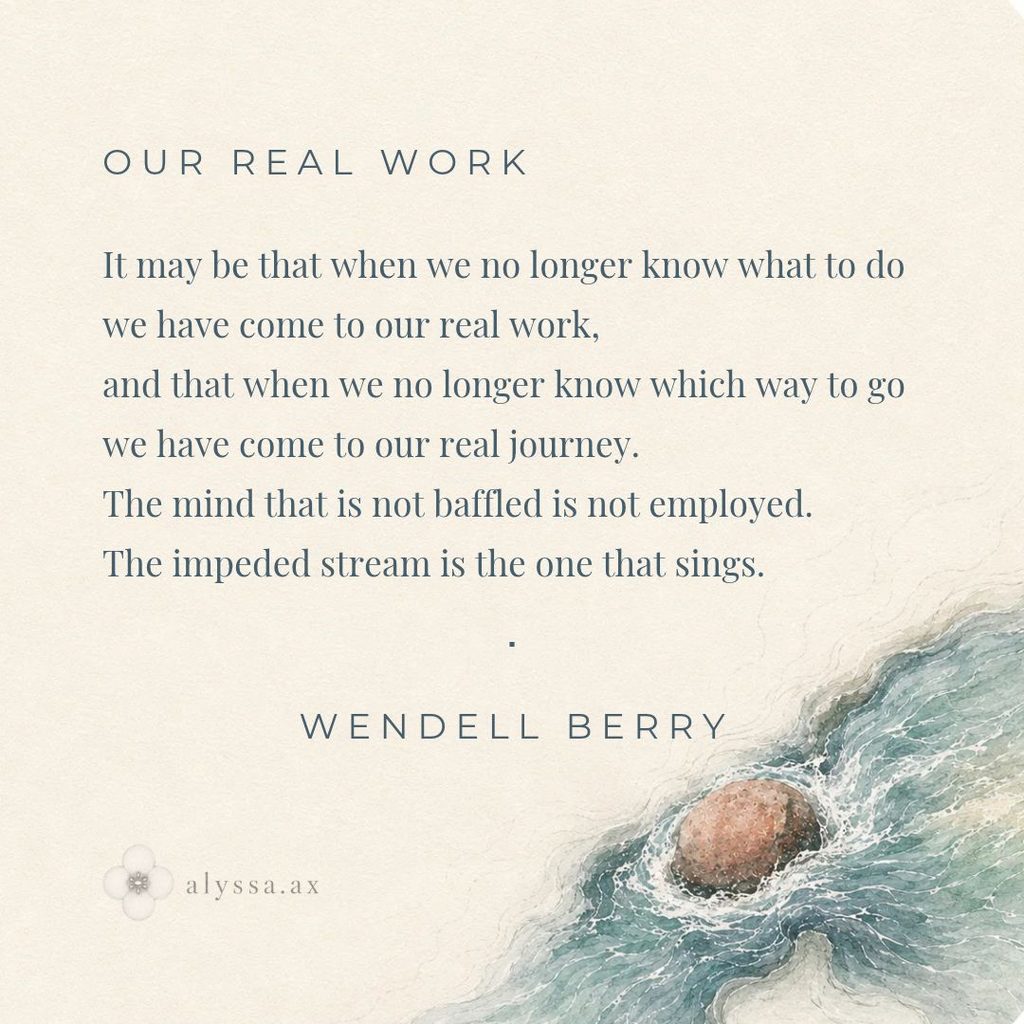
The Kentucky writer and farmer died on 31 August, aged ninety-two. I hadn’t known. Just six weeks before he died, I had made artwork around his sentence, “The impeded stream is the one that sings,” thinking I might use it for a solidarity/climate-march sign.
The sign never materialised. But the sentence stayed with me.
There are days when I want to immerse myself in literature not because I have stopped caring about what is happening, but because I need something more than another account of what is wrong with the world.
A way of seeing what our concern is exactly for. The lives within the landscape. The people within the argument. The children whose futures we discuss, and whose childhoods are taking place while we discuss them.
Two waters in Berry’s writing have brought me towards those questions via different routes. One attends to what can emerge when our passage is obstructed. The other follows a frightened parent towards a little peace.
Neither offers the uncomplicated reassurance that everything will be all right.
In our current world, I suspect there are a great many of us who are looking for something more trustworthy than that.
But before we visit the waters, there is a very particular garden in Mariehamn that can help me explain why Berry might be worth our company here.
In 1993, Ålands Natur & Miljö and Ålands fredsförening helped save what is now Mariero. I currently chair the board of Ålands Natur & Miljö, and caring for Mariero remains part of the association’s work.
That gives me a particular reason to pause over a poet who finds peace among living things. A visitor’s moment of stillness and the work that makes it possible belong to the same place. Someone can sit down because someone else kept going to preserve the space so that they might rest in it.
To the reader, perhaps a garden looks like a small thing to defend. Until we ask what, exactly, we are defending: room for other lives, somewhere to learn, somewhere to meet, somewhere to sit without being required to buy anything? A little space in which the town offers something other than yet another reason to hurry?
There is nothing especially mysterious or inherently wicked about wanting somewhere to park your car. But a garden and a car park answer entirely different needs.
Somewhere in the practical business of deciding what a place should become, people must account for what it already gives them. The fact that we can count the cars does not mean we’ve settled the value of everything else that matters.
If a place gives us something worth having, what are we prepared to do to keep it?
There is something quietly instructive about beginning a peace walk in Mariero, whose continued existence first required people to object.
Peace, apparently, is not always the consequence of being agreeable.
This is the Berry I really want to get to know—the man whose tenderness towards nature gave him reasons to be difficult, whose love for a place made him exacting about the arrangements that threatened its life. The person for whom affection was not what you added after the serious decisions had been made, but something that ought to have consequences for the decisions themselves.
On islands that value their local life, their landscapes and their identity as the Islands of Peace, that seems a far more interesting encounter than borrowing a reassuring poem.
What does it mean to love a place well?
What would count as having enough?
And how do we keep caring for a world that will not give us the guarantees we would like?
Land, livelihood, community and the future of children were not separate compartments in his thinking. He kept following the relationships between them, including where those relationships made demands on the people who professed to care.
What timely and particularly good company for my state of mind just now.
In 1964, Berry committed what his literary colleagues apparently considered a grave professional error.
He went back to Kentucky.
He had been teaching at New York University, and he did enjoy New York. The city had not rejected him. Everything was going rather well. But an offer from the University of Kentucky gave him and his wife, Tanya, the opportunity to return. They took it because they wanted to go home. His friends mostly thought the direction was backward and downward.
Apparently, Kentucky was a perfectly respectable place to be from. It was less respectable as somewhere to make a life.
Berry firmly disagreed.
There is a peculiar geography behind that judgement. Some places are permitted to produce interesting people. Others reserve the right to certify them.
Anyone who lives somewhere small might have reason to question the map. A good life in a small place need not be a consolation prize for failing to acquire a more impressive address. Nor does a community become insignificant because its most valuable work is unlikely to attract the attention of New York.
But Berry’s return to Kentucky was not the closing scene of a film in which the protagonist finally learns what matters and the credits release him from further difficulty.
Once the family had settled, the Vietnam War began pressing into his life. He thought his way towards pacifism, distinguishing it from any natural gift for being peaceable. He admitted:
I’m not a very pacific person.
There is something endearing about a man who knows the difference between a moral commitment and a description of his temperament.
Rootedness had not made Berry immune to anguish. The place he called home was somewhere from which he encountered the world, not somewhere the world could no longer reach him.
That is a more useful understanding of belonging than the promise that, in the correct bucolic location, we will finally cease to be troubled as we look at pretty flowers.
So before we borrow his peace, it is worth examining what disturbed it first.
There is a particular kind of wakefulness that begins when someone you love is asleep.
The house is quiet. Nothing has happened. The mind, unwilling to waste an opportunity, supplies what might.
A child’s future can become very large in a darkened room. There are the ordinary worries, which arrive wearing tomorrow’s clothes, and the others: the world they will inherit, the things they may have to endure, the person they will become under pressures we cannot yet imagine. We have brought someone into life. We would like to know what arrangements have been made.
The answers are not always reassuring.
When Openings appeared in 1968, Berry was still in his thirties. The collection containing “The Peace of Wild Things” also contained poems against the Vietnam War and about his fear for his children. The famous stillness had troubled company.
The poem does not identify the particular occasion behind its sleepless night. But a statement Berry made against the war in February that year tells us something about the questions occupying him. As a teacher, he rejected preparing young people to fit themselves into the machinery of war. As a father, he asked whether anything he possessed could justify his son dying to preserve it. Then he asked what meaning his son’s life would acquire through becoming the person in a bomber who delivered suffering to strangers.
He feared that the world might kill his child.
But he also feared what his child might be asked to do.
That second fear changes the first. Protection cannot mean only arranging for our own children to emerge unharmed. There is also the question of what they are being prepared to accept, what they will be taught to disregard, and whose pain they may learn to call necessary.
A child does not arrive in the world as an instrument of national policy. Someone has to make that translation.
In “To My Children, Fearing for Them,” he gives the private predicament its almost unbearable compression:
loving what I cannot save.
The poem questions what it has meant to bring children into such a world. Yet when they turn towards him, he cannot wish their existence undone. Fear cannot make their lives less precious to him. But neither can their preciousness make those lives safe.
Many parents will recognise that contradiction without requiring an introduction to American poetry.
We do not regret the person. But we are appalled by the terms.
Love gives us obligations far beyond the ordinary boundaries of self-interest, but it does not confer corresponding authority over history.
We can fasten a seat belt. We cannot fasten the future.
However, Berry does not let his imagination stop at the limits of his household.
In “To a Siberian Woodsman”, also in Openings, Berry imagines another father’s household across the Cold War divide. There is work, music, a son, the prospect of fishing. There are people with lives that have not been adequately described by the word enemy. He asks:
Who has invented our enmity?
The other man does not become valuable because he resembles an American.
The question does not erase their political differences. Rather, it interrupts the astonishing convenience of forgetting that other people inhabit their lives as fully as we inhabit ours.
The world becomes rather difficult to dismiss once we begin furnishing its homes.
Here, on islands whose peace history includes finding an alternative to violent conflict, that interruption should be recognisable. Peace requires arrangements, certainly. But it also requires an imagination capable of seeing what those arrangements are meant to spare:
somebody’s ordinary, irreplaceable life.
This is one of the movements in Berry that most interests me. Knowing how fiercely we love someone provides us with a built-in understanding as to why the loss of another human being cannot be made negligible simply because it occurs elsewhere.
Particular affection for our nearest and dearest need not narrow our moral world.
Properly followed, it can enlarge it.
This was the man who went to the water.
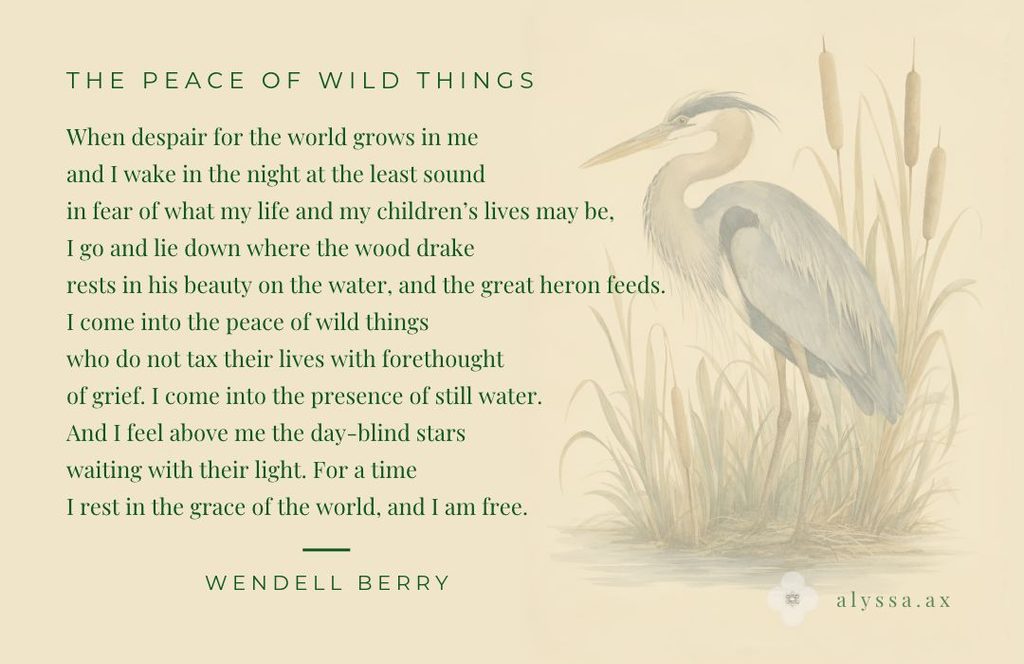
I find the sentence about the impeded stream that I encountered in July more startling as writing than much of “The Peace of Wild Things,” considered to be Berry’s most famous poem. The stream catches me immediately. The quieter poem does something else: it makes an experience recognisable with very little between the reader and the recognition.
Its opening is close to ordinary speech. An anxious parent goes to the water, where a duck rests and a heron feeds. The poem gives us the unforgettable phrase “forethought of grief,” then ends with a freedom it carefully refuses to make permanent.
There is no need to pretend that every line astonishes in order to understand why someone might need the poem.
Sometimes a piece of writing matters because it finds the right shape for something we have been carrying without adequate language. We recognise ourselves, and the recognition is not the end of the experience. It makes further thought possible.
Forethought of grief.
The sorrow has not happened. Nevertheless, the mind has already begun making room for it.
I think many of us mistake this occupation for useful work. There are preparations to make, certainly, and responsibilities that cannot be met by looking away. But anticipation can continue long after it has ceased to prepare us for anything. It becomes an attempt to pay for safety in the only currency immediately available: our attention.
The future does not accept the payment.
So Berry takes that attention elsewhere.
The heron, it should be said, has not joined the peace movement. It is feeding. Certainly, the fish in the vicinity might have a different reading of the scene.
He has not discovered a world without danger. What changes is the relationship between danger and the whole of existence.
Beside the water, the feared future is no longer the only thing present. There is another life proceeding according to needs that have absolutely nothing to do with the human mind’s forecasts. The world has not suspended its other business to accommodate some man’s imagined catastrophe.
Perhaps that is precisely what he needs to encounter.
Because nature does not necessarily make our problems smaller. It makes the world larger than our problems again.
In May, while wandering through Iceland with a mind heavy with worries, I wrote about my own experience. Amid moss, stone, and sleeping volcanoes, nature offered a quiet truth: it needs neither our attention nor our understanding. It simply exists, undeniable, reminding us that even what has grown enormous in our lives remains held within something larger than itself.
It would be easy to interpret the poem as nature simply taking his mind off things for a moment, but the experience is more than simply a pleasant distraction.
To stand beside the sea or enter a wood is to be addressed by something other than our own interpretation. The light changes. Something moves. We have to look again. For a moment, the attention that has been tightening around one terrible possibility admits something it did not put there.
Mind you, we are still concerned. We are also cold, breathing, noticing. We belong to the life we are worrying about.
Our relief comes from no longer having to be central in order to belong.
Berry called the experience grace. When Bill Moyers asked him about that word, he explained it religiously: the creation was holy, sustained by the power that brought it into being. He saw the devastation of surface mining as desecration. The consolation was inseparable from his sense that the world possessed value beyond its usefulness to us.
Nor must we share his religious faith to recognise the encounter. But we should notice that the place does not become valuable because he feels better in it. His relief is one way of discovering a value that was there all along. The poem ends:
For a time
I rest in the grace of the world, and am free.
Those first three words keep the promise honest.
He does not know that everything will turn out well. He has not solved the future. He has experienced something that makes the present more inhabitable.
The loss is possible. The damage, imagined or real, deserves our attention.
But even justified fear can occupy more of life than fear can sustain.
There is a kind of enoughness in that modest ending. The moment does not have to last forever to have given him something real. Peace needn’t settle every question before it can be received.
I can say with a lot of experience and considerable room for growth that I can be so intent on securing a good life that I become suspicious of any portion of it arriving before total security.
Berry lets the water interrupt. We should all do the same.
The other water is less still.
The words often circulated as “Our Real Work” come from “Poetry and Marriage: The Use of Old Forms,” an essay dated 1982 and collected in Standing by Words. The original setting is not a general instruction to turn adversity into character. Berry is thinking about what happens when we commit ourselves to a form—a poem, a marriage—and encounter something that will not merely accommodate our intentions.
A poem has language to answer to. But a marriage contains another human being.
Berry had a wonderfully literal souvenir of that second fact. When he first saw Tanya at university, she was standing beside a wooden newel post. Years later, when the building was being remodelled, he asked for the post. The builders eventually put it in his truck.
It is a rather extravagant thing to preserve, a piece of staircase from the beginning of a love story. It is also charmingly practical. Why confine memory to the mind when someone can load it into a pickup?
In the same interview, Tanya is asked whether she agrees with the importance her husband gives to ours rather than mine. She supplies a distinction: “there’s mine and there’s ours.”
A marriage, in other words, is not an essay that one party gets to write.
This is part of the resistance Berry is interested in: the presence of something real beyond our own wishes. Another person’s difference ceases to be an appealing abstraction and becomes a very real need, an objection, a way of seeing that cannot simply be folded into ours. Commitment asks us to become capable of more than we originally knew how to do.
Then comes the sentence:
The obstacle participates in the sound.
The song is not a prize waiting downstream, to be collected when the obstruction has finally been defeated. It comes into being through the meeting between movement and resistance.
If you are a writer like me, think of the difference between having an idea for a piece of writing and discovering what the writing requires. Before the words arrive, the thought can seem magnificently complete. Sentences, however, are less easily impressed. They expose what has not been connected, where an attractive phrase has outrun its meaning, where I know the feeling but have not quite yet grasped the claim I want to make in words.
Sometimes the difficulty is a bad idea. Sometimes it is the work becoming more real than my initial account of it.
Something similar happens when people try to make a life together in a place. It is easy to admire community while imagining that its members will be broadly agreeable versions of oneself.
The actual community has other plans, though. Someone objects. Someone needs something we had not thought to provide. Someone remembers a promise at an inconvenient moment.
I have been that inconvenient someone. I have not always played the part expected of me. I have always understood participation to mean that I might help shape the conversation, not merely recite the expected lines.
We can experience all of this as obstruction and call the resistance a defect to be eliminated. Or we can recognise that the shared life has begun to answer back.
That does not mean every impediment is fruitful. Berry himself allows for failure and warns against rigidity in a marriage. And there is a distinction I would not leave to the inspirational-quotation industry.
A garden requires patience. It does not require poisoned soil.
The difficulties intrinsic to caring for something are not interchangeable with the difficulties that needlessly injure it. A society should not manufacture avoidable hardship and then admire the strength people develop while enduring it. The fact that someone makes beauty from a damaged life can never vindicate the damage.
Nor does a river owe a song to whoever puts stones in its path.
But we cannot expect a living relationship to offer no resistance at all. The person, the place, the poem will have things to teach us precisely because we have not invented them entirely ourselves.
The passage asks us to discern an obstacle to life from the resistance through which life acquires form. Nor does every difficult passage mean we have chosen wrongly. Sometimes we have simply reached the limits of the understanding with which we began. There may be work on the other side of certainty that could not have been done within it.
It means that sometimes we need to remove an obstacle. Sometimes we need to revise an assumption. Sometimes we need to stay long enough for our understanding to catch up with our commitment.
This discernment is the never-ending work of relationship.
There is a wonderfully blunt sentence in Berry’s conversation with Moyers:
To make a living is not to make a killing, it’s to have enough.
Enough is an oddly uncompetitive word. It has no ambition to become anything more than itself.
But listen to what it might allow: enough food, enough warmth, enough time to finish a conversation without treating the other person as the reason we are behind. Work that pays for a life without quietly consuming the life it pays for. A place where children can grow without every adult being permanently occupied by the fear of falling short.
This is not an argument for telling people who have too little to cultivate more gratitude. Enough has to arrive before anyone can reasonably be asked to recognise it.
Nor is it an argument against invention, aspiration or the pleasures of discovering what lies beyond us. It asks what our efforts are meant to achieve—and whether we would recognise the achievement if it did not come with an instruction to expand it.
That question belongs here on Åland as much as it belongs in Kentucky.
At Skördefesten, Åland’s harvest festival, food can still be an encounter with the people who grew it. Buying apples directly from a grower makes a relationship visible that a price label alone cannot describe. The pleasure is not only in obtaining the fruit. It is in knowing something about the place that produced it, seeing the work, taking a little of that place home.
But the grower needs more than our pleasure in the encounter. The work must support the person doing it. The land must be capable of another harvest. Our affection for local life needs an economy in which local life remains possible.
In Berry’s account, soil, livelihoods and the continuity of communities belong to the same concern. Agriculture cannot be judged solely by the quantity leaving the farm if the production of that quantity damages the land or destroys the community around it. His argument keeps asking what has been omitted from the calculation of success.
Even Berry’s famous refusal to buy a computer is worth reading beyond the amusement of the position. His standards for new tools included their energy use, repairability and effects upon existing relationships. The question was not simply whether something new could do more. It was what the improvement would cost, and whether the things disrupted had been properly valued.
We can keep our keyboards and still ask what an upgrade is actually upgrading.
A place can have value that is badly represented by somebody else’s account of efficiency.
But the value must be lived, not merely advertised. Love of a landscape acquires practical meaning through what we permit to happen to the land.
Berry could be disarmingly practical about this. When Mark Bittman visited him in Kentucky, their conversation reached the difficulty of sustaining a place through affection when economic pressure made that affection impossible to act upon. Berry wanted public support for the conditions in which people could continue caring.
Then he remembered the seven new lambs in the barn.
The argument had living creatures waiting at the other end of it.
I find that interruption more persuasive than a hundred solemn declarations that everything is connected. Here was the connection. Somebody needed to get up.
This is also what keeps enoughness from becoming an attractive private philosophy for people who can afford to withdraw. There are lives to support, needs to meet, burdens to share. The good life cannot consist of a few people becoming wonderfully serene while somebody else carries the cost.
Enough, taken seriously, asks both what we can cease demanding and what we must make sure nobody is left without.
The point is not to become immune to difficulty. It is to stop confusing the exhaustion of people and places with evidence that they have been properly used.
The garden at Mariero has remained a garden. That did not end the work. There would still be tending to do.
But the work had somewhere to continue.
And so would the pleasure.
That is a far greater ambition than simply acquiring more.
Berry did not spend all his time contemplating these matters beside an obliging river. In 2011, he joined a sit-in at the Kentucky governor’s office against mountaintop-removal coal mining.
The poet of peaceful water made himself inconvenient on its behalf.
There is nothing contradictory about people working for peace also working to prevent a place from being destroyed. To care about what sustains life is already to have reasons for saying no.
A walk beside the water cannot substitute for clean water.
A poem about the dignity of work cannot substitute for the conditions that make work dignified.
The experience and the obligation belong in the same thought. We cannot treat the living world as a place to recover from arrangements we have no intention of questioning.
Neither can we make concern and worry our only form of participation.
A child is not only a future adult to be prepared for difficult circumstances. A landscape is not only something at risk. A community is not only a collection of problems awaiting competent administration. They possess lives and possibilities that our concern can obscure as well as protect.
Fear tells us something is precious. It must never be the only way we know its preciousness.
There must also be the encounter itself: the conversation that runs longer than intended, the pleasure of doing something well together, the ridiculous thing a child says, the changing light that briefly makes an utterly familiar place unfamiliar again.
This is the view I wrote about in “The Climb“: not a reward waiting at the summit, but the life that comes into sight while the climb is still unfinished. The rock in front of my face has not disappeared. It is simply no longer my whole world for a moment.
These are not consolatory decorations hung around the serious business of securing a future.
They are among the reasons a future is worth securing.
This, to me, is where Berry’s two waters meet. One asks us to enter the difficult, unfinished work of remaining in relationship with what we cannot command. The other lets us encounter an existence that is not waiting for us to finish before it can be beautiful and give us a moment’s peace.
We need both. And we need a shared life that makes room for both: work worth doing, support when the work becomes too much, and places where we can briefly stop making a case for the value of being alive.
Parents know this boundary intimately. So do people caring for an ageing relative, sustaining a community, tending a landscape or undertaking work whose consequences extend beyond their own lives. We can be answerable for our contribution without being able to determine the outcome.
That is a difficult condition to accept. It is also the condition under which much of the work worth doing must be done.
But accepting limits should not become an excuse for abandoning obligations. The fact that no parent can guarantee a child’s future is a reason to take shared responsibility seriously, not a reason to leave each household alone with its fear.
A family cannot privately purchase peace. It cannot, through exemplary parenting, repair every public decision shaping the life of its child. When the anxiety concerns housing, education, violence or environmental damage, helping the parent feel calmer does not settle the matter that made the parent afraid. Nor can a farmer keep a community alive through affection alone.
A person cannot sustain an endless expenditure of care without receiving anything that sustains them in return.
Otherwise, the instruction to become more resilient can become a way of leaving everything else unchanged.
Consolation is necessary. So are better conditions.
The water gives us no guarantee.
Berry’s stillness does not prove that the feared losses will never come. His stream does not establish that every difficult undertaking will find its song. Neither allows us to stand outside the life we have been given and wait until its terms improve sufficiently for us to enter.
We are already here, among people we love, making decisions whose consequences we cannot entirely know.
We can pay attention. We can learn what a particular place or person requires, remembering that our present understanding is not the end of what there is to know. We can refuse needless destruction and remove unnecessary obstacles. We can make it easier for someone else to carry what cannot simply be put down. And we can recognise a good thing before its disappearance teaches us what it was worth.
We can also, for a time, cease our negotiations with tomorrow.
The world is not only what threatens the people we love. It is where they will find things to love in turn.
There should be water beside which they can stand without needing a poet to tell them what used to live there. There should be work worth giving themselves to, people willing to share its difficulties, and enough freedom to discover that the world contains more than the dangers we foresaw.
We cannot promise them an untroubled life.
We will refuse to make trouble the whole of their inheritance.
Comments