
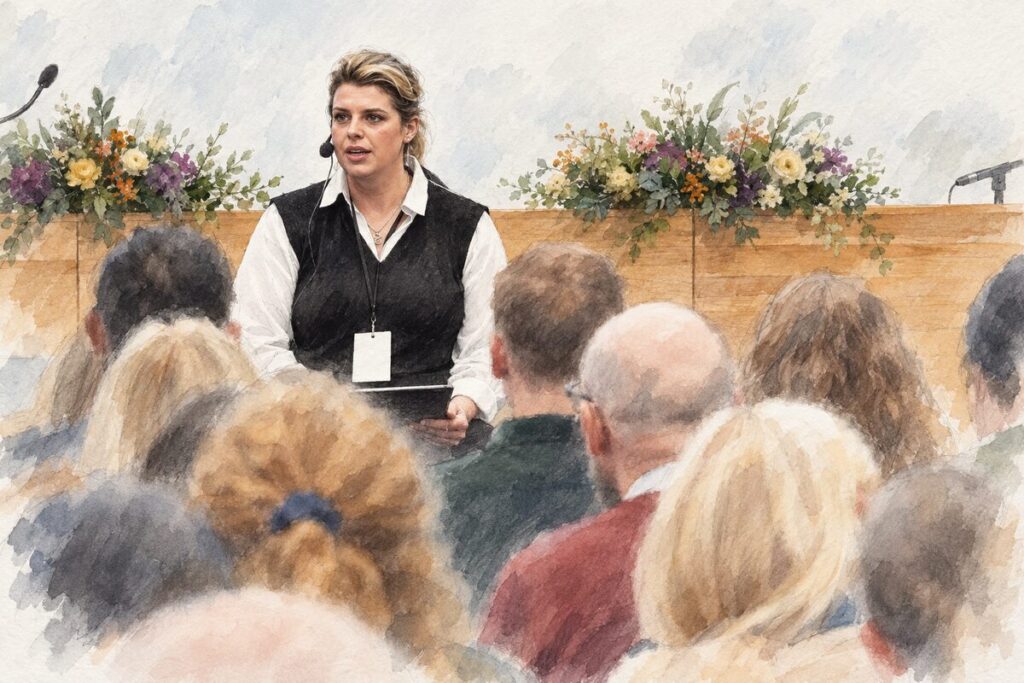
Author’s note: I delivered “A Language to Live In” as my first keynote address at the Finland-Swedish Integration Days in Tampere, Finland on 9 October 2025. Published here in my own English translation from the original Swedish, it traces the relationship between language, belonging and the institutions that shape our lives, through my journey from the United States to Sweden and eventually Åland. At its heart is a question we ask too rarely: what must a society do to deserve the people who choose to make it their home?
Introduction
My hope in coming here today is not to inspire, represent, or to be a case of successful integration. I am a human being whose story is still being written—a single star in a sky of constellations.
I came here to speak as someone who has tried to live—and raise a family—in places and languages I was not born in, but chose.
For it is not our origin that shapes us, but what we choose — and what chooses us back.
When my family moved to Åland in the middle of the pandemic in 2020, it was not to begin again, but to hold on — to a way of thinking, belonging and speaking before it slipped out of my hands.
The language I had spent two decades inside — first as an exchange student, then as a wife, mother, and finally a citizen — was never a practical choice, but rather a commitment repeated in silence, frustration, and faith.
I had no formal path — no SFI, no plan. I learned through subtitles, volunteer work, and bedtime stories — by listening, imitating, trying again.
Swedish has become a language I argue in, feel, dream in.
But most importantly: it has been a language I have failed in.
When I was seventeen, I didn’t know that my exchange year and the language I picked up would become a language of the heart. I just knew that something in it was calling me—as if I already missed it.
But a language cannot sustain a life alone. It also has to carry you back.
When I left the United States in 2013, I thought it would be enough to understand the nuances, speak well, to be just right.
I walked through many doors, yet there were rooms for which I was never given a key.
Then something withdrew—as if a place could look at you and then slowly turn its gaze. What broke was not my belief in the power of language itself, but a dawning realization that understanding the codes is never the same as being trusted with the keys.
After my talk, I hope you will take one thing with you—not answers, but a story that changes the way questions are asked.
On leaving the United States
When I left first the United States and later Sweden, the same rift emerged: faith in the system gave way to the clarity of what it could not see.
As a new mother, and later as a migrant during the pandemic, I saw how easily care and belonging became conditional— how structure forgets the human it was built to carry.
I became a mother in 2010. My husband Keith and I had done everything right— good jobs, postgraduate degrees, a condo in an expensive area. Everything that was supposed to guarantee stability.
And yet, it wasn’t enough when Allie arrived. The world had no place for the parents we wanted to be.
When Allie was three months old my parental leave ended, and Keith’s two weeks had already been used up during her first days.
Every policy and rule said the same thing: productivity first, parenthood optional. We learned to live in shifts, to measure our value in sleepless efficiency. There was no language for dependency, for the slow rhythm of an infant’s need for closeness during those tender dark hours.
Parenthood did not expand our world – but compressed it into negotiations between guilt and survival, an endurance American parents know all too well. Allie fell ill so often that ear infections threatened her hearing: she underwent surgery at eight months.
Even with saved sick leave, our employers disliked that we used it.
Then came the final straw that confirmed everything: nothing.
After Sandy Hook the laws remained the same. The unthinkable was treated as inevitable.
That was when I understood: you can love a place and still decide not to raise a child there.
The United States wasn’t merely fracturing— it had forgotten what responsibility for each other meant. Time has proven me right: from the economy to the climate and the functioning of democracy itself.
We left not in protest, but in grief— seeking a place where care was still a shared instinct rather than a private luxury.
When I thought about my exchange year, I remembered what I once knew about Sweden.
On a dream of Sweden
In our view, the Nordic countries were proof that such places existed— where equality, solidarity and trust were woven into the social fabric; where politics served as the infrastructure of a civilized society.
Not perfection, but proportion and dignity. That image— and our longing for balance—drew us across the Atlantic.
Not to be taken care of, but to belong to a society still capable of caring.
We didn’t leave to escape responsibility, but to find a place that still believed in it.
Because the opposite of dependence is not independence. It is reciprocity.
I thought I was prepared— well-educated, with a decade of professional experience, most of it at world-famous Harvard.
My Swedish was good, several acquaintances, and an unshakable faith in effort— a legacy of the American immigrant myth in which optimism, hard work, and endurance are the cardinal virtues.
In 1998 I was expected to learn a little Swedish— not master it. But I wanted to. I still do.
When I returned in the summer of 1999, I held on to the language— not out of obligation, but because it had changed me.
I couldn’t let go. It sharpened my English and gave me an emotional register I hadn’t known I lacked.
Over the years Swedish was hard to maintain, but always worth the effort.
The language became a symbol of who I could be— persistent, resilient, shaped by something greater than my origin. An effort repeated in silence, in daily life, in resistance.
A silent anchor to a year of discovery — of Sweden, of course.
But mostly of myself and the person I was still becoming.
On reality 2013–2020
I loved Sweden. I still do.
I knew the codes. I believed — with a certain quiet privilege— that I could step in easily, be enough: the ideal immigrant who blends in politely and doesn’t demand adjustment.
Not because I was better, but because I was legible.
European appearance. American origins. Native English-speaking.
I wasn’t completely naïve; I knew that Sweden wasn’t perfect.
But I thought that if I just did…said…was right — it would be fine.
I wasn’t alone in this illusion. My old host family thought so, as did my Swedish friends.
Most Swedes trust their systems: if you follow the rules, it will work out. This characterizes the whole of the Nordic region: trust (tillit)— the famous Nordic gold.
And most immigrants believed it too, at least at first. That’s why the disappointment is so heavy when reality collides with the excellent, glossy PR.
If the immigrant who seems perfect on paper — linguistically fluent, well-educated, socially competent — still becomes invisible in a system she thought she understood, what does that say about everyone else?
About those without prior knowledge, language or credentials, fleeing in the most desperate moment of their lives?
And what about those who are non-white, look visibly different, carry a foreign accent or wear a veil— for those whose otherness cannot be translated in Nordic familiarity?
I was well-educated but not credentialed in the Swedish system; experienced, but outside its workplaces.
I applied for jobs that matched my background— administration, coordination, international companies.
I was told that my education was impressive, even too impressive— but not Swedish. Meaning: worthless.
When I applied for simpler jobs, I was “overqualified.”
When I got interviews, the process almost always ended with the same casual dismissal:
“We already know someone who will fit. But you were wonderful – you’ll get the next one. Good luck!”
After a while, they didn’t even have to say it. I could hear it anyway.
And that’s the logic of cronyism— not hidden, not hostile, just habitual.
The labor market was a web of closed circles held together by trust and recognition.
The same people hired the same people— unaware of how exclusionary it becomes when similarity becomes the currency of belonging.
So much for the dream of combining motherhood and career in the land of gender equality.
Sweden prides itself on feminism— but equality that rests on recognition instead of inclusion is only cosmetic.
That became my first real education in intersectionality: In the United States, I was just a woman who became a mother, in Sweden I was primarily a foreigner.
I learned how easily even well-intentioned systems confuse justice with familiarity.
Especially if you’re neurodivergent, as I am— you notice the patterns— the same polite phrases, the repeated subtle cues.
Fluency is praised until it threatens hierarchy. Competence is welcomed until it disrupts comfort. Meritocracy collapses under its own weight.
My Swedish was admired — until it was assessed.
Accent became proof: fluency seemed to require the erasure of origin— a condition no adult can meet, as every sociolinguist knows.
At several interviews, when I mentioned that the role required English, I was told firmly,
“Our English is just as good as yours.”
The irony was painful. The same companies’ websites— which I looked over beforehand— were riddled with grammatical errors and spelling mistakes— or, worse, technically correct but lifeless. English stripped of its vitality— a small hypocrisy that said more than any diversity statement ever could.
What could one possibly say in that asymmetry?
One of the last jobs I applied for was at an English-speaking firm that also wanted fluent Swedish. I sent materials in both languages. Their written response:
“We’re looking for someone with fluent Swedish.”
No interview. Just an email, perhaps triggered by my non-Nordic surname.
I replied— in perfect Swedish— to correct the image. I never heard back.
At last, I had evidence— not suspicion, but documentation.
I contacted the Anti-Discrimination Bureau for the first time. On the phone with two other immigrant women, we laughed until we cried. The entire conversation was in Swedish — the language the company claimed I lacked. The absurdity was complete.
Then, the company replied that they had hired internally and that the email had been sent by mistake. Förlåt.
Sure. Okay. The case stopped there— how could I prove otherwise?
My husband Keith’s story was the mirror image of mine. He arrived during the golden age of software development, when English alone opened every door. One company offered a Swedish course at lunch, but SFI classes were full-time, daytime — an impossible setup that makes language learning impossible or cruel for full-time working parents of small children.
He didn’t avoid Swedish — the structure avoided him.
When the tech sector collapsed in 2023, only the foreign staff were allowed to go — the Scotsman, the Dane, the Filipino, and him.
Recognition survived where difference died.
In IT, everyone is expected eventually to move into management. But management happens in Swedish, because that’s what the CEO prefers
The same system that once hired him for his English later used the same English to hold him back.
And when he finally found a new job this year, my position was cut three days later.
Stability lasted only long enough to bridge his unemployment.
Security has always been fleeting—enough to survive, never to build anything that endures.
Our rhythm for over a decade: as soon as one leg heals, the other breaks.
He still struggles with Swedish.
Systems rarely fail by accident; they fail by design.
By convenience, habit, from the tacit assumption that inclusion will happen on its own.
But inclusion that must be earned again and again is not inclusion at all.
Integration has become a dance where you do everything right in systems that reward likeness and call it trust. Trust is demanded, yet seldom earned. Meanwhile goodwill and human potential are constantly squandered.
The system speaks its own dialect — polite, logical, seemingly fair — while simultaneously silently deciding who belongs:
“We’re impressed… but we already know someone who’ll fit.”
“Fit.” That small, slippery word that explains both everything and nothing.
The same networks recycle, the same people rehire each other. Similarity becomes safety. Recognition replaces innovation — sometimes even competence. Exclusion protects itself not through malice – but through habit.
There are no villains twirling moustaches. No one has to mean it. They just have to repeat it.
Language, I realized, is part of that architecture.
It is never just about words, but the way a society scripts its own story from within.
And when the imagination is narrow, so is the belonging.
For migrants, language is on our checklist, but they who have it as their mother tongue carry far more than native grammar — they possess the authority of interpretation.
And those on the inside, who own both the language and the story, decide who gets to stay.
Swedish is beautiful. But language is never just language.
Systems love the sound of diversity. But rarely do they change their structure to make room for it
I was never outright excluded — just never fully invited in. Trusted enough to contribute, never enough to decide.
Neither a threat nor a threshold.
On carrying the weight of a country with a megaphone
To come from a country with a megaphone is its own burden.
The United States. Russia. China. Nations that fill every room with their volume.
You don’t arrive as a stranger, but as projection – a walking emissary of your homeland.
People think they already know you; after all, they’ve seen your country on TV!
I was rarely asked “Where are you from?” out of curiosity — only as a social marker.
I was good for practicing English, an informal interpreter — the accidental representative of a place I had already left with sacrifice and patience.
Everyone assumes that proximity equals understanding: they think they know you because they’ve eaten hamburgers, watched Netflix, or visited New York once.
There is no space left for complexity or belonging — only projection, admiration, resentment, often all at once.
That’s what we from “loud” countries share: we become symbols for noise we didn’t create — though we aren’t entirely innocent of it either.
Yet I think of others who carry that noise in other ways: Russians who fled to Finland and meet suspicion; my mother-in-law, who left Poland as a shy thirteen-year-old during the Cold War, only to be doubted and mocked.
To flee and still be seen as the system you escaped is a quiet form of violence.
I, on the other hand, was never dangerous — just a curiosity. I had the right signals, never the right place.
That too is privilege: to be aestheticised rather than questioned.
I was consumed as an image, seldom engaged as a voice.
During the pandemic
From that vantage point, I began to observe how belonging really works.
If Sweden didn’t want to acknowledge what I already knew, I had to learn the game in order to change it.
In 2017, I began my master’s degree in political science. The year before, Matilda had been born. I gave her a name that carried my hope: strength in battle.
When I held her in the early morning of November 9, 2016, my home country had just chosen the worst in itself.
What was I to say to Allie, who was sleeping deeply and thought would wake up to the news of the first female president of the United States?
The only way to endure was to turn grief into something serviceable—to show my daughters the art of transforming heartbreak into study: to understand power and its language.
When the program ended in 2019, an old dream came true — I became a Swedish citizen, after having pursued a court case that forced the state to follow its own law.
The irony was brutal: immigrants are portrayed as lawless, but often it is we are the ones who make the law keep its promises.
The moment was not a victory, just a step on its knees.
“One of us now.” On paper, yes. In practice, not really.
But hope—the stubborn remnant of American optimism—refused to die. I thought that the next year would be mine. They say that it takes seven years to reach one’s level.
And then came 2020.
Suddenly, I felt dumber in Swedish than in English — not because the words were missing, but because the space for questioning had disappeared. Trust and obedience had begun to merge. Asking questions was seen as disloyalty.
Friends were harassed simply for existing while wearing face masks. A Chinese-American friend no longer dared to take the subway; “go back to China”, a country she had never even visited. Even more absurd: my French— even Gallic— friend was told the same thing.
Racism has never been intelligent— only frightened.
I myself was threatened—just for wearing a face mask while shopping for groceries with little Matilda.
So the world of immigrants’ shrank. We sent my husband to shop instead — in gender-equal Sweden.
The air of calm civility had sharp edges. We existed with clenched jaws.
And then Allie, ten years old, in the middle of evaluating her for a heart defect and wiser than all of us, said:
“I want to leave.”
Not out of fear, but out of clarity. She saw that washing hands until they bled was theatre.
I refused to teach her to betray her own observation in exchange for comfort.
Nor the science, which the rest of the world already followed: that the virus was airborne — something Sweden finally acknowledged in 2022, with an admission quietly added on a government website.
On daring to begin again
All I had left was my name, my integrity, and the language I wanted to keep.
We began a search, but every option required a new language. After seven years outside the labor market and two small children, it felt impossible to postpone life any longer.
In the middle of everything, a message came from a new friend online:
“Have you considered Åland?” — where she herself had moved two years earlier.
I had only been there once—ten minutes, to change boats.
If Sweden had lost its balance — would Swedish-speaking Åland have kept it, shaped by survival instinct rather than spectacle?
Åland was probably not perfect either. (It isn’t.) But it offered a new perspective.
Language remained the thread I had followed for two decades — connecting me to who I had been and who I was becoming.
6 August 2020. On the Rosella, I stood on deck, mask tight against my face, and watched Sweden disappear in the fog—poetically, almost exactly 22 years after I first arrived, enchanted under the same gray sky.
But here I didn’t feel brave, only shocked. Once again in exile — by my own choice.
Yet it felt like staying loyal to what could still be true: myself.
Listen – courage can be still, even tender.
An hour after we arrived at the home she had found for us—two strangers—the doorbell rang.
Neighbors had left bread, cheese and cider on the stairs — nothing intrusive, only everyday vigilance.
Small gestures that showed it mattered that we had come, that we existed.
Soon I noticed that Swedish felt different — not in grammar, but in spirit.
The Ålanders immediately spoke about what I could contribute, what was needed.
“We need people.” (I have always admired Åland’s directness.)
The first few months were simple motion: the store, the post office, small errands. Gradually, a new world took shape around the repetitions.
And somewhere in this unannounced departure, exile transformed into another homecoming—not built on permission but on a promise:
to hold on to trust—not to the systems, but to proportion,
to put one’s foot down where honesty can still take root, even in red granite.
And in the middle of it all, barely eleven months after our arrival in Mariehamn, life turned a page:
I was expecting — not one, but two, identical twin boys.
I laughed. I cried.
I surrendered to something I hadn’t chosen — but that had chosen me.
The pandemic erased the final opportunity of stable employment and proper parental leave.
At forty, it felt as if life said: “You listened? Here, have a little more reality.”
I had wanted a third child — but not this doubling of risk and wonder.
Then came months in hospital in Turku.
There, with lives at stake, there was no language to lean on—not my Swedish, not anyone else’s.
No hostility, only a silent hierarchy: Finnish first, English second, Swedish on the margins.
There I understood something: that a Swedish-speaking immigrant and a Swedish-speaking Finn meet the same limit when the system has no language to answer in.
It was not just my loneliness, but a shared vulnerability that all linguistic minorities recognize in crisis.
Thank goodness for English. But if it wasn’t my mother tongue — then what?
The same English that denied me belonging outside those walls protected me within them.
Language again — bearing both obstacles and bridges.
On speaking oneself in and chosing to stay
I have lived half my adult life abroad — in Swedish.
Another master’s degree, a new citizenship — perhaps a third soon.
Four children born in three different countries.
When the crisis ebbed in 2022, I began to speak again — not the Swedish that had been questioned, but the Swedish that first gave me a place.
Did you know — three years ago I was completely unknown on Åland? Even by the end of 2023, known by very few.
But I wrote, I volunteered, I stepped into the light.
I made a rule for myself: always say yes — even when it frightened me. Especially when it frightened me.
Like today, my first keynote.
I was seen when I stopped trying to prove myself — and instead tried to contribute with the wisdom I had carried, both from the margins and the middle.
The seam is the place everyone passes — but where few remain, because few can live in uncertainty without promises.
As neurodivergent — like my husband and our children – we see the weave — how everything is connected in its complex tapestry.
To put that into words is not to pathologize difference, but to demand that inclusion be shaped by reality, not simplicity.
There are so many of us who stay—not because we were invited, but because we refuse to abandon the idea that this place is ours too.
The art of saying yes, even in doubt, became a civic mission—a voice I have earned and do not intend to give back.
Our presence is often seen as temporary, as a burden, as a demand.
But what if that presence is the glue that holds our society together?
Integration is not becoming like the majority.
What we call integration is most often a map drawn by those who have never crossed anything themselves.
No — integration is not a gift, but rather a democratic task for the society we create together.
And when the system falls silent, it is those who have lived in the cracks who carry it further.
Those who can read the emptiness, translate the unspoken, join corners that do not meet. They’ve always been the ones who shape the future – even through resistance.
This is not sentiment, but competence: design intelligence shaped by survival, experience, and resilience.
We are human beings first. Not symbols. Nor exceptions. We don’t carry the statistics of the future — we carry the truths of the present. And the potential for what we can become — together.
Here — my offering, my art.
Flourishing is no endpoint, but a series of clearings in the forest: moments when the systems open, the language carries, and someone says:
“I hear you. And what you say changes what I do.”
So I ask the question as we begin our work today:
What does it take for a society to not only accept — but to truly deserve us, and itself?
This is how social capacity is built. The inner human capacity — the only growth that can save both humanity and society — is what we must now turn toward.
The future is not shaped by fixed principles, but by movement, by listening and the courage to speak oneself in — and stay.
The Swedish language brought me here today, to Åland and to the Finland-Swedish Integration Days.
Because it was a way to stay and continue. But it was exile that taught me to observe, to listen, endure—and finally, to engage.
And my life’s task is to make these two acts — to speak and to stay — carry the same meaning.
Thank you.
Comments