

What does safety mean on a planet in crisis?
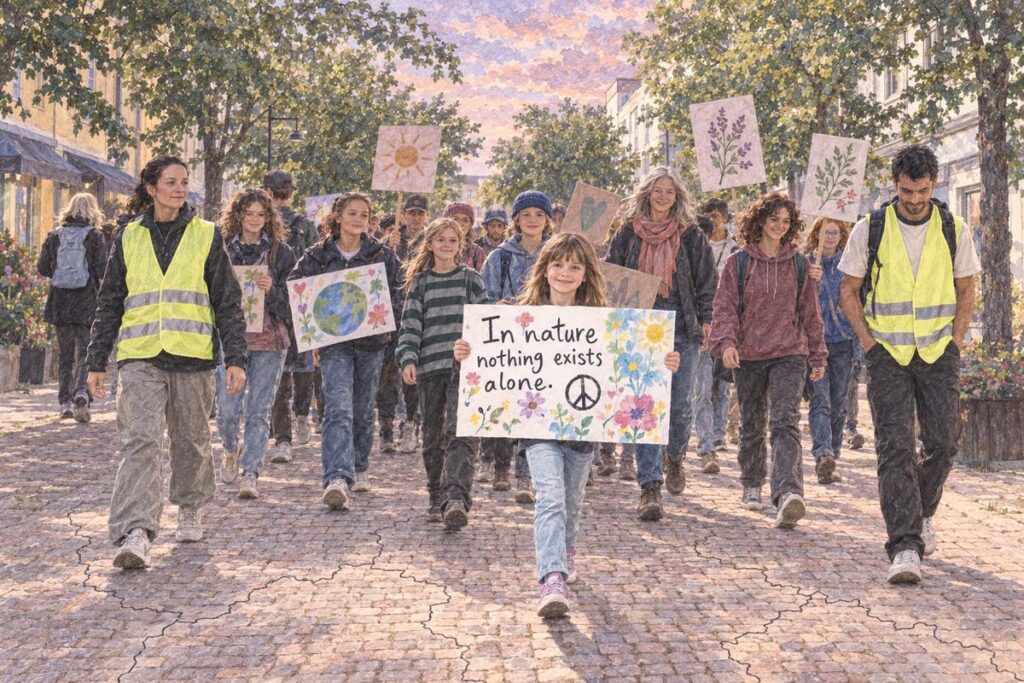
Author’s note: I delivered this speech at a climate march on Åland on 23 August 2025, as chair of Ålands Natur och Miljö. The year’s theme was “Safety Beyond Borders.” My address explored what safety means when ecological breakdown crosses national boundaries, while protection remains so unevenly distributed.
My name is Alyssa, and I’m speaking as the chair of Åland’s Natur och Miljö.
Today, I stand here with deep gratitude—both for the land beneath our feet, and for every person who made the journey to be here.
Most of you crossed seas.
All of you crossed comfort.
Åland is a unique place. It’s demilitarised, self-governed, and committed to peace. A place that continually reminds us that safety can be something we build—not through force, but through cooperation, care, and responsibility shared across borders.
This is what “Safety Beyond Borders” means: not just the absence of danger, but the presence of dignity. A deeper sense of belonging that doesn’t depend on passports or privilege—but on the mutual recognition that we share one planet, one future, one fragile ecology.
I don’t know what this week will change. But I do know who is changing it.
You are.
By realizing that the most radical thing we can do is to care more deeply than the systems expect, you are already shaping what a sustainable planet can look like.
And looking around, I don’t just see a gathering—I see resolve. I see cross-border courage.
You’ve come prepared—not just to speak, but to listen.
Not just to protest, but to contribute.
To meet politicians not just with noise, but with knowledge.
This is the kind of power that lasts.
As an immigrant on Åland, “Safety Beyond Borders” is deeply personal. It’s a truth I live with.
That means no one is safe unless everyone is.
That means safety can’t be gated, hoarded, or sold.
That means ecological safety, social safety, and climate justice are inseparable.
Here—where the water and wind remind us of our interdependence—this isn’t theoretical.
It’s life.
Fires don’t stop at national lines. Rising seas don’t respect fences. Pollution, fear, war—they move freely, while too many of our protections do not.
And if we treat safety as a privilege of place or wealth, we fail both the Earth and each other.
Because every ecological crisis is also a human one—and the only safety that is worth building is shared: rooted in cooperation, and not competition.
We live in a time of storms. Yet many still believe that inaction is neutral.
It isn’t. It is a choice—with consequences.
True leadership means knowing when the house is on fire—not cosplaying prudence while rearranging the furniture.
And the Earth does not need neutrality. She needs guardians. Stewards. Love with a backbone.
Mother Earth’s story still holds; that when we treat nature as separate, every wound we inflict returns to us—not as punishment, but as simple truth.
We cannot restore ecosystems with the same disconnection that destroyed them.
And yet too many leaders treat regeneration like it’s a strategy.
It isn’t!
Regeneration is a way of being. Not just mending what’s broken—but becoming people who know how to protect what still holds.
Sustainability has never only been about the world we build—it’s about the people we become while we are building it.
And today, after marching together, you’ve shown what that becoming looks like. You show that democracy is not just a vote—it’s your voices, your steps, your insistence that delay is betrayal and silence is complicity.
Because when leaders ignore the science, they don’t just fail the climate.
They fail democracy itself.
What good is a promise if it’s never kept? What good is a system if it shelters the powerful and leaves you–our most vital commons–exposed?
Nothing could give me more hope than looking out and seeing you.
Because you are not just the future.
You are living, breathing proof that care exists today. Our most precious resource.
And in crossing seas and borders, you’ve woven your identities together. This is what regeneration looks like—not a buzzword, but a shared practice.
So, as you gather, remember:
To inherit a planet is not to receive it.
It is to be changed by the responsibility of holding it.
And for holding it with care, we thank you.
Comments