


On Åland, the ideas and stories we dismiss as “flummiga”, and our common future that cannot wait for certainty.
Åland has a great deal of knowledge. But it also needs a more serious conversation about the limits of what it knows. Every place knows something the rest of the world could learn from. No place knows enough to stop learning. Åland is no exception to either.
In a small society such as Åland, familiarity carries considerable authority. We know the names, the institutions, the histories. We know who has held which position, who usually gets things done, and which explanation will be readily understood around a particular table. That familiarity can make cooperation possible. It can also make a room feel much larger than it is.
Over time I have repeatedly noted that the people in it may begin to mistake the boundaries of their shared experience for the boundaries of a reasonable world.
On Åland, we tend to have the same efficient little words for what arrives from outside those boundaries.
Fluffigt. Flummigt. Abstrakt.
The first suggests something airy, padded, lacking weight. The second suggests something hazy, imprecise, perhaps faintly ridiculous. In conversation, either can spare the speaker considerable work, which I note seems to be precisely the political point for their invocation. An idea that might otherwise require reading, interpretation or a difficult question can be waved away before anyone has established what it actually asks of us.
Sometimes a proposal is truly poorly reasoned. Sometimes beautiful language conceals an empty room. Then we should be able to identify the missing argument, the unsupported claim, the distance between the promise and the practice. That work gives criticism its substance.
But there is a particular kind of rather depressing dismissal that attaches itself to anything involving meaning, imagination, belonging, trust or the stories through which people understand their lives. These things can sound insufficiently solid beside a budget line. They are difficult to hold still. They resist being reduced to a deliverable with a neat box beside it.
But the very hard research shows us that their consequences are solid enough. Trust can determine whether people cooperate. Belonging can affect whether they stay. A sense of injustice can make a technically competent policy politically impossible. A shared story about who we are can sustain a community through hardship, or persuade it to exclude the very people whose knowledge it needs.
It is also rather easy to call these things soft when someone else outside the room has to live with the consequences of their absence.
I also note that our patience with vagueness is interestingly uneven. Words such as “efficiency”, “competitiveness” and “growth” can pass through a room with their seriousness already assured. Yet each requires questions of its own. Efficient at doing what? Competitive on whose terms? Growth that improves whose life, and at whose expense? The familiar abstractions deserve the same intellectual scrutiny as unfamiliar ones.
Here I must regret to inform you that a word does not become concrete by acquiring a place in a government programme.
So I think Åland needs to examine what it dismisses, and why. Sustainable development offers one example. But I also observe that this habit reaches much further to pretty much nearly everything we do here.
On 24 April, I saw a public post from Harvard’s Human Flourishing Program announcing the forthcoming release of a white paper connected to the Everyone Can Flourish work. It was this announcement on LinkedIn that prompted me to write Micke Larsson to ask about the publication, to which I had contributed alongside others. I received no response to that inquiry. It claims:
The small autonomous region in Finland is the first to build a public framework explicitly around human flourishing—for the world.
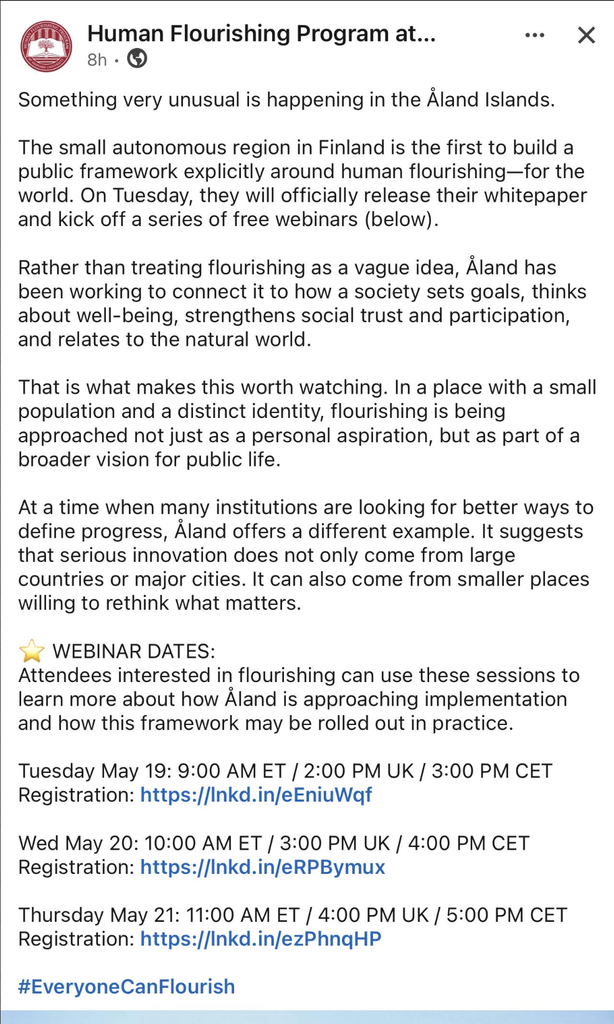
It then explained what it found significant:
Rather than treating flourishing as a vague idea, Åland has been working to connect it to how a society sets goals, thinks about well-being, strengthens social trust and participation, and relates to the natural world.
It also described flourishing as part of “a broader vision for public life”, and saw an opportunity for serious innovation in smaller places willing to rethink what matters.
Those are demanding questions. A society can measure economic activity while struggling to explain what that activity is meant to make possible. It can adopt environmental targets while failing to understand what would give people the trust, security or sense of common purpose needed to pursue them. It can become very accomplished at administering the arrangements it has inherited, while losing the ability to ask whether those arrangements serve the lives people are actually trying to live.
There is serious emerging intellectual work in connecting these questions, even here in the Nordics. My own interest focuses primarily on both inner and existential sustainability. Inner sustainability concerns the capacities and orientations we cultivate within ourselves: self-awareness, an ability to reflect, a sense of purpose, stable values and our ways of relating with each other and the world. Existential sustainability asks how the conditions of our shared world sustain or undermine meaning, dignity, belonging and the possibility of a future worth participating in. Familiarity with a budget does not, by itself, equip someone to dismiss it as silly.
Political and administrative authority bring the responsibility to recognise when a question requires expertise beyond one’s own. Holding office does not make the boundaries of one’s expertise disappear. A seat on the Development and Sustainability Council held by virtue of office carries a responsibility to understand what one is there to contribute, where one’s competence and remit might end, and when to listen instead.
Access to the room is not the mastery of everything discussed in it.
Any serious challenge should engage those reasons fairly and fully, assessing the work against its stated purpose, intended audience and the context in which it is meant to be used. It should compare like with like, explain the grounds for disagreement, and recognise where the limits of the critic’s own knowledge require a question rather than a quick verdict. Sadly, this is where the culture here repeatedly fails us. The cost reaches into almost every area of life on Åland, and falls hardest on those with the least power to change it.
Any broader criticism of Åland’s sustainability work deserves the same care. In a reservation dated 21 May 2026, Wille Valve criticised excessive international profiling, process work and “story telling”, arguing that the public should see concrete results. He also raised questions about accountability and the visibility of costs.
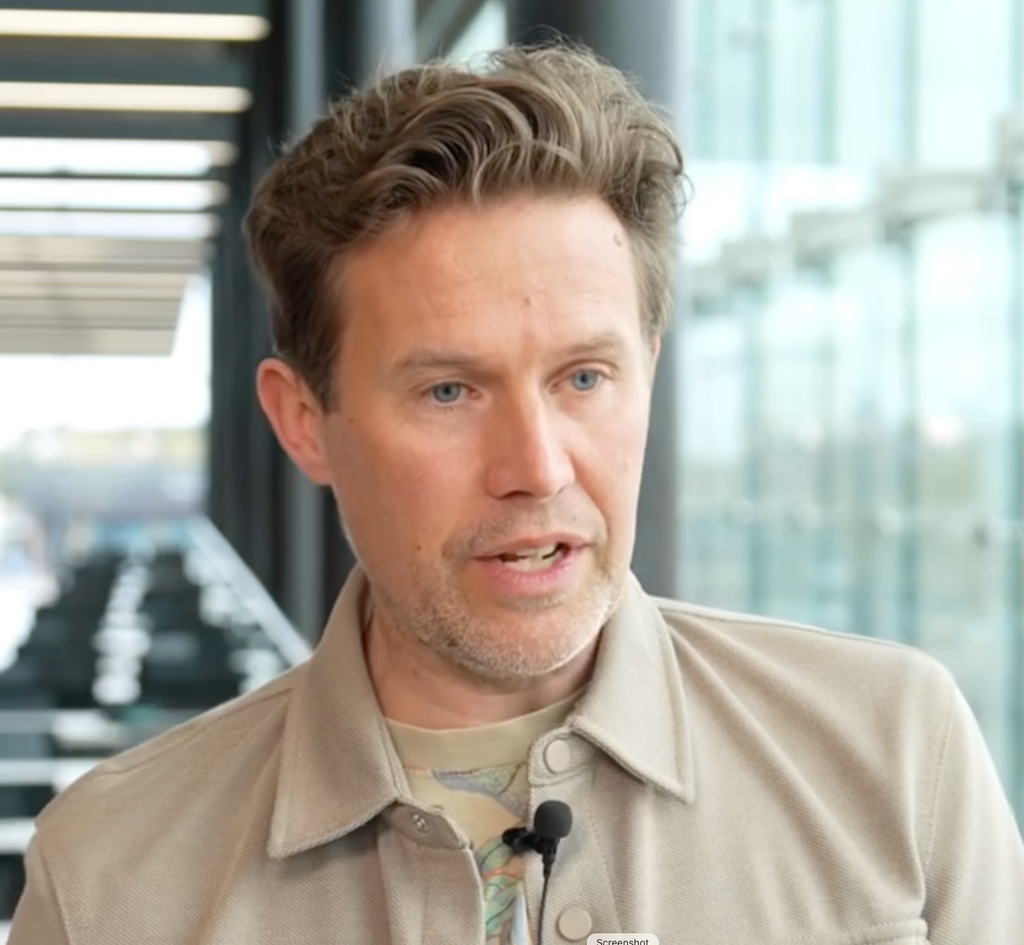
This video, still available on the social media channels of Harvard’s Human Flourishing Program, borrows the moral weight of other people’s hardship and spends it on Åland’s reputation. Children beside a tent, barbed wire and flooded homes establish the gravity of the world’s problems. Micke Larsson then supplies the interpretation and the proposed direction. Other people provide the suffering. Åland provides the wisdom. That is an extraordinary hierarchy to smuggle into a message about human flourishing.
Like many others in Åland’s political class, I found it in appallingly poor taste. The apparent lack of awareness of how it comes across only makes it worse.
The people pictured are visible, but their knowledge is absent. We hear nothing about what they need, what they have already built, or what they might teach us. Their lives become illustrations in somebody else’s account of what the world requires. This is precisely the paternalism, or “white saviourism”, that international collaboration should be capable of recognising in itself. I was stunned into silence that UN-Habitat allowed this to run. Given its work in post-colonial contexts, they absolutely should have known better.
Meanwhile, the “very concrete governance model” remains remarkably difficult to see in this video or the subsequent webinars that Harvard’s Human Flourishing Program hosted in mid-May. We are told that it translates a vision into practical policymaking.
Show us, Micke. Put the camera in front of the collective of Ålanders who have been doing the work for the last ten years. Ask what they have changed, what has failed, and which institutional bottlenecks hold them back. Put people from UN-Habitat on camera too. Ask what they have actually learned here, what they would adapt, and what they would challenge.
Their collective testimony would give the account a credibility that institutional self-promotion cannot supply. It would give us something to examine, question and learn from, including perspectives that might challenge the official account. Sharing the authority to tell the story is therefore a matter of substance: the audience needs access to the knowledge behind the claims. Holding a paid position gives someone responsibilities within a collective endeavour. It does not make that person the collective endeavour.
We already know how that went.
Over two words required by Finnish law. My first name. My last name.
On just my own contribution.
Now, the obvious defence is that this is a promotional film: its purpose is to generate interest, while the publication supplies the detail. Of course. Nobody expects the entire framework in two minutes. But brevity does not decide who gets to speak. That is an editorial choice. The same running time could have introduced the people doing the work, allowed an international partner to explain its significance, and given the audience a reason to believe the claims beyond the confidence with which they are delivered.
Instead, the collective endeavour is presented through a central spokesperson, while other people furnish its emotional weight. Flourishing is the subject. Prestige and hierarchy becomes the obvious organising principle, which is one primary reason I believe we have been struggling for some time with serious trust issues around sustainability on Åland.
So Ledamot Valve’s questions do have real substance, even if we generally share different political ideologies. I share his insistence on concrete results, visible costs and clear accountability. Public money and public promises require an account of what they produce. The work associated with Bärkraft and the Utvecklings- och hållbarhetsagenda för Åland must be open to that scrutiny.
I agree with him that the way this work is organised and delineated also needs serious review. For a start, I feel there are too many bottlenecks, too many opportunities for work to be delayed or blocked by people insufficiently familiar with its substance. The power to stop something should carry at least as much responsibility as the ambition to start it. Those exercising that power should be able to explain what they have understood, why they object, and what the consequences of their decision will be. Accountability must also include the decisions that prevent results, as well as the projects expected to deliver them.
My own personal experience gives me particularly strong reasons to insist that the values an institution announces should be visible in how it behaves or what it puts on video. One would think this was simple common sense rather than controversial.
But here we are.
That same demand for accountability gives us a useful standard for judging storytelling. Does a narrative explain what happened, what changed, what failed and what someone else could learn? Does it make the relationship between public promises and lived experience easier to examine? Or does it merely make an institution or an official try to look good?
A story that reveals how a result was achieved can make practical knowledge available to others. A story that conceals the absence of results deserves precisely the scrutiny Valve is calling for. We should expect storytelling to earn its place by what it helps people understand and do. We should not reject storytelling as a method which has a strong evidence basis in how human beings understand and make sense of their world.
The urgency of the discussion is written into the date: 2030.
The UN’s 2026 assessment found that, among 139 Sustainable Development Goal targets with trend data, 36 per cent were on track or making moderate progress. Forty-nine per cent were advancing too slowly, and 15 per cent had fallen below their 2015 baselines. The report identifies conflict, climate change, slowing economic growth, rising debt and declining development assistance as major obstacles. It also points to an annual SDG financing gap of approximately four trillion US dollars.
Ledamot Valve is also 100% right that people cannot narrate their way out of a destroyed ecosystem, a polluted Baltic Sea, or a national budget consumed by debt. Material conditions, political choices and the availability and distribution of resources must be carefully considered. The same UN assessment records substantial gains in access to water, electricity and health care. There is knowledge worth using, investment worth expanding, and work already saving lives.
Yet the distance between knowing what is needed and making it happen remains immense. Knowledge does not allocate resources. Agreement on a goal does not settle who must do what, who pays, or who bears the cost of waiting. Institutions have to cooperate. People have to trust that the burdens are fairly shared, that promises mean something, and that the future being proposed contains a place for them. That distance is where the work happens. It is also the exact place where the story should begin.
My specific concern and research focus is with that distance. An agenda can be translated into indicators and still fail to become a shared undertaking. A goal can appear in every official document while remaining absent from the decisions that organise ordinary life.
The connections between goals also have to survive the institutions assigned to pursue them. Housing, health, transport, education and the environment meet in the same human life, however many departments divide responsibility for them. A gain recorded in one column may carry a cost in another. A long-term commitment may repeatedly lose to an immediate political advantage. We need ways of seeing those relationships and making responsibility for them harder to pass along.
When that happens, another document in the same language may reproduce the same distance.
Instead, we have to humbly ask what would help people cross it.
One answer is to become more willing to learn while acting. If we insist that an unfamiliar approach must be completely tested, universally approved and certain to succeed before anyone may try it or share it, we have created a condition that nearly all social innovation can simply never meet. Some of the knowledge we demand can only be produced through the experiment we are refusing to permit. We have to be willing to experiment some.
“No risk, no reward” as we Americans like to say.
At that point, “not yet” becomes a very respectable way of saying never.
The calendar continues regardless. A child grows up while a service waits to be redesigned. A community loses people while its future is under consideration. Ecological damage accumulates while the terms of the next evaluation are agreed. Delay has effects of its own, even when those effects fall outside the project budget.
We all know that the current arrangement is also producing results. Unfortunately, some of them are the problems we are supposed to be solving. It is remarkable how many politicians I see who do not want to do anything different or new, but give the failures of the current system a total pass and interpret its victims as unavoidable collateral damage.
We need to try things at an Åland-respectful scale that allows us to learn, with the people affected involved in shaping the attempt. We need clear questions, honest observation, resources to follow through, and the willingness to change direction. We need to share what worked, what worked only partly, what failed, and the conditions surrounding each result.
That is how evidence grows and useful approaches become lasting practice, instead of remaining promising little pilots in a chronic case of project-itis: the wheels keep spinning, the bills keep coming, and we get absolutely fucking nowhere.
UNDP’s Accelerator Labs describe an approach to international learning built around locally chosen problems, experiments and the comparison of experience across countries. That local scale is why UN-Habitat took such interest in Åland in the first place. Their work includes asking what should be tested further, adapted to another context, tried at a different scale or combined with something else. Learning travels in several directions. Local knowledge helps shape the questions.
That is a far more useful understanding of international collaboration than a procession of places announcing that they have already solved everything.
It should be considered that what has worked somewhat on Åland might work remarkably better somewhere else. A method may encounter an institutional obstacle here that is absent there. A concept that struggles to find a public language in one setting may connect with an established practice in another. A community elsewhere may recognise something we have overlooked and show us how to develop it. Our partial success may become part of their breakthrough. Their experience may then change what becomes possible here.
To discover that, we have to share the unfinished work honestly and in good faith.
We also have to learn what travels and what depends on place. People may share a need for dignity, belonging and a future they can believe in while differing profoundly in how those needs are expressed. Comparing those commonalities and differences is part of the work. It allows an idea to be examined, adapted and made useful by people who understand their own circumstances.
A requirement that Åland achieve near-perfection before contributing anything would make international cooperation available only to places that no longer needed it.
In the now-cancelled UN-Habitat publication, my personal contribution detailed the philosophical and conceptual foundations connecting flourishing, governance and practical change, drawing on accepted scholarship to make those connections useful beyond Åland. Localisation in my meaning meant helping communities interpret shared concerns through their own cultures, institutional meaning and circumstances, not just the shape of their governmental structures or their technical status. This theme dominated the ECF social media campaign that the United Nations removed on or around 11 May. The relationships between wellbeing, public purpose, trust and participation highlighted in Harvard’s announcement were absolutely central to that work.
Having the UN-Habitat simply reproduce Åland’s Voluntary Local Review, our VLR, would not have fulfilled that purpose. Publishing the same document twice would hardly double its usefulness, but rather be terrific waste. A review can document progress, expose gaps and support learning. My specific 2025 contribution closely addressed how the underlying ideas fit together on an inner and existential level and how communities elsewhere could make them their own.
The reader elsewhere has a life, a history and a problem to solve. A publication has to give that reader a way into the work.
The UN consultant praised and confirmed in writing that she had used the work as late as March 2026, just over one month before the planned publication date. In the spring of 2024, I helped edit the language of the VLR and received the proportional recognition for the work in the VLR. In 2025, I authored a body of work largely on my own initiative and suddenly proportional credit became a problem. Regardless, the incorporation of what I wrote into a collaboration between the Government of Åland and UN-Habitat did not extinguish my authorship or the rights attached to it under Finland’s Copyright Act.
It is not just a lost opportunity for me, but perhaps another kind of loss from a storytelling perspective. An account of how a community or a migrant understood a difficulty, who became involved where trust broke down and what eventually helped can make a result or a product intelligible and incredibly powerful. It can show another community what to examine in its own circumstances. It can carry knowledge of relationships and sequence that a result alone cannot convey. It can even admit the existence of people in a society who have made an especial effort or contributed in a unique way, and thus, inspire others to action.
The UN’s own statistical work recognises this. Alongside its 2026 SDG report, it publishes a collection of success stories showing how local actions, national policies and partnerships change people’s lives. The accompanying explanation explicitly describes the narratives as going beyond statistics to illuminate pathways of progress.
That is one of the best things storytelling does. We can make room for both the number and the human account of how it changed, can we not? If not, why not?
We understand the force of stories perfectly well when they are our own. On Åland, we tell stories about the sea, autonomy, language, endurance and peace. These stories help us understand what deserves protection and what we owe to one another. They very obviously influence the political choices and the rhetoric we use here. They give institutions an emotional and moral life that their financial spreadsheets and organisational charts could never, ever supply.
Other communities are entitled to the same depth and our listening ears so that our wisdom is shared wisdom.
Here is one example that distinguishes the Nordic countries from the rest of the world. According to Pew Research Center’s 2025 study, 75.8 per cent of the world’s population identified with a religion in 2020. For many people, faith and cultural traditions help shape obligations, collective identity and relationships with the natural world. Development takes place within that human reality. The UN has been addressing this for years. UNFPA’s Reaching Common Ground: Culture, Gender and Human Rights treats cultural understanding as essential to development and to advancing rights, including women’s rights. UNEP’s Faith for Earth initiative works with religious organisations towards the sustainability goals.
A secular public institution can engage that reality while retaining its commitment to equal rights and freedom of conscience. It also needs to recognise that a secular Nordic perspective has a cultural location of its own.
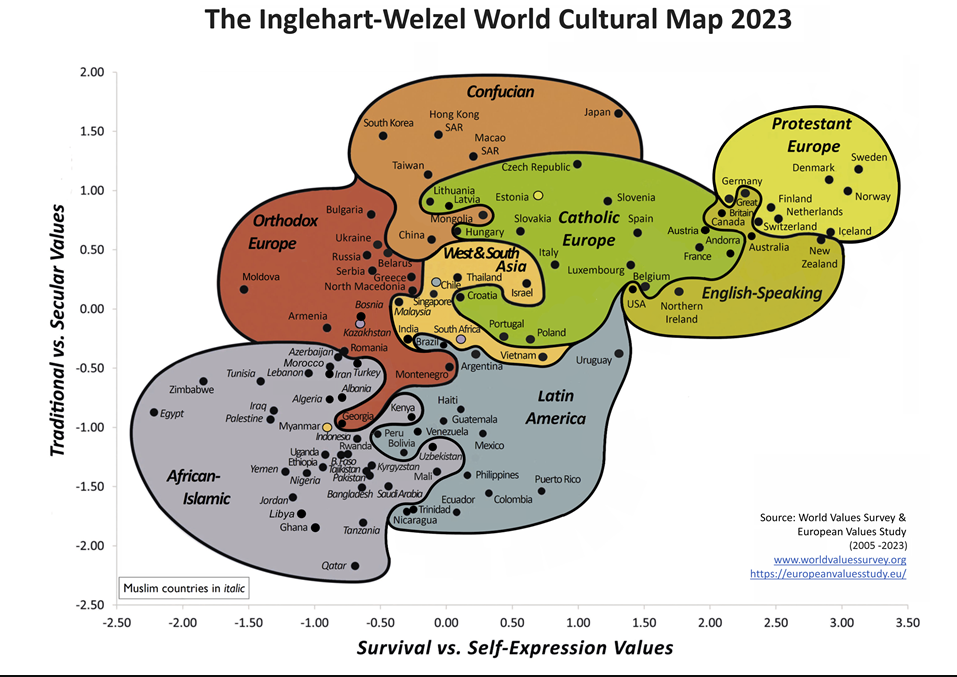
We become very poor participants in a global discussion when we treat our cultural location as the obvious benchmark for everyone else’s maturity. Nor does such a perspective speak for everyone on Åland, native or newcomer. For a start, those who move here bring cultural beliefs and practices of their own; they do not arrive as blank pages for us to fill. We can start by greeting them with respect and by demonstrating our intelligence by way of basic curiousity. I, for one, find it curious how quickly some advocates of small government discover its eagerness to issue rather controlling judgments when someone else’s beliefs enter the room.
What’s more, this should be particularly intelligible here. Åland’s very autonomy rests on the significance of a distinctive language, history, culture and way of organising public life. We understand why institutions must take a community’s identity seriously. The principle travels beyond our own shores.
It also asks something of us at home.
Consider a school encountering a child whose way of attending, learning or responding to the environment falls outside its expectations. The institution has knowledge of teaching. The child and family have knowledge of the life being lived. If the familiar classroom arrangement remains unquestionable, all the explanatory work falls on the child. The possibility that the arrangement should change may never receive a fair hearing. It often does not.
Or consider integration. A person arriving in Åland may need to learn the language and understand local institutions. That person also arrives with knowledge. A society that sees newcomers principally as people who must be taught how things work can miss what they are capable of teaching it. I want to say that I am capable of contributing a lot of hard-earned wisdom from many places, as are other newcomers here. We want to help, but we need you to listen. Instead, our participation becomes conditional on fitting into a conversation whose terms were settled long before we entered the room.
This is where epistemic humility becomes a question of power.
Who is permitted to explain what is happening? Whose uncertainty is treated as responsible caution, and whose as incompetence? Who can make a sweeping judgment and have it received as common sense? Who must arrive carrying a small archive merely to establish that their experience deserves consideration?
I might know something about that.
A confident dismissal can protect a room from the discomfort of learning, which is precisely why it works with worried voters in uncertain times. An adjective does the work of an argument. Everyone can proceed to the next item on the agenda.
But outside the room, the problem continues. There are days it breaks my heart to see it.
Epistemic humility requires us to explain the limits of our knowledge, give reasons for our objections and identify what evidence would change our minds. It asks us to take unfamiliar ideas seriously enough to examine them. It asks the person proposing an idea to make it available for scrutiny, and the person receiving it to bring more than the authority of their position.
For Åland, the stakes include our very ability to renew ourselves. Small societies can sustain remarkable trust and cooperation. They can also make the social cost of disagreement unusually intimate. We must retain the closeness that helps us care for one another while creating enough intellectual space to question what we have come to take for granted.
Some of the work we most need begins before we know what to call it, how to measure it, or whether it will succeed. It begins with someone noticing what is missing and finding a way to make it visible.
I tried to explain that absence at my job when I worked at the Government of Åland. When I could not make myself understood in the autumn of 2024, I then used my own time between appointments to create the work so I could show what I meant. What had been so difficult to understand then became useful enough to take, while my authorship became too inconvenient to acknowledge. And, what had been a pretty pleasant workplace, suddenly was not.
Until I stopped it in 2026. I won’t have human flourishing built on the trust I placed in others, my hard-won wisdom, a long and expensive education, and my uncompensated time away from my beautiful family, while I am written out of my own work, my research programme and the future I am building through them. I gave that particular work a beginning.
I did not nor would I ever surrender my place in what it could become. And that never should have been asked of me in the first place.
We cannot demand that the future arrive with all its references checked against the past.
UN-Habitat, Forus International, Regions 2030, and Harvard’s Human Flourishing Program saw an opportunity in a small autonomous Nordic archipelago willing to rethink what matters. That possibility deserved to be taken seriously. We also have experience to offer, failures to examine, and much to learn from people whose lives differ from ours.
The world is larger than the room.
The community is larger than the parliamentary chamber or the Sustainability Council’s meeting room. Its knowledge does not begin and end with those who hold a seat.
It is the people beyond those rooms who must take their rightful place in the story of us.
Our time left to act grows smaller by the day.
We should open the door while there is still time to learn from one another.
Comments