
On Mary Oliver’s “Wild Geese,” the meaning of staying, and the question I’m still asking.
Author’s note: This essay returns to my summer guest editorial, “En fråga som håller mig kvar”, published in Nya Åland on 27 June 2025. It formed part of the newspaper’s “Mitt Åland” series, which invited people who had moved to the islands to reflect on the place from an outsider’s perspective. The first link above leads to the Swedish original. The English translation, “A Question That Keeps Me Still” is available here on Alyssa.ax. These essays belong together: the question that held me here last year is still asking something of me.
Perhaps, like the geese, I will need to fly elsewhere.
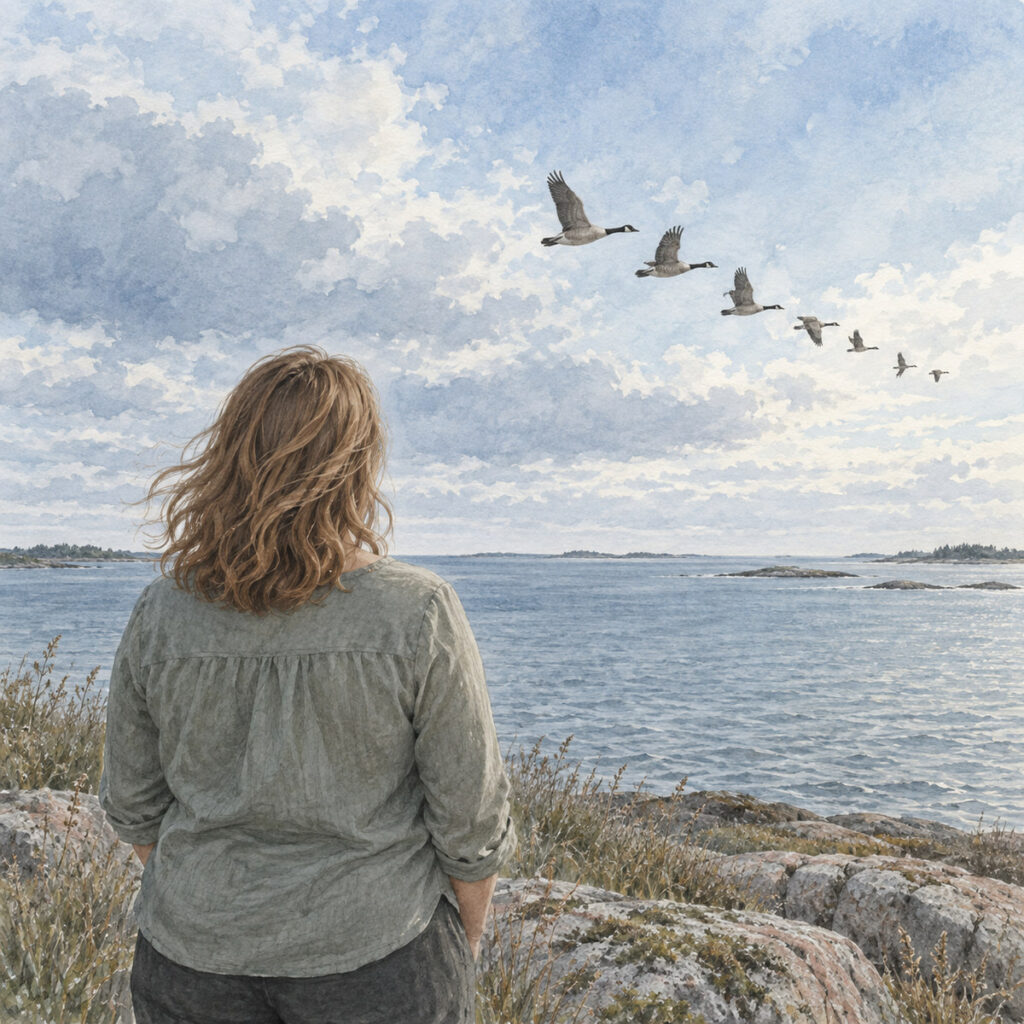
In August, I witnessed the first geese leaving us. It always comes so early here in the Nordics, and every year it takes me by surprise. I am still thinking in summer when the sky begins to speak of departure.
I have been thinking about Mary Oliver’s “Wild Geese,” and about how easy it is to hear its promise of belonging while overlooking the movement. The birds are in flight. Oliver describes them as heading home. These past months, I have found myself wondering where home is now, and whether reaching it might require another departure for my family and me.
I have begun again before, after all.
I was born in rural Pennsylvania. My adult life has taken me through Eskilstuna, Sweden; Lancaster, Pennsylvania; Boston, Massachusetts; Stockholm, Sweden; and Åland. I have crossed borders, learned another language, and carried a life between societies with different ideas about what people owe one another. My husband Keith and I have made these journeys together over twenty-six years of partnership and twenty-one years of marriage. Our four children have grown within them.
There is a particular exhaustion at the thought of beginning again. So much of what makes a person legible remains behind her. The experience she brings may need translating before it is recognised as experience. She explains herself, learns the customs, finds the places where she might contribute. Slowly, the unfamiliar acquires names, relationships, and habits. A life begins to take hold.
There is also possibility. I have moved towards things I believed in: a more humane way of living, a community, a future for my family. Hope has had practical consequences in my life. It has packed boxes.
In August 2020, we came to Åland without having seen it first. We unpacked in quarantine, took our daughters swimming in the August sunshine, and enjoyed walks beside the sea. Our sons were born in Turku and brought home to Mariehamn. What began as a place we had chosen became the setting of their beginnings.
It is difficult to explain how deeply a place can enter a life through such ordinary things. The routes you walk become familiar to your body. The seasons acquire memories. Your children’s childhood happens there, and suddenly a piece of the world holds something you could never reproduce elsewhere.
I put down roots. I joined, volunteered, worked, wrote. I did all the things newcomers are supposed to do. I became involved in the life of these islands because I cared what happened here. Over time, that care became entangled with the questions that occupy much of my thinking: trust, belonging, meaning, justice, and the conditions that allow people to truly build a life worth living.
These questions have always had an address.
They have also had a body. A person living between languages. A mother wondering what her children will learn about the world. A woman trying to find a place for her work, and through that work to make more room for other people.
Last summer, I ended my sommarledare about Åland with a conviction:
Jag har inget facit—bara en övertygelse: att stanna kvar är ett sätt att svara.
(In English: I have no final answer. Only a conviction: staying is a way of answering.)
In that same essay, I wrote that belonging begins with speaking plainly. I had also described leaving a place where questions felt like betrayal. I am now living where those sentences meet.
I wrote that my Åland asked for no perfection, only presence. Oliver opens her poem with seven beautifully simple words:
You do not have to be good.
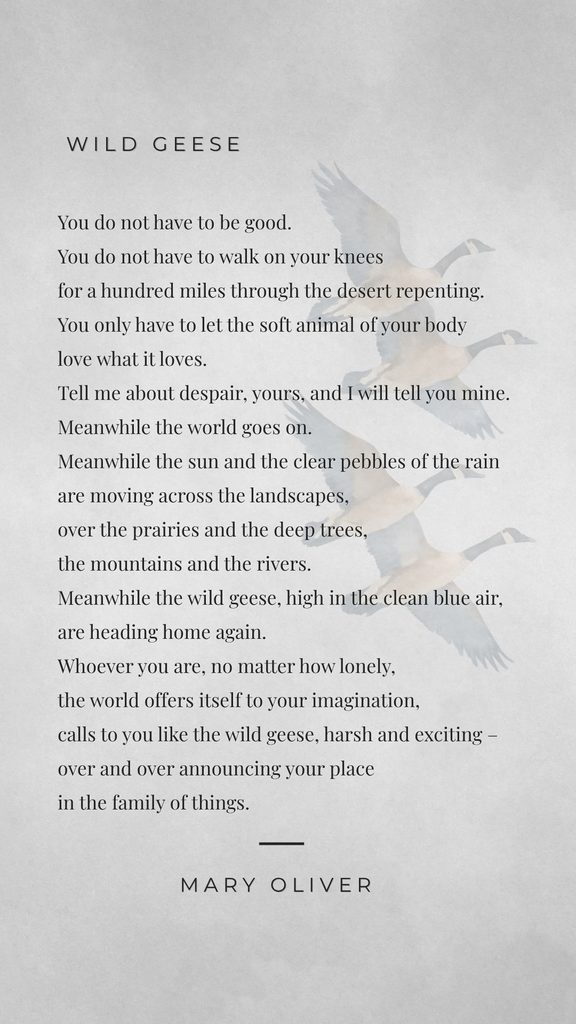
I hear in them a release from the endless examination: have I given enough, understood enough, become useful enough to justify my presence? Her poem offers belonging before the reader has supplied any evidence of deserving it.
A rather difficult proposition to carry into a world that issues so many application forms.
Oliver moves from a body subjected to penance towards a body allowed to love. The “soft animal of your body” belongs to the same living world as the birds. I hear something consequential in that movement: our capacity for attachment belongs to us before it has been made useful. And the life doing all this loving has needs of its own. My care for a place does not make those needs disappear.
Contribution matters to me. There is joy in having something to give, in discovering that an idea might help someone, in being trusted with work that has a purpose. I know what it means for a person to be given somewhere to stand. I know how much can grow from that.
I also know how easily contribution and usefulness can become conditions of belonging. You are welcome while you are useful. Then you need something yourself. You disagree. You ask for recognition. The relationship has to accommodate the part of you that makes a claim upon it.
A community reveals something about itself at that moment.
The expectation to be good can carry a whole set of quieter instructions. Be agreeable. Be grateful. Understand the difficult position everyone else is in. Find a way to absorb the difficulty yourself. A woman can become very accomplished at these things and discover suddenly that her own needs have disappeared from the arrangement.
Over one year ago I decided I had had enough of that arrangement. For good.
Defending my authorship has carried costs into my family, my work, and my relationship with the place I have called home. Writing about the conditions for flourishing while trying to preserve them in my own life has made the language painfully concrete. Recognition has my name on it. Trust has people’s faces. Belonging reaches into the question of whether we can build a future here.
And here is the difficulty: fighting can be part of the effort to stay. Insisting that something must change can express a continuing investment in the place where it happened. If I ask people to take their own stated values seriously, I am still addressing them as people capable of answering.
Yet the act of speaking can make the staying harder. A person names a problem, and the discomfort gathers around the person who named it. The original question remains, now accompanied by another: how much will it cost her to keep asking?
There is a peculiar loneliness in having your insistence on belonging on equal terms treated as the thing that makes you difficult to include.
Has Åland become another place where asking questions means betrayal?
The people I believed were better, whose values I believed were more than decorative, have made me feel like a fool yet again. I would be lying if I did not admit how disappointed I am in people. Not just for my sake, but for theirs.
And shit, last year’s sommarledare has aged like the finest Bordeaux in a billionaire’s cellar.
But here I am, increasingly asking myself whether I should leave.
The question hurts because there is so much here that I love. Love can make a place difficult to leave long after living there has become difficult too. It can keep a person working towards the possibility she saw when she arrived, still hoping that what she has given will find an answering generosity.
But a life has limits. And so does a family’s capacity to absorb uncertainty. There are children growing while the adults try to resolve what happens next. There is work waiting to be written. There are years that cannot be returned to us once they have been spent.
Before the landscape opens, Oliver offers a conversation. The speaker asks to hear our despair and promises her own in return. That exchange matters to me. Someone is willing to receive the difficult thing we have said, and to meet it with something of herself. There is already a small act of belonging here. I think of what I wrote last year about presence following words. The poem makes that presence audible before it asks us to look towards the sky.
Oliver’s poem makes room for despair and then widens around it. Weather crosses the landscape. The birds continue their journey. That small word, “Meanwhile,” allows several realities to exist at once.
Meanwhile, my sons keep flowers beside their beds. They have picked up the habit from me. We go on flower safaris in the fields and our yard, and Matthias has become something of a flower enthusiast. Both boys also supervised the strawberry patch, from which I occasionally received a small tribute. Generosity, like gardening, is a developing practice.
I think about what they are learning through these small rituals. That beauty deserves attention. That something growing nearby is worth getting to know. That a piece of the world can be brought close and cared for. I wish I could spend more time with it.
But most of all I want that capacity for attachment to travel with them.
I want it to travel with me, too.
My thinking about human flourishing obliges me to take those conditions seriously in my own life, with Keith and our four children at the heart of it. Somewhere in all my attention to roots, I have to leave room for movement.
I cannot make sheer endurance the measure of whether I ever loved a place.
There would be real grief in leaving. Another place could never contain this exact life. Åland would still be where we brought our sons home. The work I did here would still have mattered. The love would remain part of my history, along with the disappointment. A departure could carry all of it.
In Oliver’s poem, human loneliness opens into a larger living world. The closing “family of things” gives me a way to think about belonging that extends beyond the boundaries of any one community. Perhaps that larger belonging is something a person can draw on when she needs to move.
And the call itself is “harsh and exciting.” Oliver allows welcome to sound rough. It can interrupt us, carry urgency, make us look up. I think of the neatness we sometimes demand from people asking to belong.
A voice can disturb the quiet and still be calling us towards one another.
The invitation reaches our imagination, too, the part of us that can picture a life beyond the terms presently being offered. I hear that August sound again: a familiar sky suddenly full of elsewhere.
I keep coming back to the difference between having roots and being required to remain in the same soil. A life can draw nourishment from more than one place. Mine already has. Pennsylvania, Boston, Sweden, and Åland have each left something in me. At each departure, I have carried something forward. I could go elsewhere carrying what I have learned, what I have made, and the people with whom I have made a life.
There is no certainty that another place would receive us as we hoped. Beginning again would involve work, money, disruption, and the ordinary difficulties of migration that poetry cannot settle for us. Last time, we moved with two children. Now there are four. I know enough about moving to understand what that asks. The possibility still deserves to exist. It deserves room beside the reasons to stay.
So I am leaving the question open. For now, at least.
Some days, I find myself thinking: perhaps we can build the life we need here. Perhaps we will need to carry it somewhere else. Either possibility asks me to take seriously the people whose lives are involved, including my own.
But more and more, I think I am deluding myself. Increasingly, I sense that I got my answer this spring and summer.
I have spent years asking what makes it possible for people like me to flourish. To belong. To finally arrive home. The question follows me wherever I go. So will my writing, my love of flowers, and my stubborn interest in what we might become if we cared for one another better.
Perhaps, like the wild geese, I will need to go elsewhere.
There is still a world in which to make a home.
In the meantime, the geese are moving outside my window. I am still here.
I wrote last year that staying was a way of answering.
So I still answer.
But now I am asking Åland to answer, too.
Comments