
On harvest, soon turning forty-six, and the life that keeps opening.
Matthias, my little shadow, tipped his head back beneath the sunflowers and laughed.
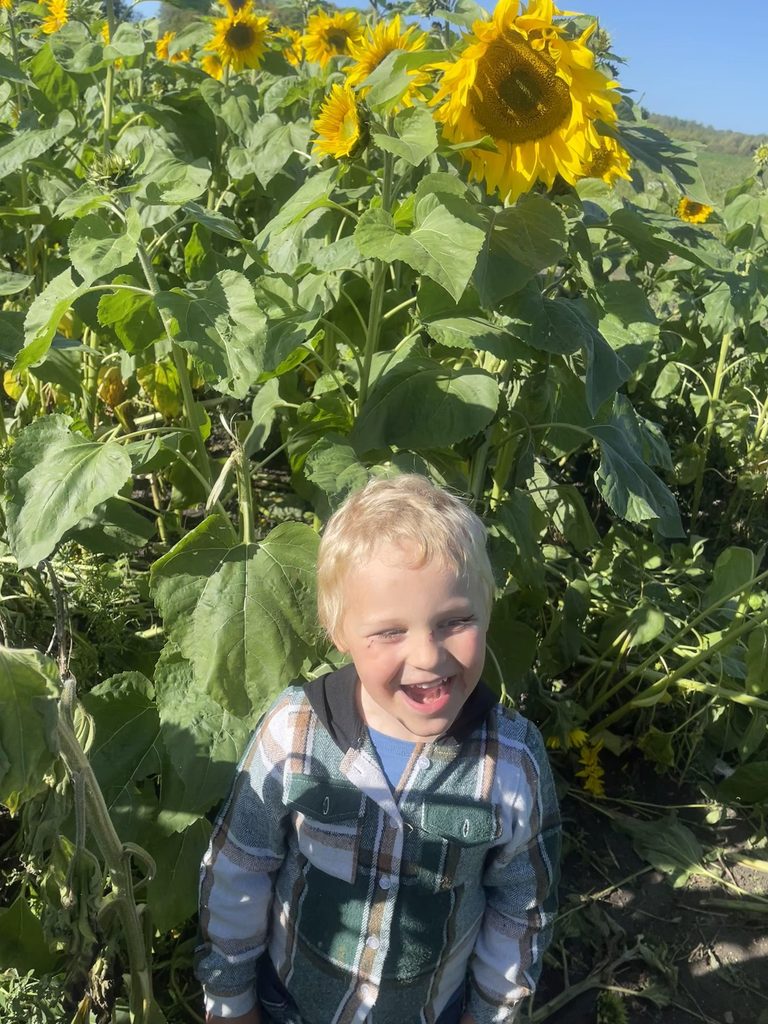
Today I took a photograph of him like that, his eyes closed, the flowers taller than he is. Many were knocked flat by last night’s storms.
Everything that had worried me that morning would still be waiting when we got home. But for the moment, I was looking at his face.
We drove to the countryside for the harvest festival today.
I have, as I always do, approximately a million things to do. With four children, this is less an exceptional circumstance than a steady description of the household. There was a time when I would have needed to finish first. The house clean, the bills paid, the messages answered. I could spend an entire day preparing to deserve the last thirty minutes of it.
I am struggling to unlearn the arrangement. The list reproduces itself. The children keep growing. Sometimes the important decision is simply to put everyone in the car.
So we went.
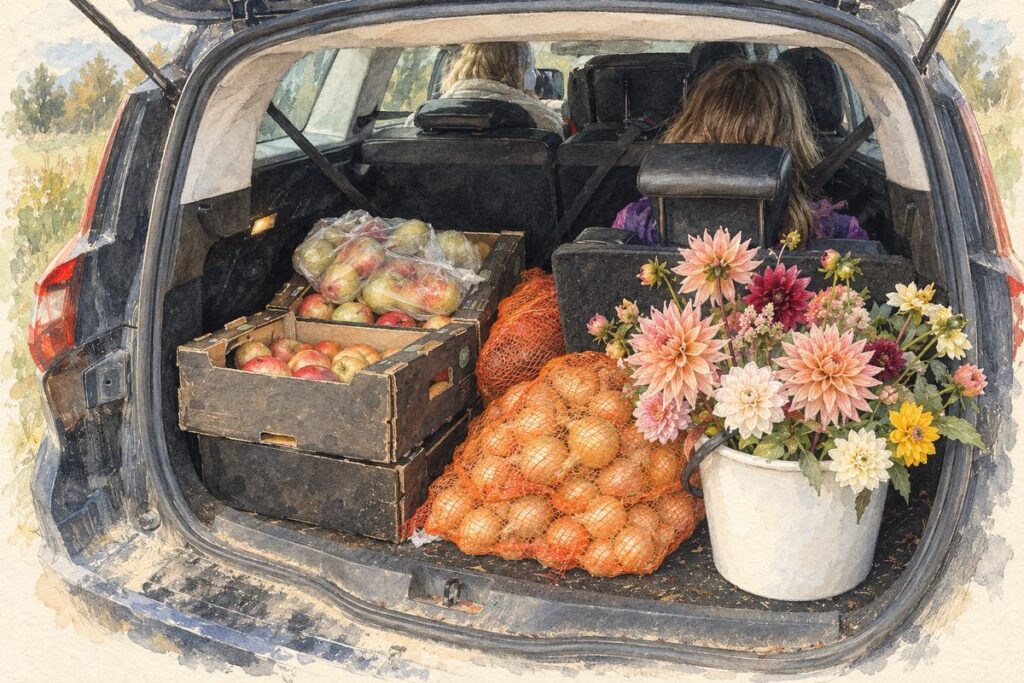
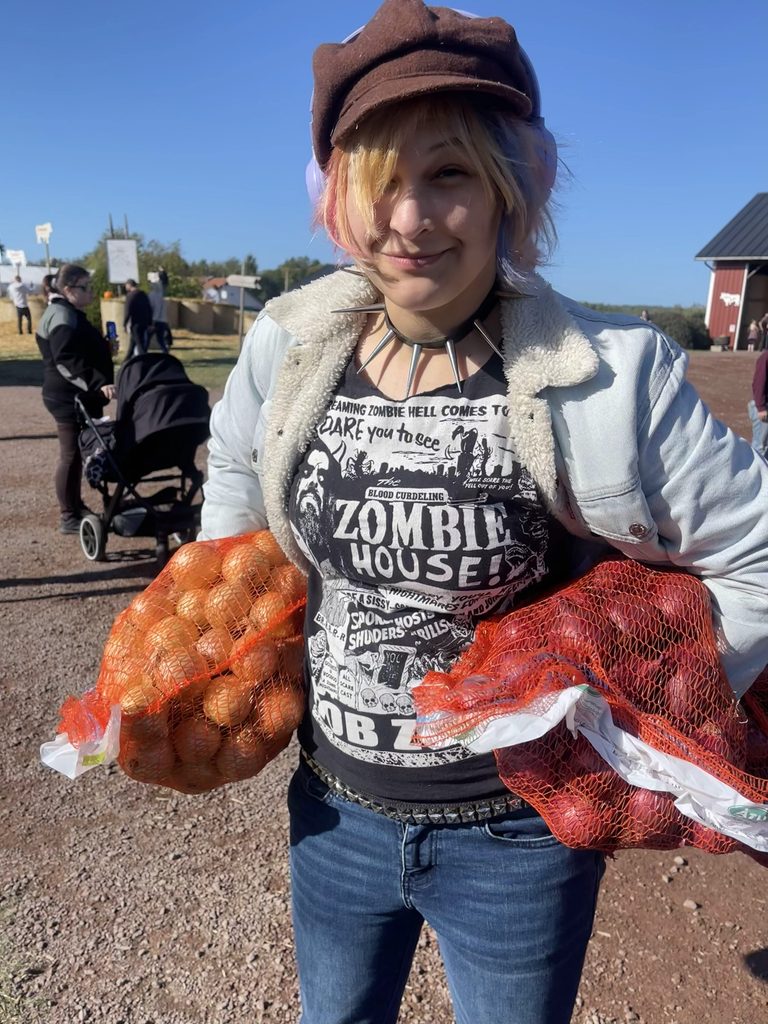
Today there were red barns and cattle resting in the breezy September light, apples and onions, flowers in extravagant colours. My eldest carried sacks of onions in a spiked collar and a horror-film shirt. Whatever the coming weeks might bring, we are now adequately equipped for making French onion soup.
I was born at this time of year. Soon I will be forty-six.
A Nordic summer is gorgeous, but an American autumn in the Northeast is magnificent. I have always loved the autumn the most, the changing colors on the mountainsides of my native landscape, the cozy nights and the impulse to gather together over good food.
Here on Åland, we celebrate the harvest now. In two weeks, the Fall Foliage Festival comes to the place I come from. It often falls on my birthday, as it does this year. Foliage festival. Same principle, different words, slightly different crops. There is Oktoberfest ahead, too, another occasion to assemble around a table and partake of beer and braised pork. A life lived between countries teaches you to recognise familiar human needs beneath different customs. We bring what has grown. We find one another. We break bread together. We count bushels and our blessings.
Across religions and cultures, people have made harvest an occasion for gratitude, generosity, remembrance, and obligation. The rituals have their own histories. Beneath them lies the knowledge that we have been sustained by something beyond our individual effort: land, water, weather, other living things, and the work of people whose names we may never know.
There is always somebody’s aching back in the food on the table.
Harvest makes the dependence visible. It also raises the question of who receives what has been grown. Who has enough to share, who is still waiting, whose labour has become another person’s abundance. These questions also belong at the table with the gratitude.
September is a month that has often changed my life. I married in September, left my birth country in September, had my second child in September. In one week, it will be thirteen years since we left. Four days ago, my second child turned ten. My life has repeatedly taken a new shape in this season. Perhaps that is why autumn has always felt so full of possibility to me. People feel the earth is done growing.
But I know what can begin as the light shifts.
In my governance philosophy, I wrote about autumn as a time to review, to integrate, to assess and reconsider what had already been sown. Approaching another birthday, I return to those words with more to ask of them, this time applying them to my own life.
What has grown from the things I have given? What has reached another? What do I want to carry into the years ahead? Where is there still reciprocity, and where has the giving become one-way?
There are things I have tended for a long time whose harvest I am still waiting to receive. I know the particular exhaustion of having to defend work that took love and thought to make. I know how much of a life can be spent waiting for an answer.
And I know that the days in which we wait are also days of our lives. We get only so many.
Making the rounds in the countryside, I picked some more dahlias.
Pale pink and peach, petals folding and unfolding into their intricate forms. There were buds beside full flowers and heads beginning to fade. Each stage occupied the same patch of earth. A flower still opening had no obligation to adopt the calendar of the one beside it. I think we forget that this is true of people, too. There is a proverb:
A flower does not think of competing with the flower next to it.
It just blooms.
In the language of flowers, dahlias are said to symbolize standing out, following one’s own path, inner strength, lasting commitment and grace under pressure. I liked their particularity, the way each flower occupied space in a geometric form so distinctly its own. We found room for beauty in the car along with onions, apples, cotton candy and children.
This summer I discovered Gwendolyn Brooks while thinking about signs for the solidarity march on 7 August. I found her poem, “Paul Robeson“, and its words:
we are each other’s harvest.
A flower in difficult ground still needs water. Even a dahlia.
I thought then and think now about what passes between us. Encouragement that makes another attempt possible. A person who listens carefully enough to understand. The consequences of speaking, and of leaving something unsaid. We help shape the conditions in which other people must live. Something of us remains in what they are able to become.
On 7 August, I gave the opening speech at the march on the theme of the “I” in Solidarity.
But I never did get around to making the sign. Letting the occasion pass is, admittedly, one way to shorten a to-do list.
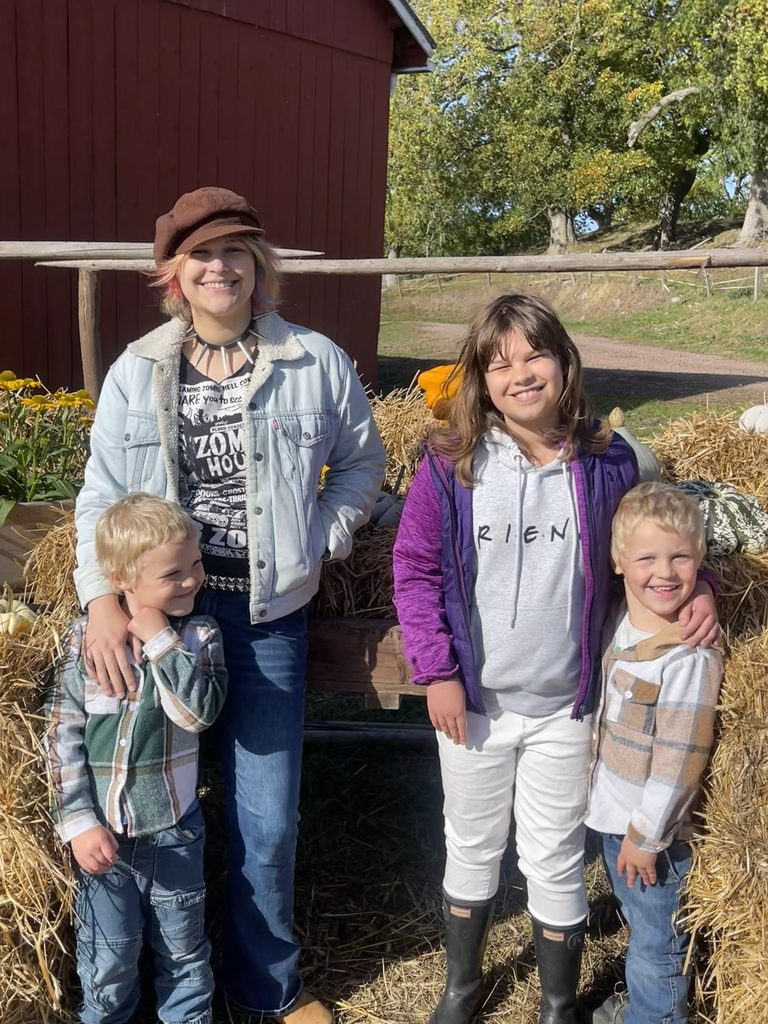
In one photograph from today, each of my older children has an arm around one of the younger ones.
I look at their hands.
There are things I hope they will carry from this part of their lives long after they have forgotten this particular afternoon. The automatic habit they revealed of looking for one another. The knowledge that someone will make room. The freedom to be distinctive, difficult, funny, tender, fully themselves. I hope they will know the pleasure of tending something and seeing it grow. I hope they will notice whose effort makes that possible and not take it for granted. I hope they are themselves.
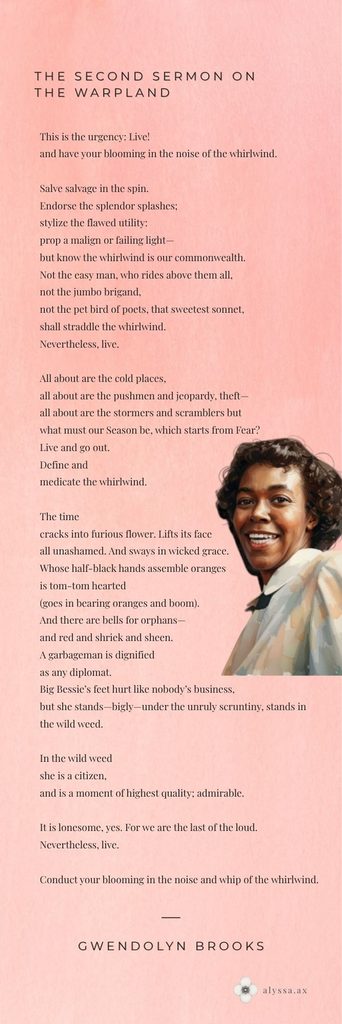
Brooks’ poem “The Second Sermon on the Warpland” appeared in In the Mecca in 1968, during the struggles for Black freedom and self-determination in the United States. It speaks from Black life in a country that denied and diminished it, holding racial violence and deprivation alongside cultural vitality, pride, and the insistence on belonging. The people in this poem have hurting bodies, imagination, dignity, and a claim upon the world.
I obviously come to it from entirely another history. I read it with my own questions about how to live, and find language that reaches places in me I have struggled to put into words.
And right now, this poem just kills me. It stops my heart.
The whirlwind is our commonwealth.
I keep thinking about that word, and about a poet who could see the violence and unfairness of her world so clearly, and still insist upon a life within it. There is also a season in her poem. There are hands assembling oranges, and time cracking into furious flower. Fruit, labour, beauty, fear. At the harvest table, we receive what someone has managed to grow within the conditions of a particular season. We inherit something of their work. The word commonwealth makes me ask what else we owe one another, beyond sharing the fruits.
Then there is Big Bessie, whose feet hurt, standing in the wild weed.
She is a citizen.
Brooks recognises her full belonging where she stands, although she aches. The garbageman has the dignity of the diplomat. We are all equals. I think about the hands that grow our food, the people who keep a community alive, and how readily we look past them on our way to someone we have been taught to consider important. What kind of harvest have we made if those who sustain us have no place at the table? And after the hurting feet, the scrutiny, the loneliness, the command returns:
Nevertheless, live.
Brooks has seen all of it. She still asks us to go out regardless. I want to attain that kind of grace: to see the world clearly, and still go out to meet it.
I return again and again to her use of the word conduct.
We always have at least some part in how our lives unfold. What we attend to. What we make. What we allow to pass unchallenged. The things we tend, the people we make room for, the moments we enter while a hundred other things remain unsettled.
We cannot guarantee the good times. We can practise how we meet the time we have, and take responsibility for what we make possible within it.
The poem also asks us to
define and medicate the whirlwind.
The world around us needs care and change. Our capacity to live within difficult circumstances carries no assurance that those circumstances are acceptable.
In my conversations with people, I often find that flourishing is understood almost entirely from the outside. You are rich, healthy, and look good. Your life looks like an influencer’s. The material conditions are favourable, the photographs are flattering, and any difficulties have been kept out of the frame.
Yet humans can be grieving something, fighting for something, worrying about tomorrow, and still be growing in courage, understanding, love, and creative power. Those things can happen in the same body on the same afternoon.
Like mine did today.
And this is flourishing. I can feel myself becoming stronger. My character is growing. I am learning what I can stand by, what I can give, and where I need to draw a line. My to-do list and my worries remain, and there is work ahead that I would gladly have been spared. Alongside it is a growing clarity about what I value, what I can make, and how I want to spend the life I have as I enter its second half.
Though I would have preferred to learn some of this more gently.
The strength is real. So is its cost.
It is easy to mistake someone’s capacity to keep going for evidence that nothing is being asked of the rest of us. We admire resilience. We might also ask what our attention, our courage, or our willingness to act could have spared that person from having to withstand.
Perhaps, at forty-six, I am entering an autumn of my own. But I have known for quite some time that this season could hold a beginning.
I still have things to learn about all of this. There will be work to gather and work to begin. Some parts of my life will need pruning; others will need more room than I have yet known how to give them. I want to keep paying attention. I want to remain capable of changing my mind, making something beautiful, and enjoying a day while it is still there to be enjoyed. I will prune carefully in some places, and burn back the brush in others.
The struggle waits. I know where to find it when the time is ripe.
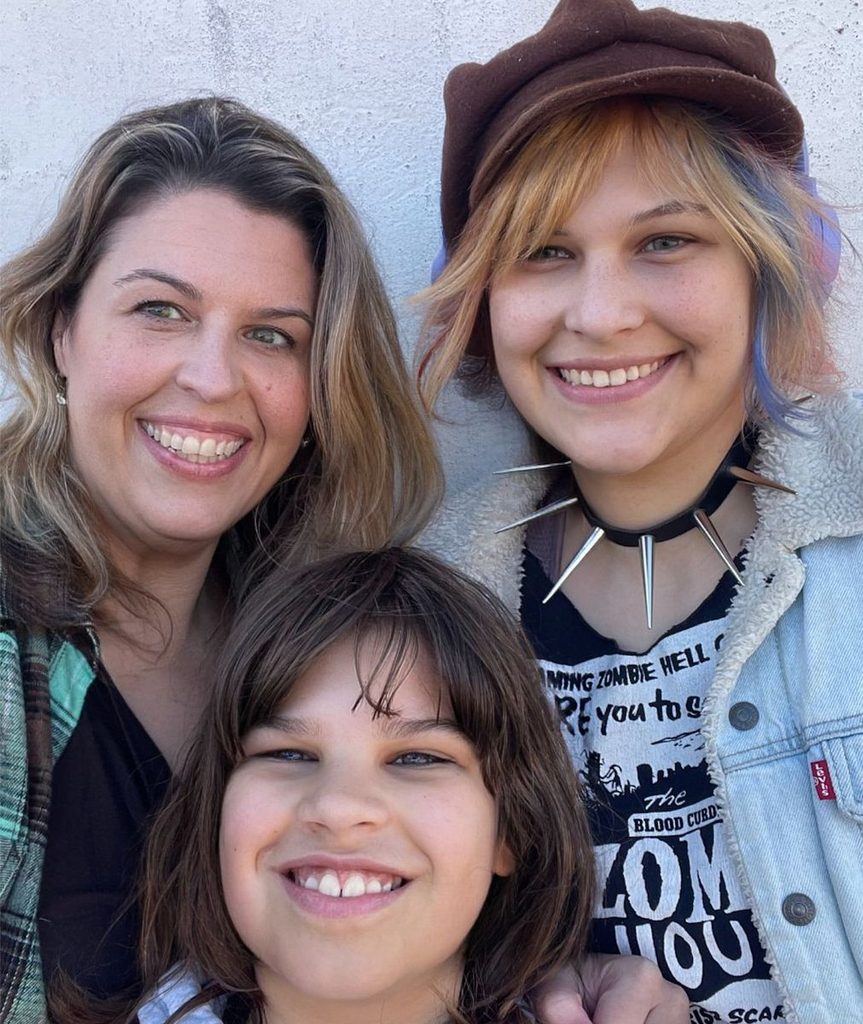
But for now, I harvest. I count my bushels and my blessings.
Neither Gwendolyn nor I are the last of the loud. There are four more growing up around me. My greatest blessings.
Apples and onions went into the car. The children settled into their seats. There were flowers wedged beside the food, a bucket full of pale pink and peach, something we would need to give water and a place in the house. Beauty found a place and a way home.
I have so often waited for everything to be ready before allowing myself that kind of room.
Today, I took the time. I picked the dahlias, held them in my hands, watched the bees collect their tribute, and just existed in the world for a bit.
And then I brought them to my table to open.
Comments