



A shared vision. Åland’s enduring search for concrete action. The coffee has been arranged.
Previously seen in the Lagting…
In September 2018, nearly two years before I arrived upon these shores, the Lagting was debating the same kind of thing it debated 7 September: a formal government message on Åland’s Development and Sustainability Agenda.
Then-vicelantråd Camilla Gunell asked a perfectly reasonable question:
Vad är det och vad är konkret handling?Menar man då att vi som ministrar ska lägga fram en lag?
Är det tillräckligt konkret?
Eller menar man att man nästan ska gå ut och gräva diken eller mjölka kor?
(English: what exactly counts as concrete action? Is bringing forward legislation concrete enough? Or are ministers expected to go out and dig ditches or milk cows?)
Now, as a country-born girl, I can definitely appreciate a philosophical question that arrives with livestock.
I also find myself imagining the cow being invited to the next meeting. She has relevant operational experience, an admirable commitment to routine and a fairly unambiguous understanding of what needs doing. Unfortunately, the meeting coincides with her milking schedule.
Her absence is recorded as an engagement problem.
Someone proposes better communication.
Someone else suggests a workshop. Or a seminar.
Of course, fika is ordered.
Eight years later, the question was still recognisable. Parliament was again debating how to make sustainability work more concrete, more measurable and more connected to ordinary life. The committee had called for clearer priorities, more practical solutions and better evidence of what the work itself had contributed.
This is where the story becomes interesting.
Not because nothing has happened.
Quite a lot has happened.
But because Åland appears to have spent a considerable portion of the last decade repeatedly invoking the same difficult question:
How does an idea become something that actually changes someone’s Tuesday?
Good News: We already noticed
The archive is unhelpfully good at memory.
In 2014, before the current agenda even existed in its present form, the Finance and Economic Affairs Committee called for sustainability to be integrated into ordinary decisions and budgets. The goals, it said, should be specific, measurable, accepted, realistic and time-bound.
That is not an especially vague instruction.
By 2018, Gunell was asking where political responsibility for “concreteness” ended and implementation began. She pointed to legislation, budgets, energy infrastructure, public procurement, renewable energy and transport as examples of what moving from words to action could mean.
Four years later, in 2022, Pernilla Söderlund looked back at her own 2018 speech about pharmaceutical residues in water, equality, preventive health and the absence of a youth clinic, and observed that much of it could almost be reused.
At least the speechwriting was operating on circular-economy principles.
However, it is a more complicated finding about institutional learning.
In 2023, the Social and Environment Committee said working structures had improved. Goals had designated responsibilities, teams and indicators; the agenda had been integrated more clearly into planning and budgeting. But the committee also found that some of the work still ran alongside ordinary administration, that cross-department cooperation needed strengthening, and that duplication and unclear responsibilities remained problems worth examining.

By 2026, Parliament was again asking for clearer responsibility, better prioritisation, more visible results and stronger connections between expenditure and effect.
The recommendation to improve coordination has, at least, demonstrated impressive staying power.
That does not mean the agenda has achieved nothing. It means that a recommendation can survive for years without the archive itself telling us what happened between one appearance and the next.
A filing cabinet can have an excellent memory.
Sadly, it cannot follow up.
Abstractions with better PR
There is also a small linguistic injustice running through these debates.
Some abstractions arrive wearing a tie and are immediately regarded as practical.
Others arrive carrying the word meaning and are asked whether the workshop is compulsory.
Growth is an abstraction. So is competitiveness. Efficiency is an abstraction. Resilience is an abstraction.
As are dignity, belonging and flourishing.
A percentage may make an idea measurable. It does not supply the mechanism by which the percentage will be achieved.
Likewise, a philosophy can explain what a society is trying to accomplish without arranging the bus timetable.
Both have some work left to do.
This becomes important when the criticism is that something is “too abstract.” Sometimes that criticism is entirely justified. A vision can float pleasantly above reality for years if nobody is responsible for making it collide with anything.
But saying we need more concrete action is not itself concrete action.
Neither is saying that we need more growth, greater efficiency, more accountability or stronger engagement.
Those statements tell us what quality the speaker wants. They do not necessarily identify a decision, an owner, a resource or a mechanism.
The April 2026 debate even wandered into this territory explicitly: if “flourishing” can be criticised as vague, what precisely makes “growth” less conceptual before somebody explains what is meant by it, how it is produced and what consequences count? The point is not that growth is meaningless. It is that plain language and practical content are not the same property.
A blueprint is not a house.
But still, I would hesitate to hire a builder whose first act was to burn the drawings as evidence of a refreshing commitment to implementation. I imagine you might feel the same.
The concept or the drawing must come first.
What did coffee ever do to you?
Then there is the coffee.
During the 2026 discussion, meetings and networks acquired the dismissive image of the kaffeklubb: people sitting around talking when they ought to be doing something.
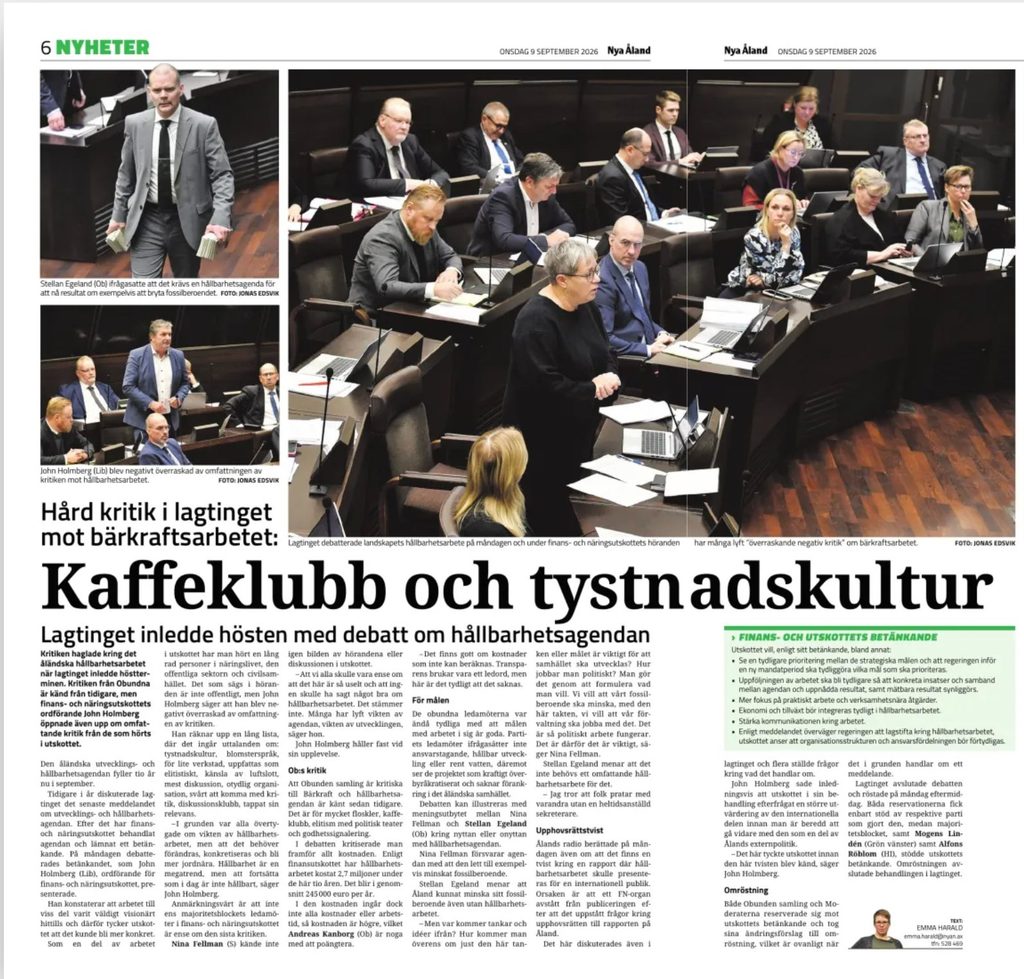
There are legitimate criticisms available here.
Meetings can become evasions. They can reproduce exactly the same hierarchy in a circle of slightly more ergonomic chairs and throw pillows. They can produce twelve pages of minutes documenting that everyone agreed something ought to happen, followed by the absolutely flawless execution of absolutely nothing.
I had been following the criticism calmly enough until coffee came under attack. I clutched my pearls. Kaffeklubb? In the Nordics.
Them’s fighting words, sir.
Fika is sacred institutional technology here, people.
For those not living here, a surprising amount of Nordic social organisation has been constructed over coffee strong enough to remove varnish and a pastry whose butter content would concern the World Health Organisation.
As such, this is not a civilisation historically suspicious of people sitting down together over a cuppa.
Collective bargaining, workplace coffee rooms, committee culture, municipal cooperation and the social understanding that no difficult conversation should begin until someone has located the thermos are not exactly foreign inventions.
So if the criticism is that the coffee never leads anywhere, fine. Understandable.
But then the problem is not the coffee.
The actual problem is that nobody owns what happens after fika.
A useful meeting has inputs, outputs and, ideally, a delicious warm cinnamon bun.
People bring different knowledge. They discover something together. Someone agrees to act. Later, somebody checks what happened.
At some point we seem remarkably capable of remembering the first three stages and treating the fourth as an advanced elective.
Remove the coffee and the meeting can remain perfectly useless, just less hospitable. Probably less well attended as well.
Leave Gevalia out of this. Some of us crossed the Atlantic in good faith, damnit.
The Coffee Is Equal. The Time Is Not.
There is another reason to be careful about dismissing participation itself.
Time is not distributed equally simply because chairs are.
Imagine four people invited to the same meeting at two on a Tuesday afternoon.
One is attending as part of a salaried assignment. One has closed the shop early. One is checking work messages between sips. One will finish the tasks displaced by the meeting after the children are asleep.
Everybody receives the same coffee.
But they have not arrived on the same terms.
The kanelbulle does not redistribute the time.
This problem appears repeatedly in the record. In 2023, Parliament itself acknowledged both that committees had limited time for sustainability work and that small businesses could struggle to participate in broad processes that did not directly concern their immediate work.
Civil society has the same problem, people.
There is a peculiar administrative magic by which a task can leave government as a shortage of capacity and arrive in civil society as an exciting opportunity for engagement.
The hours have not vanished. They have merely changed clothes.
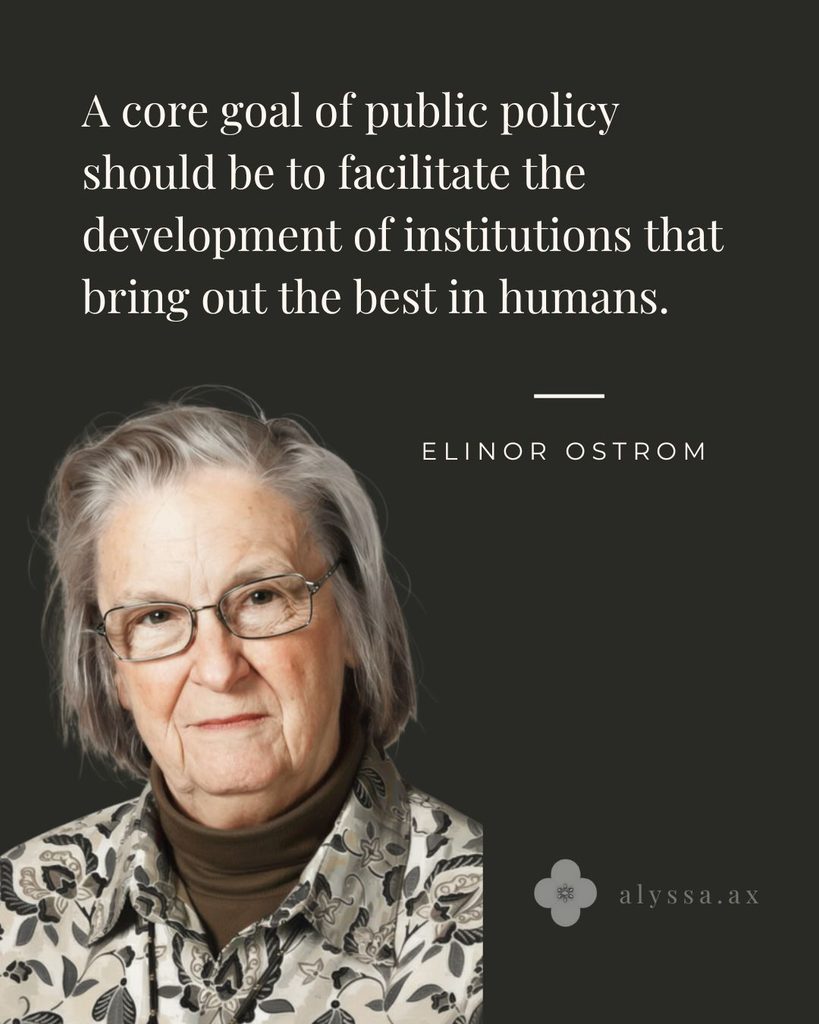
This was actually something I thought about quite deliberately in my 2025 work. I drew on Elinor Ostrom’s Nobel-recognised research on the governance of commons.
Her work showed that shared resources do not sustain themselves simply because everybody values them; they require arrangements that prevent overuse and distribute responsibility. I applied that logic to resources less visible than forests or fisheries: volunteer energy, professional goodwill, public capacity and social trust. They are renewable only if we stop behaving as though they are infinite.
PAF money or no PAF money, a grant is not a retainer on civil society’s time. It does not turn an association into an auxiliary ministry, nor does it make volunteer labour infinitely expandable. When public capacity is quietly replaced by somebody else’s evenings, we have not solved a resource problem. We have moved it off the balance sheet.
There is a democratic cost too. A system that relies on spare time will disproportionately hear from the people who have some.
Sadly, Ostrom did not, as far as I know, publish extensively on the uses of Nordic fika.
But her principle survives translation.
Societies are not transformed by gradually exhausting their volunteers, nor by telling overburdened teachers, nurses, entrepreneurs and association workers that there is now another exciting opportunity to demonstrate commitment after 17:00.
The child is not an organisational silo
Consider an entirely hypothetical young person who wants to attend an evening activity.
The activity exists. The fee is manageable. The organisation providing it is functioning exactly as intended.
Unfortunately, the last bus leaves before it ends.
The parent who might collect the child works evenings.
Transport has produced a timetable. The activity provider has produced a programme. The employer has filled the shift.
Three functioning systems.
One child at home.
The child has not become a particularly sophisticated example of cross-sector governance.
The child is just trying to get to choir practice.
This is where the distinction between strategy and implementation becomes less neat.
The youth worker does not need to operate a bus. The transport planner does not need to run the choir. But somebody needs to be able to notice that the decisions made in two separate places meet inside the same person’s life.
And then the observation needs somewhere to go.
That is the part I think much of the sustainability discussion is really circling.
Not another vision.
Not necessarily another ministry.
The space between them. This is where we need some cement.
There Is No Ministry of Between
Government has to divide itself into departments. There is no sensible alternative.
People do not.
Health runs into work; work into family; family into transport; transport into geography. Education crosses disability, culture, income, language and mental health. Every organisation can perform its own assignment reasonably well while the person moving among them experiences a system that does not work.
In 2025, I developed one possible answer to this: blomstringssystem—or, in English, flourishing systems.
I will spare everyone the full architecture here. It exists. Nobody reading an essay about excessive administration deserves forty pages of additional administration as punishment. Even I am not that cruel.
But the underlying idea was fairly simple: create a light, accountable meso-level around lived areas of life rather than expecting alignment to emerge automatically from departmental structures. In governance language, it is a middle-out, boundary-spanning function: horizontal enough to connect sectors, vertical enough to carry knowledge between lived experience and decision-making. Its job is not to create another hierarchy, but to notice patterns that fall between existing mandates, connect the people holding different pieces of them, and make sure those problems have somewhere to go.
The design was shaped as much by conversations as by theory. I kept meeting professionals with a wealth of knowledge about how Åland actually works—and full-time jobs, families, commitments and a finite number of hours in the day. Many wanted closer, more regular dialogue with governance and with the vision of Alla kan blomstra. Yes, they actually said this. Some went out of their way to have a conversation with me.
What they did not want was to recreate their working day in their spare time.
The problem was not unwillingness to contribute. They wanted a route into the system, but not another unpaid job.
So the structure was deliberately light. I sketched ten systems that seemed worth starting with:
- children and young people;
- health and welfare;
- relationships and trust;
- narrative, norms and power;
- work and everyday life;
- learning, education and culture;
- belonging and marginalisation;
- disability and accessibility;
- identity and life space; and finally,
- archipelago and countryside.
These were not ten new boxes into which people could be neatly sorted. They were starting points for gathering the people who see different parts of the same lived reality: residents, professionals, public officials, associations and people with direct experience.
A children-and-young-people system, for example, might bring together a teacher or school counsellor, youth jobs worker, scout leader, youth clergy, sports coach, child-rights organisation, parent, social-services professional and, rather importantly, young people themselves. None possesses the answer. Each can see a piece of the same child’s Tuesday that the others cannot. They can compare what they know, notice what falls through the gaps, and learn from one another.
Each system would be anchored on both sides of the public–civil-society boundary, with coordination rotating over time. The commitment was deliberately modest: roughly four meetings a year of around two hours, with some additional preparation and follow-up for whoever was taking a turn at coordination. Where possible, participating organisations and employers would contribute working time, so that useful knowledge did not depend on an ever-expanding supply of evenings and goodwill.
The aim was not to create new authorities. Authority could stay where it already belonged. The missing function was the connective one: somewhere able to recognise an issue that crossed boundaries, carry it to whoever did have authority, and bring the answer back again.
In other words: not a shadow government. Not an army of sustainability missionaries.
Just somewhere accountable for the bit between we noticed something and somebody with authority heard about it.
If the idea interests anyone, the considerably less amusing documents still exist.
Ten Years Is Not a Preservation Order
This is also why I do not think the useful response to the current criticism is to defend every existing structure.
The agenda can have been valuable and need renewal. Our family business, founded in 1946 with an eight seat restaurant, a single waitress and a single gasoline pump post World War II, became one of Bedford County’s largest employers, with between 200 and 300 people on the payroll at different stages before the company was sold in 2024. In 1994, we tore down its original building. I asked my Dad why. He said:
If you are not changing, you’re dying.
There is a difference between keeping something standing and keeping it alive.
The 2026 committee itself says both things. It identifies benefits from a common framework, cross-sector cooperation and long-term continuity while also asking for clearer priorities, stronger practical orientation and better evidence of contribution.
These propositions are not mutually exclusive.
An organisation can solve yesterday’s problem and eventually become poorly suited to today’s.
A network that once needed to build relationships may later need stronger connections to decisions.
A coordinating function can be essential during one phase and too concentrated during another.
A language that once opened possibilities can later become familiar enough that people stop asking what it means.
This is what maturity looks like in basically every other field.
We do not accuse software of ideological betrayal when it receives an update.
We generally would become concerned if it has not received one since 2016.
Sustainability should perhaps be permitted the same courtesy.
Renewal is not an admission that the previous decade was worthless.
It is what long-term work is supposed to do when it learns and hopefully, grows.
Concrete, regrettably
At this point I would be guilty of exactly the thing I have spent several thousand words teasing if I concluded that Åland needs “clearer responsibility, stronger implementation and better coordination.”
So here are some tests.
Tests, not tablets. I may live on Kasberget, but I did not carry them down engraved in stone.
Not implementation plans. I do not have every internal dataset, operational constraint or budget calculation available to the people actually responsible for these areas. If relevant information changes the picture, I am happy to change my mind. Systems thinking rather depends upon that.
But incomplete information does not make every decision unknowable.
Someone Has to Be Able to Say Yes
Åland does not lack people with responsibilities. It has ministers, leading officials, process leaders, KORA, coordinators, roadmaps and reporting structures.
The more useful question is what happens when one of them discovers that something cannot move.
A process leader may see the problem without having authority to solve it. A coordinating group may identify that responsibility belongs somewhere else without being able to assign it there. An outside participant may know exactly what is missing while controlling neither staff nor budget.
When that happens, there needs to be a short route to someone who can make an actual decision.
And when something remains stuck, say why.
Is the problem capacity? Mandate? Competing priorities? An inefficient process? Lack of money? Or simply that nobody has decided the issue matters enough to displace something else?
Those are not the same problem.
“Coordination” is not a universal solvent.
Even Fika Must Earn Its Keep
Do not abolish cross-sector meetings.
Require them to know why they exist.
A recurring forum should be able to say what it learned, what changed because it met, what remains unresolved and whether anything needs to travel elsewhere.
Networking can itself be useful. Relationships are infrastructure. Not every worthwhile conversation needs to produce a regulation by dessert.
But if the answer year after year is that people met, exchanged views and valued the opportunity to exchange views, eventually the cinnamon bun begins to carry an unreasonable proportion of the theory of change.
A Badge on the Website Is Not Participation
Signing on as a medaktör should mean more than giving the vision a thumbs-up and adding a badge to a website. But meaningful participation cannot mean the same thing for every organisation.
If Åland wants knowledge from across society, participation cannot depend primarily on who happens to have spare time.
A small association may have no salaried staff and still contain exactly the person a discussion needs. That person may also work for a school, municipality, company or another medaktör. One entirely respectable contribution that employer could make is wonderfully mundane:
give them the afternoon.
Not every medaktör needs to—or could—contribute the same thing. Some have staff time. Some have professional expertise. Some have money, facilities or data. Others have lived experience, community trust and relationships that cannot simply be purchased.
The point is not to make everyone contribute equally.
It is to stop pretending they begin with equal capacity.
A pensioner who wants to spend an afternoon at the table is welcome.
A functioning participation model should not quietly depend on everybody becoming one first.
Test Access, Not Existence
For social sustainability, stop treating the existence of a service as proof that people can use it.
Ask whether people can reach it physically, financially, digitally and socially.
A youth activity that finishes after the last bus is not fully accessible merely because a brochure exists. A digital service is not accessible to everyone merely because the server responds.
The test is not only whether the service exists.
The test is whether the person can get through the door.
Unfortunately, the Algae Are Systems Thinkers
Åland does not lack indicators, strategies or expertise.
The harder question is what happens after the evidence arrives.
For any significant intervention, ask three separate things:
- What condition are we trying to change?
- What did this particular action measurably contribute?
- And what should happen next because of what we learned?
Those questions sound similar. They are not.
Slemmern is a useful local reminder. Mariehamn can measure nutrient reduction through a wetland while monitoring still shows troubling chlorophyll levels in the bay. The intervention can be doing something useful without the wider system yet producing the outcome we want.
Unfortunately, the algae are systems thinkers.
They respond to the combined effects of nutrients, weather, temperature, water exchange and everything else happening in the system. They do not wait for us to decide which administrative box the problem belongs in.
That is why counting activity is not enough. Building something is an activity. Measuring what it changes tells us about contribution. Monitoring the condition of the water tells us about the system.
Good policy needs all three.
And then comes the part that matters most: what does the evidence make us do differently?
That also means reporting two different things honestly: what is happening in Åland, and what this particular programme, network or intervention plausibly contributed to it. Those are different claims.
If water quality improves, the improvement is real even if the sustainability agenda cannot claim sole authorship. If a particular cross-sector intervention solves a problem that otherwise persisted, that contribution is worth recording even if it does not transform an island-wide indicator.
This protects the agenda from both exaggeration and unfair dismissal.
Not every solar panel on Åland belongs to Bärkraft.
Not every useful relationship would necessarily have happened without it.
The interesting question is what changed because particular people, structures or decisions existed.
That is an empirical question.
Which means, mercifully, we do not have to settle it through adjectives.
The sea remains an unusually difficult stakeholder. It does not attend consultation meetings. It is unimpressed by unanimous minutes.
And its response to a carefully balanced communiqué may still be algae.
Give Growth a Job Description
Economic growth certainly belongs inside the sustainability discussion.
But “growth” should be asked the same questions as “flourishing.”
Growth of what? Through what mechanism? Benefiting whom? Producing which public capacity? At what environmental or social cost?
GDP has some usefulness. So do employment, productivity, household security, business formation, resilience and the ability to finance public services.
A percentage is not absolved from systems thinking merely because it contains a decimal point.
The Work is Bigger Than the Structure
I have become oddly fond of the archive. There is something quietly entertaining about reading what Åland was arguing about before I knew anyone here.
After reading the debates across the years, I do not come away thinking Åland’s sustainability work deserves either canonisation or burial.
I see something more ordinary and more interesting.
A society has attempted to create a shared long-term direction.
It built language, goals, networks, indicators and institutions around it.
Some of those things became part of normal governance. Some remain contested. Some may have outlived their original form. Some problems identified years ago are still recognisable today.
And different political perspectives are now asking legitimate questions about cost, authority, causation, participation and priorities.
None of that proves the purpose failed, nor does it make burial the obvious answer.
But it may be the moment when it finally has to become an adult.
Ten years is long enough to stop reflexively treating renewal as disloyalty.
It is also long enough for a project to stop being treated as a social project and start behaving more like infrastructure. I see steps have been taken in that general direction.
And infrastructure requires maintenance.
Parts are strengthened. Parts are replaced. Occasionally something is removed because everyone has forgotten what it connects to.
The next stage needs fewer claims about being exemplary and more curiosity about what actually works, or does not work.
Perhaps some structures should end. Perhaps some should acquire clearer authority. Perhaps some conversations should remain conversations because trust is a real public asset. And perhaps some meetings should be cancelled because everyone has already had the coffee and nobody can remember why they are still there.
These are not ideological catastrophes.
That is basic systems maintenance.
Outside the Minutes
Beneath the bureaucratic comedy, there is something I find genuinely moving in the archive.
You people keep coming back to the same things.
Water. Children. Health. Work. Belonging. The ability to make a living. The possibility that the people who come after us might inherit something functional.
The language changes. Governments change.
The meeting rooms presumably acquire new coffee machines.
The questions persist because they are not really programme questions.
They are questions about living together.
But time does matter.
A child who was seven when the agenda was launched in 2016 is approaching adulthood now. Four years is a parliamentary term. It is also a very large piece of childhood.
The future does not remain politely at the end of the strategy document while adults finish discussing it.
That is why I do not think the choice is between grand visions and getting on with the milking.
We need people capable of asking what kind of society we are trying to build. We need politicians willing to make choices about resources and priorities. We need professionals who understand how systems actually work. We need ordinary people who know how those systems actually feel.
And somewhere between all of them, knowledge needs a route into decisions and decisions need a route back into life.
There is room in that process for philosophy. There is room for economics, indicators, disagreement, committees and people who think committees should be dramatically fewer.
There is even room for fika.
Obviously there is always room for fika.
We are not barbarians, people.
But somebody has to be responsible for what happens afterwards.
By the next debate, perhaps the cow can be excused from the meeting altogether.
She has work to do.
And so do the rest of us.
The purpose of a good system is not to keep everyone permanently engaged with the system. It is to let them get on with their lives.
A society in which everyone can flourish was always an outrageous ambition.
It becomes less outrageous if we stop imagining flourishing as a permanent state of happiness and start noticing the ordinary things that make a life possible: time, access, trust, useful work, somewhere to belong, and institutions that do not consume more human energy than they return.
So perhaps the first task is not to make everyone flourish.
It is to stop making flourishing unnecessarily hard.
Ten years from now, very few people will remember which working group proposed what, who chaired which meeting, or which paragraph survived into the final report.
They may remember whether Åland became easier to grow up in, easier to grow old in, easier to build something in, easier to belong to.
Perhaps that is unfair to the minutes.
But it is considerably fairer to the people.
Comments