



The Annals of Ålands hälso- och sjukvård, where the past simply refuses to be discharged.
I only moved to Åland in August 2020. Thus, I have been here long enough to recognise some of the cast, but occasionally still need help establishing which production we are watching.
Naturally, I had assumed that missing so much background context would put me at a disadvantage in understanding how ÅHS had reached yet another crisis.
The good news is that much of the dialogue is repeated for newcomers.
Life has been busy here. But I have seen the big headlines, the front pages, the Facebook comment wars, the blocking, the public debates and the recurring notifications on my iPhone. How could I miss them?
My phone has done its best. But there is only so much institutional history you can reasonably expect from a device that thinks you would also like to know your screen time is up twelve per cent. The coverage has felt like drinking from a fire hose.
As of late, Ålandic political lore has become one of my absolute favourite diversions. Nobody is actually making me do this, which is perhaps the most damning detail. So I began searching and reading old articles, ostensibly to understand our present predicament.
And this became quite the rabbit hole. Several of the rabbits are still in office.
Please allow up to forty minutes and your preferred delicious beverage. If it makes you feel better, I lost considerably more time. This saga made the fire hose journalism look like a drip.
At least eighteen hours of reading, digging and writing later (yes), I have apparently written War and Peace, although the peace remains poorly documented. Somewhere along the way, I unwittingly became a monk with a quill, recording the succession of ÅHS directors and the periodic collapse of confidence. After some time, I surely thought this was gonna wrap up. But no. My notes began to take on a certain tone:
In the year of our Lord 2026, there arose a fresh dispute concerning the last attempt to settle the previous dispute. The archipelago remained divided between those who knew best and those who knew even better.
What struck me was how little translation the older material required. The dates may change, but the plot shows a remarkable reluctance to move on.
A brief overview: There were organisational reforms. There were doctors objecting to organisational reforms. There were boards whose precise relationship to the organisation apparently required further investigation. There was a revolving cast of directors, wounded confidence and public money being spent on lawyers to establish what should have happened before public money was spent on lawyers.
In short, for a small society, Åland has shown an impressive commitment to the repertory theatre.
1975–1990s: Let’s Get Together, Yeah, Yeah, Yeah
The story begins even before the official founding of Ålands hälso- och sjukvård, or ÅHS. A coordination inquiry appeared in 1975, five years before I was born. I was but a wee glint in my mother’s eye. ÅHS, however, required considerably more preparation than my mother’s project.
The hospital, public-health and mental-health organisations finally came together under ÅHS on 1 January 1994. At this point, I would have been thirteen and blissfully living on another continent, unaware that this would eventually become my recreational reading.
The new organisation’s first administrative chief was Kjell Allberg. In 1992, Allberg wrote the 201-page report on coordinating Ålands healthcare. His inquiry was among the foundations of the legislation that created the new organisation. He had, at least, done the reading.
The government’s 1993 proposal anticipated savings of around five per cent through rationalisation in 1995–96. It also explicitly warned that the transition would create extra administrative work and that cutting existing resources indiscriminately in advance would make little sense.
The warning was there before the institution opened, people.
It should be noted that Allberg was an economist. This was not universally welcomed. Nya Åland would recall in a later article strong opposition among doctors to an administrative chief without medical qualifications. Apparently, there were limits to interdisciplinary cooperation.
By October 1997, the Lagting’s Finance Committee was describing unresolved cooperation problems within management dating from the organisation’s beginning. Neither the board nor the management group had overcome them. Coordination and development, the purposes of the merger, had consequently taken second place.
The merger had at least given the disagreements a common letterhead.
The committee also identified weak budgeting, inadequate communication with staff and insufficient reporting on delegated decisions. Expectations of supplementary funding had weakened budget discipline. Building an integrated computer system had proved difficult.
We are still in 1997, by the way.
Its diagnosis also reached beyond the people occupying the offices. Initial savings expectations had been too high, and the pressure to save had deprived the transition of adequate administrative resources. Allberg combined the finance and administrative chief roles; the committee thought both needed full-time staffing. Clinical care, it stressed, was generally of high quality.
In 1993, the government had warned that making the merger work would require resources. In 1997, a parliamentary committee was explaining that those resources had been insufficient.
The warning had matured into a finding.
Björn-Olof Ehrnström, a doctor, succeeded Allberg in 1998 and remained until February 2009.
More than a decade. Even the office plants would have acquired institutional memory.
The first archival sighting of one Mogens Lindén comes in the audit for 1999, which names him as primary-care chief. The auditors were discussing follow-up, internal control and information systems. At Gullåsen, there were too few computers and insufficient training for the electronic nursing records. Digitalisation had arrived; enough computers to participate in it had not.
Again, as a signpost, my own 1999 involved an exchange year in Sweden and graduating from high school. I was preparing for adult life. The auditors, meanwhile, were examining how the adults were getting on.
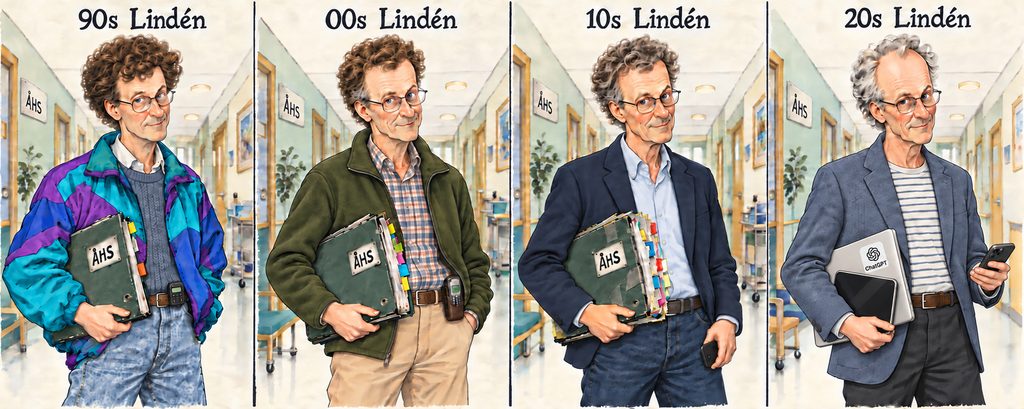
Mogens Lindén is inside management at this point. For the television adaptation of this saga, I propose late-1990s knitwear, a windbreaker, practical round wire spectacles and a substantial folder. A man prepared for both administrative responsibility and a change in the weather.
We shall meet him again. The style trends will change more often than the argument.
2000s: A Question of Authority
The early 2000s were not an intermission.
In 2001, Kai Fagerström resigned as sjukvårdschef, a position he had held since 1998. As he recalled in a 2008 interview, the conflict had begun over the appointment of an överläkare and escalated into a breakdown with the board. He distinguished between the hospital staff, with whom he had no quarrel, and the politicians, with whom he could no longer work. Ehrnström’s continued presence as administrative chief should not be mistaken for tranquillity throughout the leadership.
By 18 January 2002, Lasse Wiklöf was raising the staffing situation in the Lagting. He described appeals from the unions about inadequate staffing, personnel leaving to work abroad, sickness absence, burnout and shortages of substitutes. Their warnings concerned the ability of Åland’s healthcare system to keep functioning. Wiklöf asked whether the government understood the seriousness of the situation and was prepared to take extraordinary measures. Responsible minister Sune Eriksson acknowledged the recruitment difficulties, including competition from Norway, and described efforts to address the problems through ÅHS and its board.
An auditors’ report for 2001 recorded another difficulty: delayed financial reporting and substantial accounting backlogs. Changes to the personnel administration and payroll systems, compounded by personnel changes in key positions, had made it harder for the board to follow the organisation’s finances. The problems were still present at the turn of 2001–02. The report also described an external evaluation intended to establish how far the original merger had achieved its aims, including integration, efficient administration and better use of resources.
That evaluation became the Sonkin report, which was debated in November 2002. The questions were familiar: financial monitoring, supplementary budgets, leadership and the division of responsibility between the government, the ÅHS board and the management group. There was disagreement about the remedy as well as the diagnosis. Some saw grounds for stronger government oversight. Others considered the report insufficiently illuminating, overly hierarchical or largely a restatement of problems already known within the organisation.
By the 2000s, ÅHS had discovered one of the great truths of public administration: every reform intended to simplify an institution generates at least three new layers of explanation.
Then came the healthcare strike of 2003. After leaving TCÅ, Tehy’s Åland branch sought the right to negotiate directly with the government and conclude agreements on its members’ employment conditions, alongside demands for higher pay. The government initially rejected those demands. The strike began on 2 June and continued until 17 September. The settlement gave the branch its own bargaining status and brought additional pay increases. Both the government’s contemporary report for 2003 and Tehy’s organisational history record the dispute and its outcome. Questions of staff influence were being fought over quite literally, for an entire summer.
My own June 2003 brought a bachelor’s degree and an engagement. I moved to Boston that August. I, too, was putting considerable faith in a union.
By March 2004, Camilla Gunell was asking the Lagting to look ten or twenty years ahead. Very prescient, Camilla. She argued for stronger primary care, potentially more limited specialist care, better rehabilitation and greater staff participation. Rising costs and an ageing population required a long-term discussion about what Åland’s healthcare system should become. An internal organisational group was already working on proposals, and the resistance they encountered illustrated the difficulty of reform.
Gunell also asked who actually bore financial responsibility when the budget was exceeded: the board, the administrative chief or the management group.
Jag har frågat många, men ingen har givit mig ett svar som jag är nöjd med.
(English: I have asked many people, but nobody has given me an answer I am satisfied with.)
Her conversations with board members had revealed another difficulty. They felt they had:
mycket ansvar, men väldigt lite makt
(English: a great deal of responsibility, but very little power.)
Responsibility and the power to exercise it were already having trouble finding each other.
In September 2004, the Lagting was again hearing criticism of the failure to follow up the Sonkin report, alongside the government’s unrealised ambitions for stronger steering and oversight. By November, an organisational working group and the prospect of a new reglemente were being presented as signs of progress.
The structural questions had already been identified. What remained difficult was arranging matters so that somebody could answer them, act on the answers and remain in the job.
By 2005, the vocabulary was already remarkably familiar. The budget proposal called for reviewing management structures, rationalising care, scrutinising purchases and developing cost awareness throughout ÅHS. An external productivity review could lead to changes in staffing and in which treatments were provided on Åland. Alongside this came an explicit commitment to modern leadership that involved staff in decision-making.
Efficiency and participation were both on the programme. Their working relationship would require further observation.
On 6 September 2005, the board decided to combine the primary-care chief and hospital medical chief functions into one medical leadership role covering all of ÅHS. The same budget documentation described shorter acute hospital stays increasing pressure on Gullåsen, anticipated its development towards more specialised geriatric care, and even identified the future organisation of palliative care as something requiring investigation.
These questions have had a considerable amount of time to mature.
Margareta Bondestam took up the new chief physician role provisionally at the beginning of 2006 and permanently that October. In a November interview, she described a broad, entirely administrative job that did not always fit within working hours. She enjoyed the work, but considered combining administration with clinical practice too exhausting. This matters when we reach her later departure: the workload was already visible during her first year. It did not materialise retrospectively when somebody needed an explanation.
The financial results for 2006 supplied another useful warning about appearances. ÅHS finished almost €800,000 below its operating budget, while personnel costs were more than €1 million below budget. Ehrnström explained that the staffing underspend was connected to vacancies they had failed to fill. Recruitment of doctors and nurses remained difficult. Meanwhile, external-care costs rose by approximately €1 million, principally because of a few expensive organ transplants.
An underspent salary budget could therefore coexist with unfilled posts, while a handful of patients could substantially alter expenditure. Public administration would be considerably easier if reality would politely agree to remain consistent with the assumptions available when the budget was written. It had declined to cooperate.
There were also tangible achievements: the same report recorded 24,000 TBE vaccine doses administered during the year.
In November 2006, the hierarchy acquired a monetary expression. After Bondestam’s salary was settled, the board raised Ehrnström’s. Chairman Mikael Lagström defended the principle that the administrative chief should earn more than the chief physician, suggesting that leaving the salaries in the opposite order might affect the management group’s effectiveness. Board member Göte Winé acknowledged an unfortunate salary spiral and said he was not particularly proud of the decision. The organisational chart apparently required financial reinforcement.
By January 2007, this had become a heated parliamentary argument about who possessed the authority to make that decision. Finance minister Lasse Wiklöf said the board had overlooked the provision reserving adjustments to employer representatives’ salaries to the government. He also acknowledged the awkwardness of dividing appointment and salary powers between different bodies. Critics challenged the government’s supervision; members debated political appointments and whether the minister should chair ÅHS. By March, Ehrnström had voluntarily lowered his salary, while the authorities were still untangling the legal position. A dispute about pay had exposed a more fundamental question: who could actually decide what?
Elsewhere, responsibility was being negotiated around actual beds. In April 2007, ÅHS wanted Mariehamn to move 44 of its 62 patients at Gullåsen into municipal elderly care, arguing that they did not require Gullåsen’s level of care. The city’s immediate plan covered 21 places, only 15 of them outside Gullåsen. Its vice-chair, Anneli Ahlgren, considered ÅHS’s letter unnecessarily sharp and said the city was already working on the problem. The structural difficulty was painfully concrete: deciding that a patient belonged somewhere else did not produce somewhere else for the patient to go.
There was nevertheless a credible case for the management reform. In the 25 April 2007 parliamentary debate, minister Harriet Lindeman explained that primary and specialist care had long operated alongside one another rather than together. She regarded the single chief physician as progress and reported satisfaction within the organisation despite earlier resistance. In the same debate, Katrin Sjögren identified the three essentials for ÅHS’s future: “personalen, personalen och personalen”. Retaining staff and recruiting replacements, she warned, would become harder as neighbouring countries faced their own retirements.
The government’s own 2007 account described ÅHS as functioning well, with comparatively good resources. It also acknowledged difficult, sometimes painful integration and unclear boundaries between government and ÅHS authority. There was an unusually useful explanation of costs: a small island still needed a minimum complement of staff and infrastructure, which could make unit costs look high and productivity low. Individual expensive treatments could upset the budget. These qualifications belong in the history too. The institution was providing care, making improvements and carrying unresolved weaknesses at the same time.
The founding ambition was integration: bring the parts together so that they could work as a more effective whole. By 2007, the government’s retrospective was still explaining how difficult that had been.
One must admire a founding ambition with such enduring employment prospects. Counting from the original inquiry, it was now thirty-two: old enough to have children who could eventually inherit it.
By 2007, even the qualifications to the argument were already on the record.
By 2008, Mogens Lindén and Michael von Beetzen were objecting to administrative expansion and distance from clinical work. Management disputed the description.
That same September, Ehrnström announced that he would not continue when his contract expired. Behind the departure lay a prolonged dispute over the pay rise he had never requested. While the ÅHS board had awarded it in 2006 so that his salary would exceed the new chief physician’s, the authority to make that decision belonged to the regional government.
The case reached the Supreme Administrative Court. The decision was overturned, the government refused the proposed increase, and the board voted 4–2 to reclaim more than €8,000.
An unsolicited pay rise, followed by a repayment demand. As a staff-retention policy, it showed considerable originality.
Ehrnström also described the workload and the feeling of never being able to do enough. Asked how ÅHS would find a replacement with his breadth of knowledge, he supplied his own contribution to the annals:
Jag brukar säga att gravgårdarna är fulla med oersättliga människor.
(English: I usually say that cemeteries are full of irreplaceable people.)
Among the eleven applicants to succeed Ehrnström was his predecessor Kjell Allberg. The first administrative chief had applied to return. He was not among the six selected for interview.
Previous experience of the plot did not guarantee a part in the sequel.
Then comes the 2009 Audiator evaluation. This is where the archive becomes particularly instructive. It described unclear responsibilities between political bodies, divided medical and nursing authority, a relatively weak position for the administrative chief and a management group without collective decision-making power.
A rather interesting interpretation of both “management” and “group”.
So the problem was already more interesting than a mighty administrator ignoring the doctors. There were sizeable gaps between the pieces. An organisation can contain a great deal of authority without anyone being adequately equipped to hold the whole thing together.
By August 2009, Margareta Bondestam too was leaving. Chair Torbjörn Björkman thought she might have felt overworked. The possibility had, in fairness, been in the newspaper for nearly three years.
Her temporary replacement was none other than Kai Fagerström, who had resigned after falling out with the board eight years earlier. Asked about that history, he replied:
Det var den styrelsen.
It was THAT board. ÅHS history requires unusually precise demonstrative pronouns.
Costume is becoming increasingly important to establishing which historical epoch we are in. The wardrobe department may now issue Mogens Lindén a zip-up fleece, a checked shirt and a Nokia in a small leather holster on his belt.
The substantial folder stays. It has seniority.
However, the question of how to connect the people running the hospital with the people working in it remains available in its original size.
2010s: Who’s Paying for This?
In 2010, Ehrnström’s successor Tom Axberg resigned after just over a year. Nya Åland’s interview carried the quoted subheadline:
Närdemokratin kanske kräver en annorlunda tjänsteman än jag är.
(English: “Perhaps close democracy required a different kind of official than I am.”)
(Side note: the same edition also informed me that Åland once had a Texas Longhorn! You mean Åland preserved the administrative conflicts and lost the steakhouse!? Some deeply questionable decisions about what constitutes cultural heritage here.)
But from Axberg, that is quite an exit interview. Most people merely hand back the keys and their computer. Axberg appears to have handed back the political culture as well.
By 2011–12, Axberg’s successor Peter Rask and Mogens Lindén were in a conflict involving derogatory public statements, a defamation complaint and the question of why ÅHS was paying the director’s legal bills. Rask ultimately apologised and reached an agreement with Lindén.
Here Mogens Lindén enters in the dark, narrow-lapelled blazer, pale blue open-necked shirt and smart jeans of the early 2010s, when professional men were permitted to relax provided they did so in an approved shade of blue. The folder is still under his arm, but a smartphone has joined the supporting cast. This time, he is the subordinate whose treatment has become a public issue.
The same actor. A different relationship to the people in charge.
By now, I am reminded of an ÅHS production of the BBC’s Blackadder (Svarte Orm in Swedish) except the historical settings come with remarkably similar plotlines.
And here is where our Ålandic administrative Blackadder series acquires a crossover episode with Doctor Who.
In February 2012, then-journalist Nina Fellman wrote that minister Carina Aaltonen and government administrative chief Arne Selander had found no established practice covering legal assistance in disputes between a superior and a subordinate within the same organisation. Clear rules were needed, she argued.
Her headline was:
Stoppa slöseriet. Var lite vuxna.
(English: Stop the waste. Behave like adults.)
Still evidently a work in progress.
We must briefly borrow the Doctor’s time machine, the TARDIS. Our own administrative machinery cannot reliably move us into the future.
Get in! Set the coordinates for Mariehamn, March 2026.
In March 2026, Selander’s own departure as Mariehamn city director followed a confidence crisis in which disputed legal invoices were the final straw. The €34,000 in DKCO bills arose alongside the investigation of his conflict with Susanne Perander. DKCO said it had represented city management, not Selander personally; the parties disputed what had been authorised and known.
The city subsequently hired legal expertise to investigate responsibility for the legal bills. This decision was communicated by the city board’s first vice-chair, Nina Fellman.
The legal bills now required legal assistance of their own.
The journalist had become the board member, confronted with a question she had raised fourteen years earlier. The official associated with clarifying the earlier problem had become the subject of the later one.
It seems everyone else gets a character arc. The lawyers get repeat business.
As a deputy member of the City Board, I was involved in some of the initial meetings and decisions concerning Selander and Perander. But I had not realised how much reading there was to do before the opening credits.
Apparently Åland recycles political scandals too. The circular economy is further advanced than I had realised.
But while the disputes involved different allegations, the returning question was painfully familiar:
when an institution pays to defend its leadership, whose interests is it defending, who authorised the expenditure, and where is that responsibility recorded?
Back at ÅHS, the cast kept moving. Rask left in November 2012, citing personal reasons and missing his family in Sweden. Bengt Michelsson served as acting director before Katarina Dahlman’s appointment in 2013. That same year, chair Barbro Sundback left amid a confidence crisis.
Lindén, meanwhile proposed a different board model, warned against making opposition politicians hostages to the government’s budget, and welcomed the new director’s approach to delegation and decentralisation. He called it “a promising paradigm shift.”
That matters. We can see that Lindén has not opposed every director or supplied the same objection regardless of circumstances. Even a recurring character is entitled to more than one line.
When Dahlman left in August 2017, Bengt Michelsson returned as acting director.
The casting department clearly still had his number on speed dial.
He served through the end of the year. Marie Lövgren and Terese Åsgård then covered the remaining interval before Jeanette Pajunen took office on 12 March 2018.
The Pandemic Years: No Man Is An Island
Then came a global pandemic. For once, the word “unprecedented” had some honest work to do.
This is where my arrival makes some very light contact with the cast. In February 2021, my move from Sweden to Åland attracted local media attention, as well as coverage in Svenska Dagbladet, Expressen and Helsingin Sanomat. An unusually well-documented change of address.
Mogens Lindén, who had been critical of the Swedish pandemic response, read Ålandstidningen’s piece and took the time to send me a message on Messenger welcoming me to Åland and sympathizing with the decision we had made to move to a place we had never seen.
Before he became a recurring character in my recreational reading, he was someone who had taken the trouble to make a newcomer feel welcome.
It was a kind gesture that says something about him. We shall come back to that, too.
His pandemic duties also extended considerably beyond Messenger. Lindén served as one of five doctors rotating through Åland’s infectious-disease duty. Pajunen, meanwhile, led the organisation responsible for keeping healthcare functioning while its staff tested, traced, prepared treatment facilities and organised vaccination. There was substantial work behind the daily announcements.
By late 2021, both were publicly arguing for precautions.
On 29 November, Pajunen expressed disappointment that the landskapsregering had declined the proposed use of masks indoors where people could not keep their distance. ÅHS was already under pressure. Masks, she argued, were a relatively modest measure to take.
Lantråd Veronica Thörnroos defended the decision partly in terms of psychological effects and possible harm to private businesses.
The virus apparently had not submitted a business impact assessment.
Thörnroos was herself a trained nurse. Recall the earlier resistance to an economist leading ÅHS: here, medical knowledge was present in political office. Yet the government and the people running healthcare reached different conclusions about what the situation required.
Professional qualifications were proving an unreliable shortcut to deciding who was right.
A month later, Lindén was warning about Omicron. In a 29 December interview, he argued that Åland should act before rising infections overwhelmed contact tracing. A reassuring local classification offered little comfort when the surrounding countries were already experiencing the storm.
He praised the tracing nurses, supported vaccination and urged caution around crowded venues. He also acknowledged that important things about the new variant remained unknown:
Om det är något som har varit typiskt för den här pandemin är att vi ständigt blir överraskade.
(In English: If anything has been characteristic of this pandemic, it is that we are constantly being surprised.)
Here, uncertainty was part of the reason to act. Buying time could protect people while knowledge caught up.
On 30 December, one month after Pajunen’s comments, the government did re-introduce an indoor-mask recommendation, effective immediately. The refusal in November had not remained its final position.
And the two were capable of welcoming the same decision. When nightclub operators voluntarily closed their venues at the end of December, both Pajunen and Lindén thanked them publicly on Facebook, as Michael Hancock recorded in his 2 January editorial.
Hancock was rather less complimentary about the government’s deference to business:
För när man bugar sig djupt åt det ena hållet visar man rumpan åt det andra.
(In English: When you bow deeply in one direction, you show your backside in the other.)
A useful addition to the literature on stakeholder engagement.
The nightclub operators also had livelihoods at stake. They nevertheless chose to close. A nursing qualification had not secured the government’s agreement even to recommend masks; the businesses needed no such qualification to recognise a reason for caution.
Here, I should disclose that my relationship to this history becomes rather less detached.
I spent months that fall and winter in Åbo, pregnant with twins with dangerous complications, and totally separated from my family. After passing thirty-four weeks, at which I had been promised I could return to Åland to give birth, the local hospital literally begged me not to come back due to healthcare worker overwhelm and the possible presence of the virus in the ward. The pressure on healthcare had reached deep into the circumstances in which my sons entered the world.
My husband, himself in a risk group, had our two daughters to care for. He still needed to buy groceries. He needed to stay healthy. We had no family nearby to take over. We had lived on Åland only a year.
If he became ill, who would look after our daughters? If he could not travel, I faced giving birth to twins without him beside me in an unfamiliar place. All it would take was one exposure to ruin everything.
We had only recently bought our house when the pregnancy took over. Moving boxes were everywhere. Renovations were planned. We had expected to spend those weeks making a home ready for two more children. Instead, we were trying to keep a household functioning across the sea.
My mother flew from America to help, paying $600 for a COVID test before travelling, as travel restrictions changed daily because of Omicron. With entry rules changing over Christmas, we were in terror that she would be refused entry. What if she became ill in transit? The hospital in Åbo declined to provide the letter we requested describing the situation as an emergency. She finally reached Mariehamn, a place she had never been, on 28 December. Keith left immediately on the next boat.
As a result of not being able to return, we accumulated literally thousands of euros in additional costs: travel, accommodation and hospital charges. We reached the annual ceiling for hospital fees for 2021, then January 2022 arrived and the counting began again. We returned in February with nothing prepared. We hadn’t been able to prepare. The stress and sleeplessness were unimaginable.
I did all my Christmas shopping online that year. I was in hospital; my husband could not justify risking his ability to attend the birth for a shopping trip. Keeping shops open had not made us available to shop in them.
You could say our household had psychological and economic interests too.
We had moved countries partly to escape an approach to the pandemic in which we felt our family’s safety counted for too little. Encountering resistance even to recommending masks was a bitter familiarity.
Declining a precaution also distributes burdens. They arrive in somebody else’s household as bills, disrupted care, sleeplessness and fear. A preference about wearing a mask and the possibility of leaving children without an available parent with extended family on another continent are hardly equivalent entries in that calculation.
A small decision at one table can become a very large problem at another.
On 13 January 2022, seventeen days before my sons arrived, Åland’s first two COVID-related deaths were announced. By 17 January, the reported total was four.
Other families were experiencing losses of an entirely different order.
Åland’s earlier success in limiting the disease was real. So was the work of the people who kept healthcare functioning. Those achievements deserve recognition. They do not make every subsequent decision wise or remove its consequences from the account.
For these annals, the episode also complicates a familiar division. The administrator and the doctor who would clash elsewhere were both urging precautions. The political leader defending a different course had clinical training of her own. The disagreement ran through the professions as well as between them.
ÅSUB’s figures show that December trade turnover rose by 2.9 per cent in 2020, when indoor masks were recommended, and by 2.2 per cent in 2021. There is no demonstrated economic benefit from refusing the recommendation in that comparison. Customers worried about infection could also decide to stay out of the shops. My family did exactly that.
Lindén and Pajunen deserve credit here for urging precautions. Their other disagreements can wait their turn.
The archive does not oblige us by assigning all the good judgement to one character. We may live on an archipelago, but no man is an island.
2020s: A Question of Confidence
The question of what could reasonably fit into one chief physician’s working day returned in 2021. Janek Frantzén announced his departure shortly after taking up the post, describing both his own workload and director Jeanette Pajunen’s as unreasonably high.
In February 2022, the government acknowledged that the administrative and clinical duties could not be fully combined in one position. Wille Valve described the accumulated responsibilities as a “Frankensteins monster”. The job was split into two.
By December, the new chefsöverläkare, Zandra Olivecrona, had also announced her departure, a mere four months after starting.
An organisation chart can be redrawn considerably faster than an organisation can be made to function.
With Pajunen, relations had again become strained. By the 2024 board appointments, Mogens Lindén was both an experienced critic of the institution and a doctor with a grievance against its management over the end of his occasional work at ÅHS.
Those roles can coexist. They also seriously complicate the casting.
By 2024, Mogens Lindén has entered the Lagting in a textured blue-grey blazer and striped shirt, laptop open, with a red knitted cap available for the outdoor stages of democracy. The folder has given way to a laptop. ChatGPT will shortly be joining the deliberations, without the inconvenience of standing for election. His interpretation of parliamentary dress will remain sufficiently independent of the Speaker’s for him eventually to offer to attend in sackcloth and ashes. Even the wardrobe now has an opposition position.
On Åland and elsewhere, Cosmic has become a household name, though without any of the reassuring associations normally attached to a household product and rarely in a sentence suitable for children.
There were real problems with the procurement and implementation. There were also real problems with the old system. Replacement had been an established need long before Pajunen arrived. Lindén had circulated information about alternative systems in a mass email to all members of parliament. The email even described Esko’s chief executive’s willingness to visit Åland to present the system. Valve saw this as promoting a supplier; Lindén maintained that he was investigating alternatives and had no preferred system. He also acknowledged difficulties with Esko’s Swedish-language provision.
Any serious comparison must put the actual options beside one another: their costs, delays, financing, integration problems and risks. The chosen road does not become wise because turning back is expensive. The road not taken does not become excellent merely because nobody has had to drive on it.

During the April 2024 debate, the Lagting briefly became a book club. Wille Valve had a recommendation for Lindén:
Jag konstaterar bara avslutningsvis att kanske ledamoten Lindén borde använda sitt goda läshuvud till att läsa lite mera Montesquieu.
(In English: I would simply observe, in closing, that perhaps Mr Lindén ought to put his aptitude for study to use by reading a little more Montesquieu.)
Lindén replied:
Ja, jag föredrar Hippokrates.
(In English: Yes, I prefer Hippocrates.)
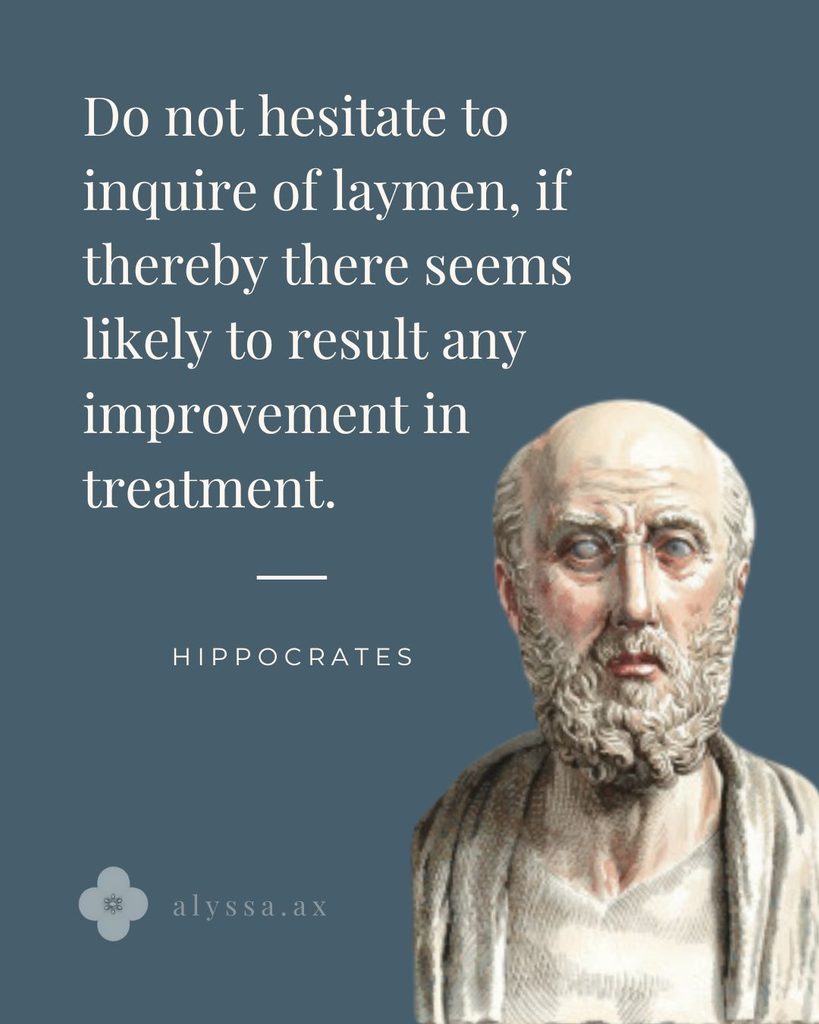
I could not have invented that exchange. The book club was off to a difficult start. Political science and medicine had arrived at the same meeting, each with its own dead Greek or Frenchman.
Neither had ever implemented a patient-record system, but in fairness neither had yet been blamed for this one.
In June 2024, the board selected Jeanette Pajunen for another seven-year term. In November 2025, she resigned, with confidence collapsing around legal expenditure and procurement practice. The chair’s subsequent account was that the board would otherwise have acted.
In December, Sandra Listherby told the Lagting that the board had asked about legal-service procurement after the audit and received assurances that procured framework agreements existed. Marcus Måtar challenged the absence of that inquiry from the minutes. Alongside the procurement failures cited in Pajunen’s departure, this raises a rather fundamental question about whether the people responsible for oversight could rely on the answers they had received.
Seven years is a very long time in public administration. Apparently it can pass in a mere seventeen months.
There is another useful detail. ÅHS replaced its internal jurist post with a verksamhetsstrateg in 2020. By late 2025, the budget committee was recommending consideration of an in-house lawyer.
We appear to have outsourced the lawyer while retaining the legal problems. Sometimes institutional development means paying consultancy rates to rediscover what used to be on the payroll.
2026: What Was the Board For Again?
This year 2026, the argument has returned to the board itself.
After a drawn-out dispute over opposition representation, Andreas Kanborg joined in March, offering strategic perspective and economic expertise. His party Obunden Samling had campaigned to abolish the board, a proposal he said remained alive, though not currently active.
In May, ÅHS had appointed Erica Bonns for seven years, at €15,000 a month plus agreed travel and housing costs. A paediatric specialist with experience of digital healthcare and running a company, she was described by chair Sara Kemetter as “en lottovinst”, a lottery win. We shall return to what the winning ticket is expected to deliver.
On 7 October, he and Sandra Listherby announced their departures, complaining that too much was presented for information when the board should be making decisions. Both explicitly said their criticism was not directed at the new director, Erica Bonns.
For a party that wanted the board abolished, I guess personally removing yourself as one member is at least a start.
It is difficult not to admire the efficiency with which Åland can move from “why does this board even exist?” through a fight over who should sit on it to “why is this board not doing more?” without pausing to enjoy the scenery in between. Before the next round of musical chairs, perhaps we could establish what the furniture is for.
Everybody wants a seat at the table until the table catches fire.
Board chair Sara Kemetter’s answer is that the strategic decisions were made in June; implementation then belonged to management. Kanborg and Listherby describe a board exercising too little meaningful control. Those accounts raise questions about what was authorised, what could still change and when members could intervene.
There was a budget decision. Then negotiations. Then operational consequences. Then a pilot. Then something was taken for information. Then something was supported. And eventually everybody was standing around a fully grown decision asking where exactly it had come from.
Strategy occurs before its consequences become photogenic.
But approving a framework cannot mean responsibility evaporates when the framework becomes a ward, a staffing arrangement or somebody’s care.
Nobody marches with a placard saying COUNTERFACTUAL BUDGET ANALYSIS NOW!
June’s strategy cannot become September’s nobody.
Nor has this board simply nodded through every demand. It kept Godby health centre in March and returned the proposed budget framework in August because it considered the savings excessive. Those events belong in the account too.
The government also proposed easing the 2027 savings requirement from €5 million to €2.5 million, allowing the planned cuts to purchased care outside Åland to be avoided. Revising a demand when its consequences become clearer is something government should be capable of doing.
And now we arrive at the beds.
In September, ÅHS announced nineteen fewer beds across four services, including a reduction from ten palliative places to five. By early October, up to seven palliative places were being discussed. Staff raised concerns. Management defended the changes. Messages about relocation conflicted. The abstraction had acquired a body.
Nobody cries over an Excel cell.
They cry when they recognise what it might mean for someone they love.
Palliative care touches a particularly deep promise: that when cure is no longer possible, care will still be there. Pain will be relieved. Someone will answer. There will be room for the person dying and for the people who cannot bear to lose them.
That is why a proposal about beds and premises can be heard as a question about whether we will be abandoned. It deserves an answer people can trust, including a concrete account of how care will work. The depth of that fear does not settle the correct number of beds. It does explain why an assurance that the figures add up cannot, by itself, settle the fear.
The wider plans also include developing care at home, and supporters of reform have described a mobile palliative team. Better care can mean helping people remain where they want to be, with appropriate professional support. That deserves serious consideration. So does the timing: Bonns distinguishes the current bed reductions from the future expansion of home nursing. We need to understand what capacity exists at each stage, as well as what the eventual model promises.
Here I am going to be direct and firm: I do not know how many palliative beds Åland needs. I have not seen enough of the occupancy, staffing, clinical and alternative-care evidence to determine that.
It turns out that reading several newspaper articles does not confer specialist competence in palliative medicine. A regrettable limitation of the subscription model.
I am perfectly capable of being mistaken. I simply prefer not to schedule it in advance.
So I am not going to build a position on incomplete information. I refuse to.
Looking at Facebook, I recommend more people try this approach.
I do know that counting beds cannot settle the matter without asking what care they provide, who needs it, what happens at peak demand and where the work goes if those beds disappear. A cost transferred to another ward, a municipality or an exhausted relative has not ceased to exist. It has changed its address.
I also know that keeping everything as it is carries consequences of its own. Demography does not suspend operations while we establish whose fault it is. Money, staff and time are finite. Governing means making choices among real possibilities, including the consequences of postponing them.
Mogens Lindén argues that the real expertise is among the staff treating patients. They certainly possess knowledge that should shape decisions before the choices have closed. But Erica Bonns is a paediatric specialist, and Peter Nieminen is a chief physician. A medical degree does not expire upon appointment to management.
Nor does their expertise count only when it agrees with one’s personal position or wish.
Expertise appears to become suspiciously volatile in this argument: abundant on the ward, liable to evaporate on the way upstairs.
If the elevator is destroying medical qualifications, perhaps we should start the reforms there.
Doctors know things the rest of us need to hear. But it is one band of expertise, sometimes limited to one specialised area of medicine. That does not make a doctor the final authority on procurement, organisational design, democratic representation or the distribution of scarce resources across an entire society. Nurses know things doctors miss. Patients and relatives know things neither may see. Managers have to consider consequences beyond an individual service. Each can also be wrong, defensive, overconfident or attached to a familiar, comfortable arrangement.
And every one of them is capable of mistaking the part of the elephant they are holding for the entire fucking elephant.
Expertise does not cancel interest. Interest does not cancel expertise.
Experience deserves a chair at the table. It does not automatically include all the other chairs.
A doctor may certainly know where my pancreas is. I should still like somebody to check whether the legal services were procured within a budgetary framework.
The task is to build an institution in which these perspectives can actually correct one another. As I stated in my last piece, listening must be capable of changing a decision.
It also cannot mean that whichever profession speaks with the greatest authority acquires a veto over everyone else’s responsibilities.
There is an old Mogens Lindén line worth retaining here. In December 2023, discussing a possible board appointment, he warned:
träffar du en tvärsäker doktor ska du byta doktor.
He extended the warning to politicians.
On this, Åland’s healthcare Blackadder offers excellent advice to the entire cast, including himself.
Epistemic humility sounds rather solemn. In practice it includes recognising where your knowledge stops, what might change your mind and which consequences somebody else will have to live with. It is especially useful when you possess enough expertise to make being wrong sound very convincing.
There is a useful interval between hearing the first alarming fact and announcing the final answer. It is traditionally known as thinking.
And it applies upstairs too. A presentation is not proof that a board can govern. A consultation is not meaningful merely because somebody attended. Calling a change a pilot does not make it reversible if the staff and expertise needed to reverse it have already dispersed. These are questions one can ask without pretending to know the correct number of beds.
Institutional memory is useful. It becomes rather less useful when we turn its owner into either the villain or the oracle of the entire institution.
Mogens has much to contribute. He can also have a way of explaining at people rather than speaking with them. The distinction is small on paper and considerably larger at the receiving end. A conversation can begin to feel like a lecture for which nobody remembers registering.
I have not forgotten the man who took the trouble to welcome me to Åland. It was a very kind gesture, and one I still remember over five years later. Both impressions belong in this account. His manner does not put his arguments beneath consideration. Neither does his kindness or intent put his manner beyond criticism.
By September 2026, Allberg, yes–the very first ÅHS director, was again commenting on ÅHS.
In his 17 September letter, he argued that leadership must be present in the organisation and involve staff in preparing major changes. He criticised what he described as exceptionally high remuneration combined with acceptance of part-time service in senior medical roles:
Denna ordning ger dåliga förutsättningar för framgång!
(English: This state of affairs provides bad conditions for success.)
He then asked, pointedly, whether Mariehamn would recruit a city director who worked part-time while living in Helsinki. That is his criticism of the arrangements, and quite a sharp comparison.
There is also a useful earlier statement. In March 2000, running Hälsinglands sjukhus in Sweden, he argued that politicians’ demands for financial balance conflicted with their existing decisions about maintaining hospital services. Management’s responsibility was to spell out the consequences so politicians could choose. His assessment:
Vi befinner oss helt enkelt i en ödessituation.
(English: We are, quite simply, in a make-or-break situation.)
He argued for leadership present in the organisation and staff involved in preparing major changes, while criticising the combination of high remuneration and part-time service in senior medical roles.
The man who had written a foundational coordination report in 1992 was still explaining the conditions needed for people to work together.
At least the original cast had retained commenting rights.
Must Walk on Water. Archipelago Experience Preferred.
The salary criticism needs to answer a question of its own: have we even been paying attention to the job? We require clinical credibility, financial discipline, organisational reform, digital competence, political tact and the ability to recruit scarce staff. Then we expect the director to make economies without anyone experiencing a loss.
The vacancy appears to be for a director. The expectations suggest we are actually recruiting the Second Coming.
A high salary deserves scrutiny. So do presence, performance and the terms of employment. But a salary is neither self-evidently justified nor self-evidently extravagant without asking what responsibility it buys, what recruitment requires and whether the person has the authority and support to do the work. €15,000 a month does not confer the power to manufacture nurses or repeal population ageing.
The speed of the passage from lottery win to public disappointment in local commentary is instructive. A September opinion piece attacking ÅHS’s leadership opened with the generous salaries of Bonns and Nieminen and proceeded to their supposed failures of thought. A subsequent piece by the same writer called minister Arsim Zekaj confused and likened his explanations to Trump’s. These are examples of the rhetoric, not a summary of everyone’s objections. Bonns and Zekaj must answer for their decisions. Neither personally invented the conditions under which those decisions have to be made.
Allberg’s two interventions, twenty-six years apart, belong together. Leadership needs to be present and listen. Political instructions also need to be possible to carry out. “Find somebody better” is a recruitment instruction. It is not a healthcare strategy.
Åland’s smallness is a real constraint. We need a breadth of care that cannot shrink neatly in proportion to the population. Some local capacity must exist even when it is not fully occupied; some specialist care must be reliably available elsewhere. A few expensive treatments can upset a small budget. Smallness cannot be managed away by hiring someone impressive and waiting for them to become unpopular.
So what would doing this properly require? The government is right to insist that a changing population and finite resources require reform. Zekaj also has a point when he objects to demanding adaptation and then politicising each operational change. But government cannot demand savings and leave management to guess which political promises it is allowed to break. It must say what care Åland is committed to providing, fund that commitment credibly, and own the choices where everything cannot be maintained.
The board must make the boundary between strategy and implementation usable: what has it decided, what has it delegated, and which changes require a fresh decision? Management must show the evidence, the alternatives and the practical arrangements, including who will do the work before a replacement service exists. A pilot needs published criteria for success, a review date and a way to respond if the assumptions prove wrong.
Lindén is right that staff knowledge must shape decisions before they are settled. He is wrong insofar as that becomes a claim that expertise belongs exclusively to the ward or entitles one profession to determine the whole settlement. Staff and patients need a route to influence decisions and to see how their concerns were answered.
Critics also need to put the risks and costs of their preferred alternative beside the risks and costs of the proposal they oppose.
Finally, the institution needs to retain what it learns. Record the reasons for decisions, follow up their consequences, and carry those findings into the next budget, recruitment and handover. Thirty years of newspaper coverage should not be the most accessible induction programme.
What saddens and angers me is how readily structural conditions are turned into allegations about a human being’s character. Demographics, staffing pressures and the limits of a budget become somebody’s moral failing. The person explaining the difficulty is treated as though they personally arranged it. That is profoundly unfair.
There are moral choices here: whose needs take priority, who bears the cost of change, what we fund and what we allow to deteriorate. Those choices deserve serious argument. So do the consequences of carrying on as we are.
But caring deeply does not make every existing arrangement sustainable. Nor does recognising that make someone indifferent to the people who depend on it. The moral work is deciding how to care for them under the conditions we actually face.
We cannot keep asking people to prove their compassion by declining to notice the arithmetic.
I have lived here for just six years. I cannot supply thirty years of institutional memory. The archive can supply quite a lot of it, however, and I have now done an unreasonable amount of the reading.
I am never getting those hours back. But I do appreciate what they have given me: a clearer view of the pattern, and of the system that keeps producing it. Each new board, minister, director and employee inherits arrangements, expectations and unresolved questions that were there before them. Their choices matter. So does the machinery through which those choices must pass.
After this much reading, I understand better how people can arrive with quite different intentions and still find themselves performing remarkably familiar scenes.
The wardrobe department cannot carry the entire reform programme.
When you have not spent decades assigning people their permanent roles, you can still notice when the supposed outsider used to be management, when the critic becomes the board member, and when the institution is defending an arrangement its own history gives it reason to reconsider.
In the end, all the people in this story are capable of knowledge, vanity, courage, mistakes and changes of mind. The institution needs to make room for those realities without making the quality of care depend on which public personality wins the latest episode.
There are limits to what a hospital can save.
There must also be limits to how often a society pays to discover the same thing about governing it.
At ÅHS, the past has an impressive record of reappointment.
Perhaps the next organisational chart could include a place for what we learned last time?
Comments