
On distance, belonging, and what we reveal to one another.
I can put an Ålandic committee into an English sentence and, with a little luck, produce two quite different responses.
Someone here might think:
I have never quite heard it put like that.
Someone elsewhere thinks:
Oh God. We have one of those.
The committee has not moved an inch. But the distances around it have changed.
One reader has stepped back from something familiar. The other has come closer to something foreign. For a moment, they are standing somewhere neither quite occupied before, looking at the same arrangement of human beings.
This interests me rather more than simply poking fun at a committee. Although I am human, and some committees do make a compelling case.
I have written here before about my choice of English: what it gives me, where it allows the writing to travel, why another language can make a familiar place sound unexpectedly like itself. But underneath the question of language is something more intimate.
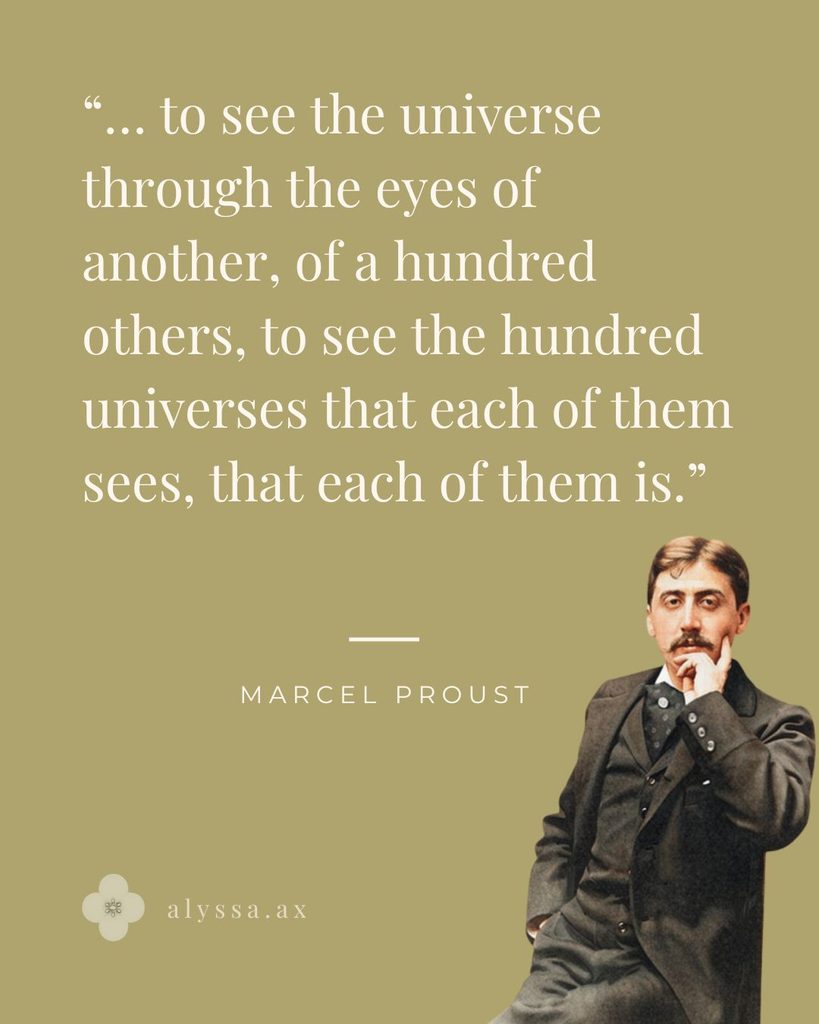
What happens when we borrow another person’s eyes?
What do we discover about the world—and about one another—when somebody asks us to look again?
A borrowed first sight
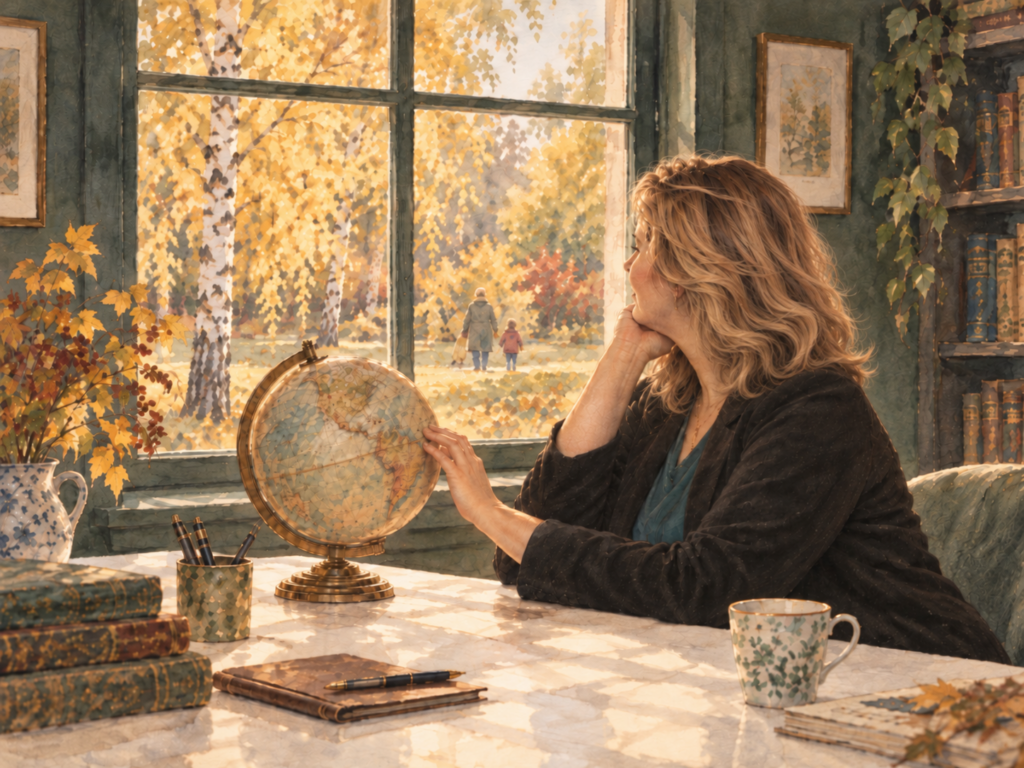
This month 28 year ago, I travelled via a small plane from Zürich to Innsbruck with my Swedish host family during fall break. I had just turned eighteen, newly arrived in a world I had spent much of my childhood trying to enter through books, maps and the little globe at my grandparents’ house.
And the Alps were outside the window.
Of course they were. That was where the Alps were supposed to be.
But knowing that mountains exist is a rather inadequate preparation for encountering them. I pressed my face towards the glass. The landscape I had known in pictures had acquired depth, light, an almost unreasonable physical presence.
Then I looked up and saw Magnus, my host father, gazing intently at me with a warm smile.
I was looking intently at the mountains.
But he was watching me.
The landscape was immense. For a moment, my first sight gave him a second.
When I returned to that memory in my Sommarprat for Ålands Radio in August 2025, I tried to describe the exchange in my best Swedish.
Nykomlingens glädje är att se världen med otränade ögon. Att förvånas av skönheten i det som lokalbor och världsvana slutat lägga märke till.
En värds glädje är återupptäckten – att få låna en nykomlings förundran. Att minnas att ens vardag – nationalrätten, den vackra naturen, till och med ens politiska system – kan vara någon annans mirakel.
Att vara vän med en nykomling är att bli stillsamt inbjuden att förälska sig igen i sin egen värld.
In English:
The newcomer’s joy is to see the world with untrained eyes. To be astonished by the beauty in what locals and seasoned travellers have stopped noticing.
The host’s joy is rediscovery—to borrow a newcomer’s wonder. To remember that one’s everyday world—the national dish, the beautiful landscape, even one’s political system—can be somebody else’s miracle.
To be friends with a newcomer is to be quietly invited to fall in love with your own world again.
I still think there is something important in that last sentence.
We speak so readily about what newcomers need to learn when they arrive here. The language, the customs, the history, the unspoken things that everyone else somehow absorbed without receiving a handbook. There is much to learn. I am still learning.
But the person who does not yet know your world also brings something into it.
The astonishment has not worn off. The comparison has not disappeared. What you pass every morning may stop them in the street. Something you consider ordinary may loosen a knot they have carried for years.
And through their response, you may recover something of your very own first encounter.
You do not have to lose your world to discover it again.
Sometimes somebody else can return it to you while you are still standing in it.
That is one of the things I want to give through writing.
Not merely information about what is outside the window.
Something of the feeling of looking.
Making the familiar strange
There is a literary history behind this movement.
In his 1917 essay Art as Technique, the Russian Formalist Viktor Shklovsky described ostranenie, usually translated as defamiliarization or estrangement. Habit, in his account, can reduce perception to recognition. We identify the thing and move on, scarcely encountering it. Art interrupts that economy: through unfamiliar descriptions and forms, it makes us spend time with what we thought we already knew. Its task is, in his memorable formulation, to
make the stone stony.
The word stone is convenient. The weight of one in your hand is another matter.
Shklovsky even uses the sentence “The Swiss mountains are beautiful” to illustrate how a whole expression can be mentally reduced to its initials. The words remain available, while the experience they name recedes.
Apparently the Alps had been waiting for me in literary theory as well.
Bertolt Brecht gave estrangement a distinctly political purpose in his twentieth-century theatre. His Verfremdungseffekt sought to make familiar conduct and social relationships available for conscious examination. In A Short Organum for the Theatre, written in 1948, he argued for representations that would help audiences see historical conditions as things people create and maintain—and can therefore change. The aim was not simply to arouse feelings within the world of the play, but to encourage thoughts and feelings capable of transforming that world.
A familiar scene, seen from another position, can cease to look inevitable.
That is the possibility that interests me. The small interruption between recognising something and accepting the explanation that normally accompanies it.
Sometimes a metaphor creates it. Sometimes a joke. Sometimes all that is necessary is to describe what happened without using the phrase that usually makes it sound reasonable.
And sometimes the interruption brings us back to beauty.
The sea becomes more than the bit beside the road. A familiar voice acquires, for a moment, the strangeness of belonging to a separate human being whose whole life we will never quite know. The person we have been calling a mother, a colleague, a neighbour comes into view beyond the convenience of their role.
We had the name.
We had just stopped looking.
Near enough, far enough
Åland is a particularly interesting place in which to think about distance.
From elsewhere, it can be a small uncertainty on a map: some islands between Sweden and Finland, a flag someone does not recognise, a place that requires a little explanation before the conversation can continue.
From here, it is a whole world.
There is a peculiar intimacy in living somewhere that another person can overlook with a fingertip. The map gives them a small mark. Inside that mark are children going to school, people falling in love, somebody waiting for a diagnosis, someone discovering that a life they thought was settled has dramatically changed.
Nothing about those experiences is smaller because the place occupies less paper.
Here, the horizon keeps reminding me that elsewhere exists. Daily life keeps reminding me that people are near.
When we arrived on Åland in August 2020, in the middle of the pandemic, neighbours appeared within an hour after the moving truck drove away. They brought bread, cheese and cider, placed them on the doorstep and asked questions from a distance.
There was no embrace.
But the welcome crossed the space they were careful to leave between us.
I think about that when distance is treated as the opposite of care. Sometimes the space is part of the care. Sometimes a person who gives you room has come closer to understanding you than someone who insists on standing beside you.
The social nearness of a small place has its own gifts. In my experience here, help often has a name before it has a procedure. Someone knows whom to ask. Someone remembers what happened. The person in the public role also exists elsewhere, in another relationship, with other responsibilities.
That can make public life more human.
But it can also make it difficult to step back.
When an argument arrives carrying years of acquaintance, disappointment, gratitude and loyalty, it is not easy to hear only the argument. There may be excellent reasons to trust someone. There may also be reasons we have stopped examining because examining them would disturb something larger than an opinion.
An explanation can become so familiar that it feels almost disloyal to ask whether it explains anything.
I live within these relationships, but I did not inherit all of them. I can learn the history without having lived every allegiance it produced. At the same time, I cannot close the laptop and exempt my family from the consequences of what happens here.
That is the double vision.
I am close enough for the world I describe to matter to me, and I carry enough of elsewhere to know that ordinary has more than one possible shape.
English gives that perspective somewhere to move. A familiar title enters another language without quite the same tone of voice around it. A name that carries decades of local associations here may arrive elsewhere as a name. The reader needs to be shown why the person matters, what the responsibility is, what actually happened.
And in the act of making those things intelligible to somebody outside, they can become newly visible to somebody within.
In Same As It Ever Was, I gave the history of ÅHS a wardrobe department. The changing clothes helped mark the passage of time while the recurring institutional arguments remained in view. The theatrical framing was already there in the opening: a changing production, familiar dialogue, a conspicuous reluctance for the plot to move on.
The joke lies in the recognition.
But the recognition can do different work for different readers.
Someone here may know the people and begin to reconsider the roles. Someone elsewhere may recognise the roles and begin to understand the people. A local controversy becomes less automatic for one reader and less remote for another.
They do not have to end up with identical opinions. They have, however, acquired somewhere to look together.
This is part of the pleasure of writing a small place outward. Its particularity does not have to be removed before it can mean something to someone else. The unfamiliar names can remain. The history can remain. The sea can remain exactly where it is, causing its usual logistical complications.
Recognition does not require sameness.
A person far away can encounter an Ålandic argument and recognise the exhaustion of asking a question that nobody quite answers. They can understand the relief of finally being heard. They can laugh at an institutional absurdity without having attended its inaugural meeting.
And someone here may discover that what felt like an exclusively local predicament belongs to a much larger human conversation.
The room gets bigger.
The Mind’s Eye
Our eyes can follow a stranger only so far. Across a garden, along a street, through a window, until a corner is turned and the person disappears.
But the mind’s eye can travel further.
It can imagine the life continuing beyond the edge of our vision. A childhood we never witnessed. Someone waiting at home. A private sorrow, a remembered happiness, a future taking shape without our knowledge.
We cannot know these things merely by imagining them. But we can recognise that they exist. And perhaps this is where wonder begins to become something more demanding than curiosity: in the recognition that another person’s life is as immense to them as our own is to us.
We are not the boundaries of one another’s worlds.
There is another distance in all of this, and it is harder to explain without an ache.
A life lived across places becomes distributed among people.
Some know where your voice began. Others know what it spends its days responding to. Some remember the young person who left; others have only encountered the person she became. Each knows something true, but the pieces do not automatically find one another.
There are people who can hear the Pennsylvania in me without understanding the society in which I am raising my children. There are people here who understand the immediate subject of an argument without necessarily hearing everything that travelled into it with me.
Writing has given those worlds somewhere to meet.
People who have known me for decades can encounter more than photographs from a life abroad. They can see something of what I love, what catches my attention, what makes me laugh, what I cannot reconcile. That was already part of what I tried to describe in my earlier essay Not Lost in Translation about writing Åland outward: the pleasure of allowing people elsewhere to encounter the lived world behind the pictures.
And readers here can encounter a voice that did not begin at the border.
For the length of an essay, I do not have to keep those parts of myself in separate company.
In my radio talk, I said:
Vi som lever i översättning vet att saknad också är en form av kärlek.
In English:
Those of us who live in translation know that longing, too, is a form of love.
Writing is one of the things I do with that longing.
I cannot bring everyone I have loved into the same kitchen. I cannot recover every conversation that distance made impossible, or make one place contain all the versions of me that grew elsewhere.
But I can write a sentence that reaches someone there from someone here.
And they can recognise the voice.
There is intimacy in that recognition, even when the subject is apparently public. Perhaps especially then. To understand what occupies another person’s attention is to understand something about the life they are actually living.
It is also possible to become fond of a place through somebody else’s attention to it. Not the place arranged for visitors, but the place in which people are trying, failing, arguing, helping, making something of their days.
A reader may never stand on this shore. Still, the people here can cease to be abstractions.
That is more than explanation.
It is a kind of company.
What the eye also finds
But an attentive eye cannot promise to return only with lovely things.
There is another sentence in the same chapter of my Sommarprat:
Förundran är inte bara skönhet. Det är att se klart – och aldrig kunna blunda igen.
In English:
Wonder is not only beauty. It is seeing clearly—and never being able to close your eyes again.
I meant that too.
The eye that notices an ordinary kindness may also notice an ordinary cruelty. The perspective that makes a familiar achievement look remarkable may make a familiar excuse look inadequate.
You cannot ask another person to bring you the gift of their perception and guarantee in advance that every discovery will be flattering.
Nor can you make that bargain with yourself.
Sometimes wonder is the astonishment of finding more goodness than you expected. Sometimes it is the bewilderment of discovering how readily people can accommodate something they would condemn if it were described from a little further away.
Humour has a place here. It can loosen the solemnity around an arrangement long enough for us to see what the solemnity has been concealing. For a moment, nobody quite manages to keep the required straight face.
Then the laugh subsides, and something remains.
A question. A contradiction. A person whose experience no longer fits inside the accepted account.
The joke may have opened the door. What we find on the other side deserves more than another joke.
This is why I need both nearness and distance. From too far away, people can become an elegant illustration of a problem. From too close, one person’s account can fill the whole field of vision. I want to move between the scale at which a pattern becomes visible and the scale at which somebody has to live through it.
The human consequence gives the pattern its weight.
And seeing the pattern may change what we owe the person.
There is power in that change of view. An arrangement that once seemed inevitable becomes something we can judge. We can ask what it protects, whom it serves, who carries its cost. We can also recognise what is worth keeping and understand why it deserves our care.
Things could be otherwise.
That recognition gives us something to do besides either accepting the world whole or rejecting it whole.
It also has a cost.
There are things we can remain uncertain about for a long time, and attachments we sincerely want to preserve. But once a recognition has settled into us, continuing as before is no longer quite the same act.
We know what we are overlooking.
Closeness can then become its own kind of distance: a gradual retreat from the judgment we once trusted, from the reason we cared, from the person we understood ourselves to be.
I do not think belonging can ask that of us.
Nor do I think affection becomes less real because it cannot make that sacrifice. Sometimes the love remains. It is the holding on that must end.
A clear view may disturb a cherished relationship with a place. It may also be the only way to keep that relationship honest enough to remain alive.
Look again
None of this means I want to become a person who can see only what is wrong.
That would be another surrender of vision.
The world would have become predictable again, reduced to a different set of familiar explanations. Every kindness would require suspicion. Every hope would arrive already discredited. I would know what I was going to find before I looked. From my radio talk:
Framtiden byggs aldrig av den mest cyniska personen i rummet. Det har den aldrig gjort. Den tillhör dem som fortsätter lyssna, välja, och riskera kärlek i osäkerhetens ansikte.
In my native English:
The future is never built by the most cynical person in the room. It never has been. It belongs to those who keep listening, choosing, and risking love in the face of uncertainty.
I do not want my disappointments to become so authoritative that nothing is allowed to surprise me.
There is a wonder that comes before experience, and a wonder that has made its way through it. The second has more to carry. It knows that beauty does not make a place innocent, that affection does not settle every question, that people can be generous and disappointing within the same lifetime.
It still looks up.
Near the end of my radio talk, I addressed the little girl with the globe:
Förundran är motstånd. När världen känns liten är din inre värld oändlig. Nyfikenhet är helig intelligens. Aldrig släpp den.
In English:
Wonder is resistance. When the world feels small, your inner world is infinite. Curiosity is sacred intelligence. Never let it go.
That was not advice to remain a child.
It was a promise not to abandon something the child understood: that the world is larger than the portion we have been given, and that other people’s lives are worth imagining—and worth allowing to change our own.
I am still interested.
After everything, I am still interested.
In the place. In the people. In the extraordinary things we manage to build together, and the astonishing complications we introduce while doing so. In the kindness that arrives without an audience. In the sentence that suddenly makes something clear. In the person whose story rearranges what I thought I knew.
There is plenty here to laugh about. There is plenty to grieve. There is more to come. There is far too much to fit into one life, which is perhaps one reason we keep trying to share it.
Distance allows us to see what familiarity conceals. But when we share what we see, distance can become a form of intimacy.
Sometimes even an embrace.
I do not need every reader to stand exactly where I stand. I would like them to feel that something has become available to them: a place they had not understood, a person they had reduced to a role, an experience they had believed belonged only to them.
Or something in their own world that my attention helps return.
Perhaps you arrive here knowing very little about Åland and leave feeling that it contains people you could care about. Perhaps you have lived here all your life and encounter something familiar with a small, startled pleasure.
Perhaps you look up from the page and notice the light in your own window.
That would matter to me.
Because I remember the mountains, but I also remember the man looking back at me. His smile is part of what I saw. The beauty of that moment was never entirely outside the glass.
Something became possible because we did not bring the same eyes to it.
I would like to keep making room for that exchange.
Keep your courage. Your curiosity. Your clarity.
Wonder should be shared. Clear sight should never be surrendered.
Look again.
And tell me what you see.
Comments