
On Emily Dickinson, Midsommar, and the hidden work of becoming
Author’s Note: I wrote this on Midsommar, 21 June 2026, after nearly two months of carrying an authorship dispute over Everyone Can Flourish. I had been fighting simply to remain named and connected to work I had helped create, while being told not to contact the publisher or lead author about it. Nor even have my name on my own work on my own research profile on Zenodo. By then, I well suspected the story would not have a happy ending. So Dickinson was coded writing: the hidden conditions, the right of dew, the things that must be endured before anything is allowed to bloom. Within days, the website began to change. July 1 the news came that the publication was dead.
Midsommar has bloomed, and the days here in the Nordics are at their brightest.
My great-grandmother Beatrice (1899–1991) loved Emily Dickinson’s poetry, and I still have distant memories of visiting her in the nursing home and reading poems aloud to her when her vision had failed. It was good for her to listen, and good for me to practise my elocution as a child.
The cream afghan she made for my parents’ marriage in 1979 has been at the foot of my bed since I was twelve. I am lying on it as I write this little post. She also made the Christmas stocking I have had my entire life, since my birth in 1980. Of hers, I also have a quilt covered in pansies, her favourite flower, tucked away safely.
I wish I had needle skills like hers. Every time I see the pansies planted outside my front door, I am reminded of her.
So Dickinson, who died thirteen years before my great-grandmother was born, and who you will notice loved the dash — and no, she most certainly did not have AI — does not arrive for me only as an abstract literary reference.
She comes with thread, inheritance, sleep, memory, and the quiet company of women who left something behind by hand, in words or in craft.
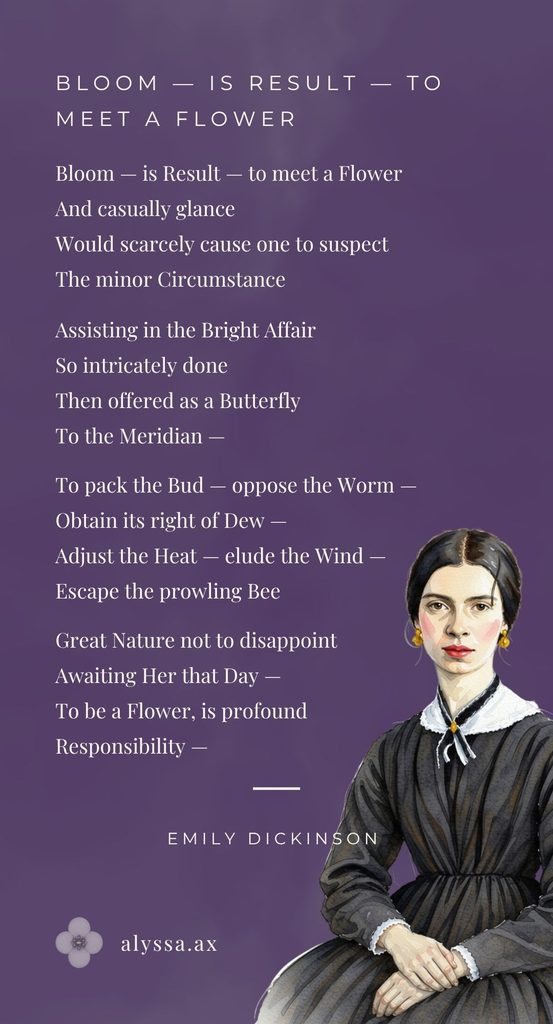
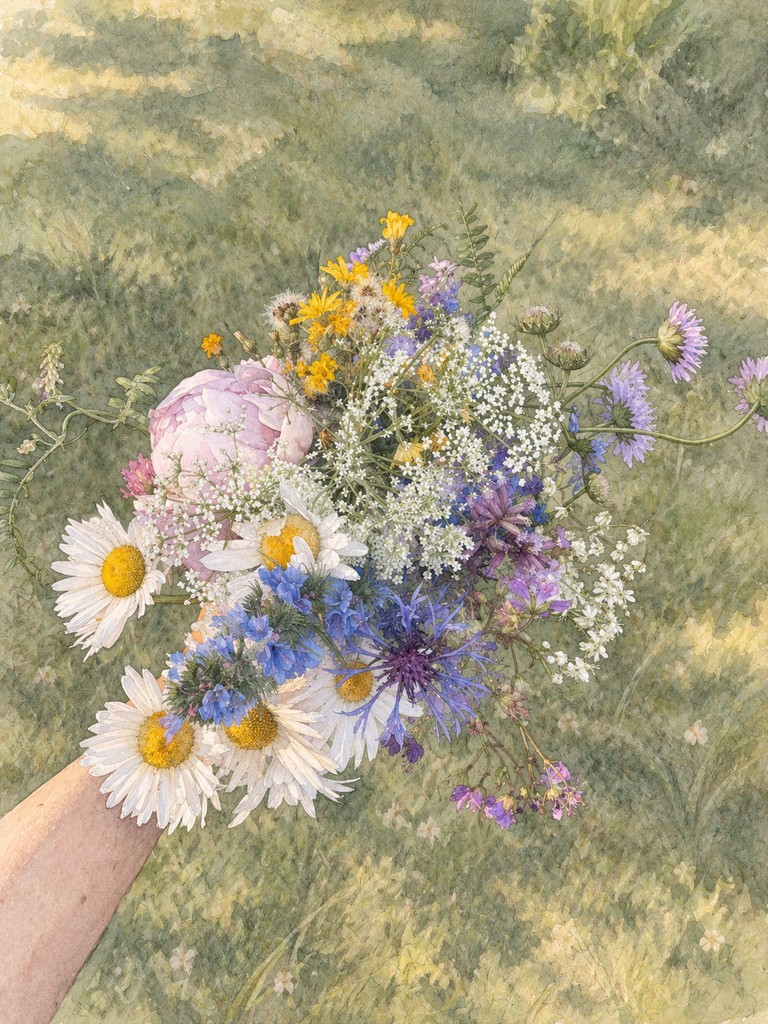
This poem feels right for Midsommar because it refuses to treat flowers as mere decoration, something I have always respected. Flowers remind us of presence. They remind us that summer is vivid, embodied, and fleeting.
“Bloom — is Result —”
That is the whole turn.
Bloom is not presented as accident, prettiness, or ease. It is an outcome. Something has happened before the flower becomes visible.
To meet a flower and “casually glance,” as Dickinson suggests, is to miss almost everything. The casual glance sees colour, delicacy, maybe beauty. It does not suspect “the minor Circumstance,” a phrase that feels almost wry once the poem begins to unfold.
The circumstances are not minor at all.
They are simply hidden.
The flower has been assisted into its “Bright Affair,” and that brightness is “so intricately done.” There is ceremony in that phrase, but also labour.
A bloom is an event made possible by many small, exacting things that had to happen before flowering could occur.
Then Dickinson gives us the flower almost as a butterfly, offered to the meridian: a rooted thing becoming visible in full light. Something that began folded, protected, and unseen is suddenly exposed to the height of day, much as the days are at their absolute brightest now.
But before that offering, there is the work.
“To pack the Bud” means to hold becoming tightly before the time has come.
“To oppose the Worm” means survival is part of beauty and flourishing.
“To obtain its right of Dew” is one of the poem’s most striking phrases: not merely to receive dew, but to obtain its right to what it needs to become.
“To adjust the Heat” is to live with intensity.
“To elude the Wind” is to endure instability.
“To escape the prowling Bee” reminds us that even what belongs to the natural order may arrive as pressure, hunger, attention, or demand.
The flower is delicate, but it is not passive.
It is beautiful, but it is not simple.
By the end, Dickinson has made the flower accountable to something larger than itself: “Great Nature” is awaiting it. The bloom matters because it participates in a larger order. It is not just a private achievement.
It is part of the world keeping faith with itself.
To be a Flower, is profound
Responsibility —
For these recent months, and for this Midsommar, that feels exactly right.
Not flowers as ornaments for maypoles or flower crowns.
Not flowers as easy symbols of summer.
Not flowers as proof that life is gentle.
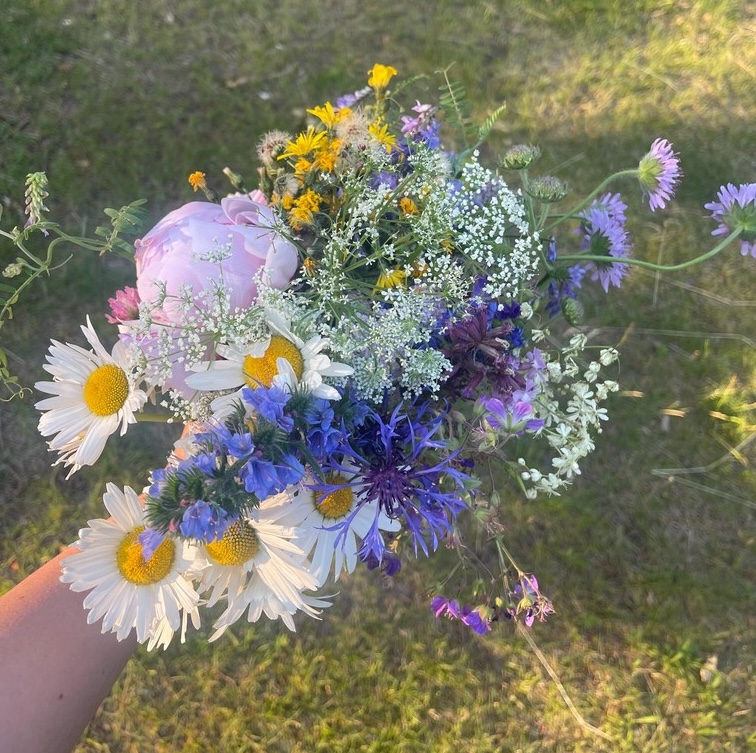
Flowers as evidence.
Of timing.
Of presence.
Of endurance.
Of hidden conditions.
Of what had to hold.
Of what had to be survived.
And of the astonishing seriousness of becoming.
And perhaps that is why I have never been able to mistake the flower for the whole story.
Comments