



On the Sustainable Management of Disagreement and Other Threats to Institutional Comfort
On 23 September 2026, Åland’s Development and Sustainability Agenda turned ten.
The Development and Sustainability Council marked the occasion with a meeting.
Over three weeks later, the minutes have yet to appear.
Ten years of planning the future. Three weeks—and counting—to put one afternoon on the record.
A glance through the Council’s protocol archive, accessible via bärkraft.ax, suggests that minutes are ordinarily published within a few days—not weeks.
Perhaps the wording requires particular attention this time.
But if the reporting on Ålands Radio this week is to be believed, there has been a considerable difference between what was said, what was understood, and what everyone is prepared to put on the record.
Now, I appreciate that democracy takes time. Consultation takes time. Deliberation takes time. And an institution concerned with sustainable development must naturally think in the long term.
Still, for a Council that meets all of three or four times a year—and has a rather handsomely paid head secretary—one might reasonably expect the minutes of those rare gatherings to appear before they pass into Ålandic oral history.
To be fair, the head secretary has other responsibilities. Many of them, in fact. I’ve already examined the rather extensive arrangements surrounding his appointment in Everyone Can Advise.
For the moment, one is interested in just one modest deliverable.
A protocol.
Ten years into the sustainability agenda, one would hope we might have mastered the renewable production of meeting minutes.
But while we wait, I thought we might entertain ourselves with a little game.
Place Your Bets: PROTOKOLL BINGO!
The 23 September Edition — Minutes of Silence
Ladies and gentlemen, prepare your cards. Somewhere on Åland, a public document is making its way toward publication. We do not yet know what it will say.
But we have all attended meetings.
We know the lingo.
We know the music.
And we know how reassuringly similar the ending can sound, regardless of what happened in the middle.

Disclaimer: These are speculative formulations for satirical purposes, not quotations from the unpublished protocol. Any resemblance to the eventual document may simply indicate that I have attended way too many meetings.
How to play
Everyone gets the same card. Naturally. We would not want different starting positions to produce different conclusions. And I cannot make thousands of bingo cards.
Choose ten squares you predict will appear in the forthcoming protokoll. Make your selections before publication. Retrospective amendments are reserved for the institution.
Then wait.
The publication date is the first test of your commitment to sustainability.
Once the protokoll appears:
One point for each of your selected phrases that appears. Each square counts once, however often the Council expresses its confidence.
Two additional points if a selected phrase replaces a recognisable substantive objection.
Three bonus points if the protokoll identifies a problem but nobody responsible for addressing it.
Five bonus points if an acknowledgment that responsibilities are unclear is followed by an assignment to an unspecified responsible party.
Ten bonus points: Everyone was given the opportunity to speak, but the record establishes no discernible relationship between what they said and what happened.
Full House: All ten of your predictions appear. You have successfully anticipated the outcome of an open process.
Twenty bonus points if the Council agrees to establish a working group to examine how the Council might improve its ability to discuss the need for further dialogue about clearer responsibility.
- The working group will naturally report to the Council.
- The report will be prepared by the secretariat.
- The Council will note it for information.
The highest score wins. In the event of a tie, all winners will be described as having reached consensus, regardless of their individual positions.
Grand Prize: An all-expenses-spared trip to the next ordinary meeting, where you will enjoy a unique opportunity to raise a concern and later discover what it was.
Includes a commemorative group photograph and the opportunity to take responsibility for how your participation is communicated.
The prize is non-transferable. Responsibility remains transferable throughout.
Lycka till!
A brief and partial guide to the language
For those unfamiliar with the subtle and exquisite poetry of institutional minutes, a few expressions may require translation.
Olika synpunkter framfördes.
(In English: Different views were expressed.)
A beautiful phrase. It confirms that disagreement occurred while leaving open the possibility that nobody will ever discover who disagreed, about what, or why.
Rådet noterade informationen till kännedom.
(In English: The Council noted the information.)
An extraordinary administrative achievement. Information has successfully entered the room, been acknowledged by the appropriate authority, and departed without necessarily inconveniencing a single pre-made decision.
Behov av fortsatt dialog.
(In English: A need for continued dialogue.)
Not to be confused with the previous dialogue, which presumably produced the need for the continued dialogue.
Ansvarsfördelningen behöver förtydligas.
(In English: The distribution of responsibility needs clarification.)
An encouraging development. With sufficient determination, we may eventually discover who is responsible for determining who is responsible.
Frågan bereds vidare.
(In English: The matter will receive further preparation.)
A dignified resting place for many a difficult question. Not quite buried, not quite alive. Sustainably suspended between consideration and action.
And my personal favourite:
Rådet uttryckte fortsatt förtroende.
(In English: The Council expressed continued confidence.)
A statement that becomes especially interesting when the thing being questioned is the basis upon which that confidence rests.
Of course, these are all perfectly legitimate expressions.
Sometimes a Council genuinely reaches agreement. Sometimes a question requires further consideration. Sometimes information is received without requiring a decision.
But there is a difference between taking minutes and taking the point.
And this brings us to a rather more serious question.
What happens to disagreement when an institution turns a meeting into its official memory?
The remarkable cooling properties of institutional prose
I have developed a growing interest in the linguistic properties of meeting minutes.
Some meetings are difficult. Some are uncomfortable. Some involve substantive disagreement about what the organisation has been doing and whether it has been doing it particularly well.
On paper, however, institutional conflict can acquire an astonishing serenity.
Objections become “perspectives.”
Uncertainty becomes “discussion.”
Questions of responsibility become “opportunities for clarification.”
Nobody necessarily has to lie. Not needed.
The vocabulary can perform an impressive amount of the work.
We have an opportunity to examine this phenomenon rather closely.
Consider the Council’s meeting of 12 September 2025. According to the official protocol, the Council approved a proposed revision of its own mandate, with certain matters left for its November meeting.
That revision is particularly interesting because the previous mandate explicitly provided for proposed changes to be discussed with the wider Bärkraft network before formal adoption by the incoming Council. The revised arrangements instead gave the Council the ability to amend its own mandate, including through decisions taken per capsulam.
An institution established to represent different parts of society was reconsidering the rules governing its own authority.
Which raises a rather obvious question:
Who gets to decide how the institution decides?
Then came 11 February 2026, when the Council met at Högskolan på Åland.
Among other matters, the Council decided to extend the period for which its head secretary is appointed from two years to four and appointed Micke Larsson until its first ordinary meeting in 2030.
These are consequential decisions.
And the protocol records them with admirable economy.
It establishes what the Council formally decided. What it does not give a reader is much insight into the reasoning, reservations or discussion—if any—that preceded those decisions.
This is not inherently unusual. Minutes are not transcripts, and nobody needs or wants to read an official inventory of every raised eyebrow.
But the distinction becomes important when the nature or meaning of the decision is subsequently disputed.
And now we await the account of 23 September 2026.
Whatever that document ultimately says, it will become part of the institutional record against which future explanations can be tested.
That matters because minutes do not merely describe what happened.
They help establish what the institution will remember having happened.
A future Council member may never hear the arguments that preceded a decision. A member of the public may know only what the minutes record. A government official may later refer to a Council decision as justification for an administrative action.
The official language begins to acquire a life beyond the room in which it was produced.
This places an unusual responsibility on the people preparing and approving the record.
A protocol need not reproduce an argument word for word. But it should preserve the distinctions necessary to understand what was discussed, what was decided, and what was actually not agreed.
There is a difference between recording that an institution made a decision and demonstrating that everyone understood the decision in the same way.
The record of a meeting can become more certain than the people who attended it.
And as we saw this week, that can be a rather expensive certainty.
Someone actually said the quiet part out loud
On 13 October, Ålands Radio reported that Minna Hellström, Executive Director (förbundsdirektör) of the Association of Åland Municipalities and the municipal sector’s representative on the Development and Sustainability Council, had publicly raised concerns about the Council’s governance, division of responsibility and handling of criticism.
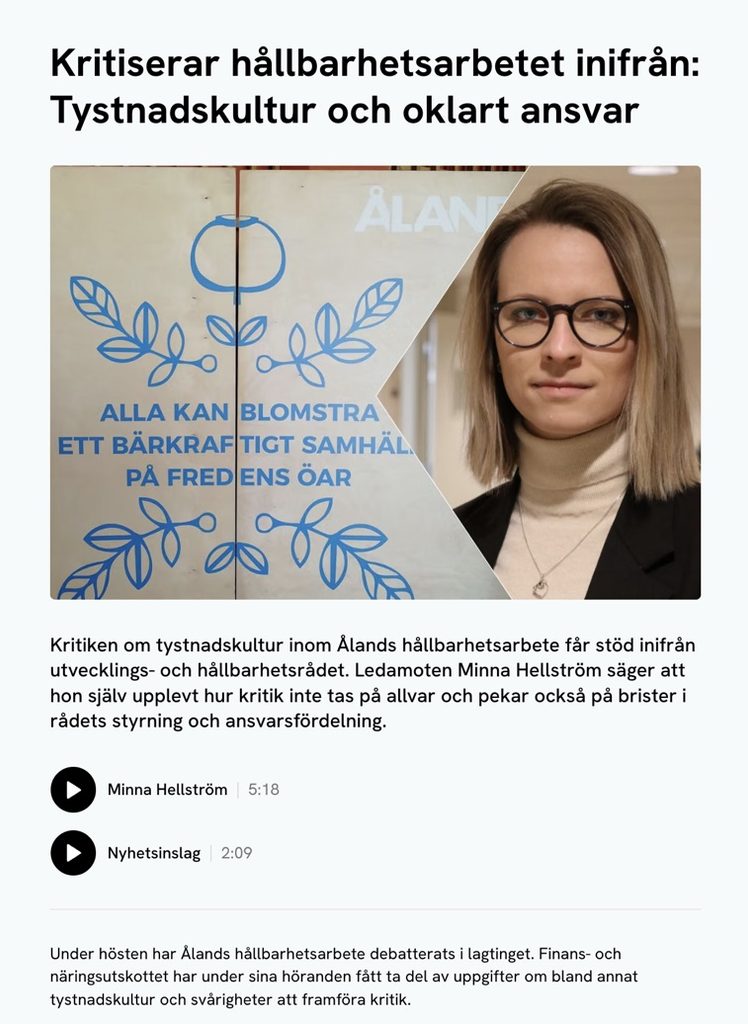
She also observed that the response to recent criticism appeared more focused on:
försvara systemet än att förstå vad själva kritiken bottnar i
(English: Defending the system rather than understanding what the criticism actually stems from.)
I find that distinction particularly important.
Hellström has clearly described a culture of silence that does not require anyone to prohibit criticism outright.
This casts a rather revealing light on lantråd Katrin Sjögren’s response in the media to warnings raised in the Lagting about a tystnadskultur or “culture of silence” within Åland’s sustainability work.
There is, of course, one key detail worth mentioning.
Sjögren herself chairs the Development and Sustainability Council.
So she is not an outside observer being asked to comment on somebody else’s institutional culture. She presides and is ultimately responsible for the very body whose handling of criticism is now being questioned from within by one of its members. Hellström has been on the Council for three years.
On 11 September, when questioned by Nya Åland about employees’ freedom to speak to the media, Sjögren responded:
Du tror väl inte jag satt munkavle på någon?
(In English: You don’t seriously think I’ve put a gag on anyone?)
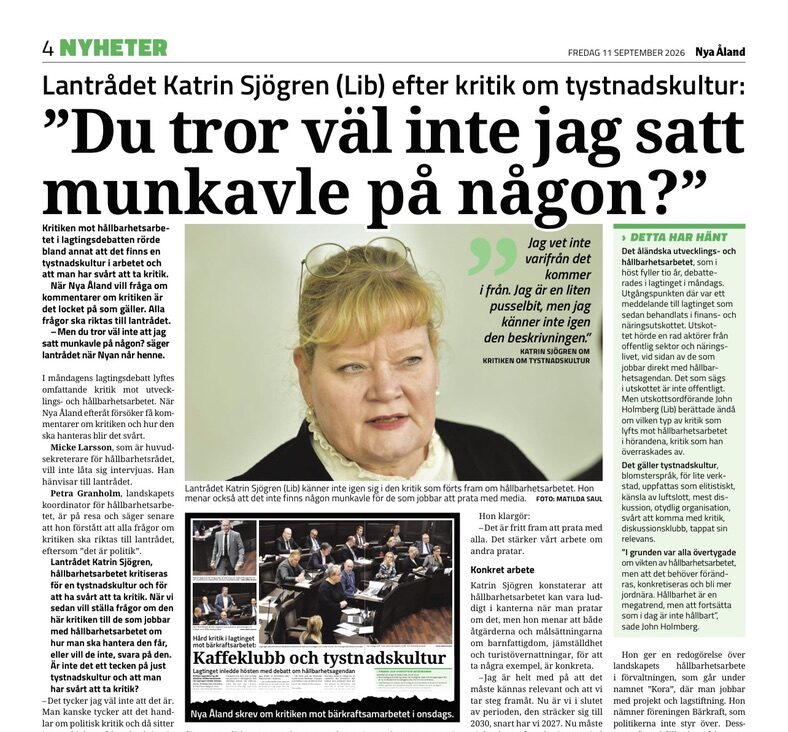
One would certainly hope not.
Refraining from silencing people is certainly not an act of enlightened leadership. Respecting freedom of expression is a legal obligation, not a personal favour bestowed by those in power.
Nor does administrative authority give public officials licence to suppress legitimate claims of authorship, sit in judgement on disputes to which they are themselves a party, control the communications of a private citizen, or bar individuals from contacting those involved in their work to defend their rights. The state has a duty to protect rights. The government’s name is not a weapon to be wielded against the people asserting them.
As everyone well knows, I have personal experience of the latter.
In my September Nya Åland insändare, “Vad kallar lantrådet detta?”, I documented how the government’s highest administrative official sought to restrict my contacts with UN-Habitat and the lead author of a publication concerning my own work.
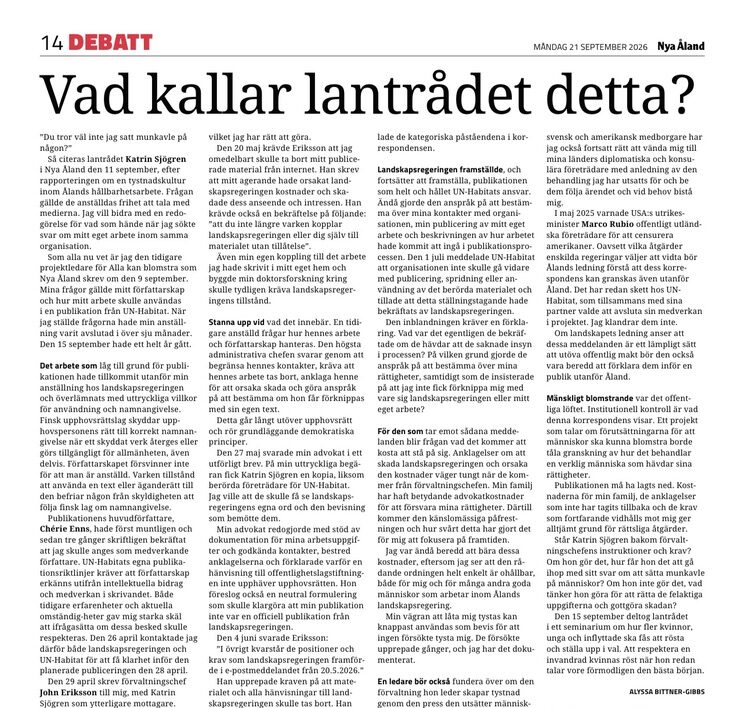
The correspondence and much more commentary can be found at The Buck Stops Here. Readers need not take my word for it.
I had rather assumed that not gagging people was a prerequisite for holding a meeting, rather than an achievement deserving its own sustainability indicator. For a Council whose mandate explicitly encourages fritt tänkande, the possibility that people have learned to silence themselves ought to be considerably more troubling than whether its chair has ever personally told anyone on Åland to shut up.
If the absence of a literal gag is the standard for an open institutional culture, the bar has been set unforgivably and embarrassingly low. One has then profoundly misunderstood what a culture is.
A culture of silence is usually not established by an order. It develops through experience.
People observe what happens when they question authority. Whether criticism is investigated or explained away. Whether objections change anything. Whether those responsible are expected to answer—or those who raise the questions are expected to move on.
And, perhaps most importantly, what happens to people who refuse to let the matter drop. Ahem.
Eventually, the institution may no longer need to discourage criticism explicitly; its members have already learned which conversations are worth having—and which are not.
That is the distinction Hellström brought into public view, and one I explored in Everyone Can Speak: being permitted to speak is not the same as being heard—and being heard is not the same as having the power to change anything.
Ålands Radio also spoke to another Council member who shared much of Hellström’s criticism but did not wish to be named. Over time, I have heard a few private grumbles from others involved in sustainability work, but not from Hellström herself. Criticism is evidently not an entirely scarce resource. Its public distribution is rather more restrained.
What a seat at the table is actually for
There is a particular kind of meeting I have attended rather more often than I would like.
Something is wrong.
Not necessarily something dramatic. Nobody has caught fire. The building remains structurally intact. The coffee is perfectly adequate.
But something is wrong, and at least some of the people in the room know it.
The problem may have been there long enough to become familiar. People have learned to move around it. It may even have acquired a preferred chair.
Then someone does something terribly inconsiderate.
They actually mention it.
The temperature changes.
Someone quickly suggests that we should remain constructive. Someone else chimes in to remind everyone of the considerable progress already achieved. A third expresses appreciation for the opportunity to exchange perspectives.
These are perfectly reasonable contributions.
Unfortunately, none establishes whether the problem is still there.
If the discussion goes on long enough, the institution may even produce a revised procedure for discussing it.
The original problem, meanwhile, continues enjoying its preferred chair at the table.
Which is why I want to give Minna Hellström credit for speaking publicly.
Not because I expect her to agree with me about every aspect of the Council’s work, or because our experiences are identical. We likely don’t, and they certainly aren’t.
And not because she has declared the entire sustainability project a failure. Quite the opposite. She has acknowledged its achievements and the contributions she believes the Council has made.
She also responsibly distinguished what she knew firsthand from what she had not personally witnessed, including the February meeting concerning the head secretary’s appointment.
That is what makes her intervention meaningful. She has not abandoned independent judgment in order to criticise an institution, nor has she abandoned criticism in order to demonstrate her loyalty to it.
She has treated the institution as something worth holding accountable.
Hellström has obvious institutional standing, professional authority and a public platform. None makes her immune to consequences, but they provide a degree of security and influence that others may not possess.
By speaking publicly from within the Council, she has used that standing to make concerns harder to dismiss as the complaints of an isolated outsider. She has also made it easier for others to raise questions without having to carry the entire burden alone.
Power should not exist merely to protect those who possess it. It should also be used to protect those who do not and be their megaphone.
There is a world of difference between using one’s position to shield an institution from criticism and using it to ensure that criticism can be heard.
And that difference becomes especially important in a small society, where professional relationships, political loyalties and personal familiarity so often overlap.
I am increasingly exhausted by the frankly bizarre expectation on Åland that loyalty to a collective undertaking should be demonstrated by protecting it from uncomfortable truths.
I would have thought the opposite was closer to the point.
However, I began to understand this just before I moved to Åland, when I encountered research on Sweden’s incredibly low levels of critical patriotism; here, the expectation that we protect our collective self-image from uncomfortable truths feels stronger still. Finland’s numbers are not so great either.
The fact remains that an institution that responds to uncomfortable information by concentrating on the discomfort has learned remarkably little about the information itself.
An institution that welcomes criticism only when the criticism is agreeable does not particularly welcome criticism.
It welcomes agreement, preferably with a few constructive suggestions attached.
The person who identifies a problem is not necessarily the person undermining the institution.
Sometimes that person is providing precisely the information the institution needs to adapt, improve and survive. Because they care.
Which is the very real purpose of independent judgment.
Not to guarantee that everyone agrees.
Not to preserve everyone’s comfort.
And certainly not to exhaust oneself reassuring those in authority that their good intentions have, once again, been duly acknowledged, as though demanding accountability were a failure of gratitude.
It is to make it possible for an institution to recognise what it would otherwise prefer not to see.
And if a Council devoted to sustainability cannot absorb criticism about its own sustainability, we may have discovered an additional dimension requiring serious development.
Free Thinking, Subject to Amendment
We have examined what happens when someone challenges the prevailing consensus.
Now let us examine who establishes the rules under which that consensus is produced.
There is, happily, one part of the Development and Sustainability Council that appears quite comfortable with transformation: its mandate. I now have four versions, from January 2024, November 2025, February 2026 and May 2026. Three editions in the last six months of that sequence, which seems like…a lot.
Whatever else is struggling to evolve, the document is keeping busy.
Council members change. The head secretary remains.
Under the February 2026 amendment, his appointment now spans two Council terms. The Council is required to meet at least three times a year; the secretariat maintains the work, relationships and institutional memory between meetings. The head secretary prepares those meetings with the chair and vice-chairs. By the time the wider Council exercises its formal authority, a smaller, more continuously involved group has already helped determine what it is being asked to decide.
Scrutiny begins before anyone brews the coffee or raises a hand. Someone selects the documents, frames the question and explains how the present arrangements came to exist. After the discussion, someone records what happened and gives an account of what has been resolved. Who performs that work when the people preparing the account are themselves under scrutiny? And who determines whether criticism has been adequately addressed?
This is not necessarily a malfunction. After all, every governing body needs someone to prepare its business.
But it is important to remember that a vote takes place at the end of a process. By then, somebody has selected the material, framed the question and explained the available options. When continuity is concentrated in the people preparing the decisions, independent scrutiny needs a route that does not depend entirely upon their account of themselves.
Independent scrutiny is considerably less alarming when you have prepared the reading list.
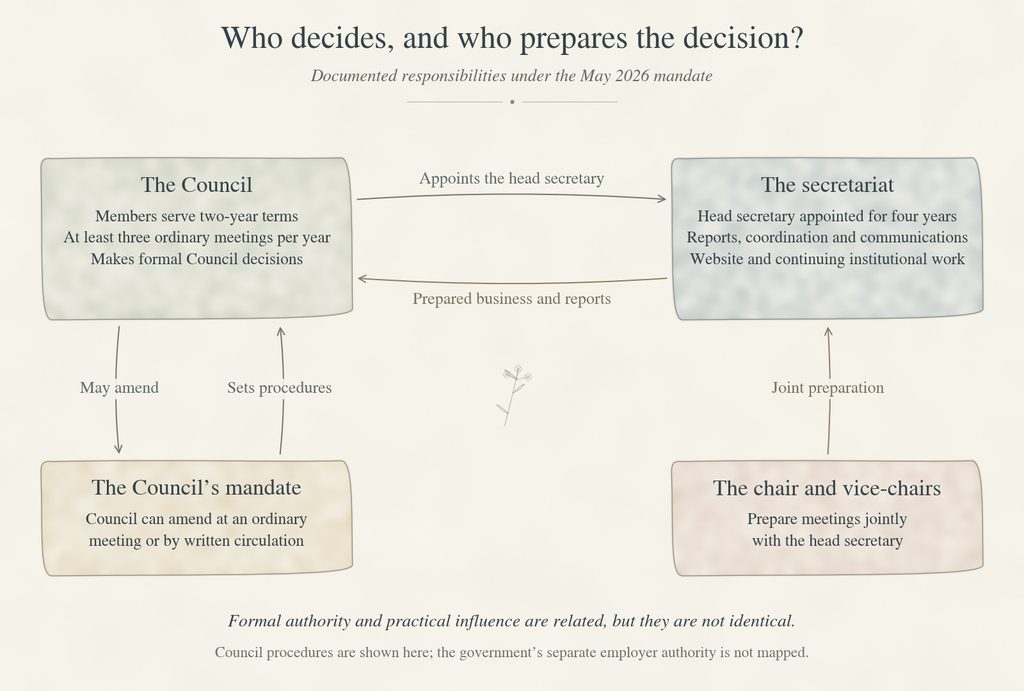
A Council can retain every one of its formal powers while depending heavily upon the account supplied by the people it is supposed to examine. The ability to vote does not answer whether members can independently test what has been put before them. Nor does recording an objection establish that it has been answered. Power also lies in deciding when the institution has heard quite enough to move on.
Hellström’s account gives that power a recognisable consequence. She described criticism being explained away or leading nowhere, until remaining silent could feel easier than continuing to object. The opportunity to speak may remain formally available while experience teaches members how little it achieves.
Her concerns about the Council’s role in the head secretary’s appointment expose another part of the problem. She had not understood the Council to be participating in an employment decision, and had gathered that other members had not understood its role either. Independent judgment requires knowing what one is being asked to judge, and what significance will be attached to one’s participation.
One should not have to read the minutes to discover what one supposedly helped decide.
A mandate can promise free thinking. It cannot make being ignored a form of participation.
The Council is supposed to represent the diversity of Ålandic society. Its members bring different knowledge, experience and institutional responsibilities into the room. But representation is more than a decorative arrangement of sectors around a conference table. It requires that their independent judgment can change what happens, including the framing of a problem and the proposed response.
Otherwise, society supplies the standing while a smaller circle supplies the terms.
Even the critics look agreeable in the group photograph. How inclusive we become once nobody can hear us.
In Everyone Can Advise, I examined the distance between being asked for a view and having a meaningful opportunity to change the outcome. The question here goes even deeper: who controls the conditions under which collective judgment takes place?
The mandate history gives that question a paper trail. I worked under the January 2024 version and gave some feedback on it in June 2025. I downloaded the November and February versions in early 2026 for a research paper I subsequently had to abandon after the international collapse of Everyone Can Flourish. The May text completes the sequence now before us.
| Version (with link) | What the text changes or provides |
|---|---|
| January 2024 | Co-actors discuss proposed revisions at their last meeting of a Council term; the incoming Council adopts adjustments. Council members and the head secretary serve two-year terms. |
| November 2025 | The Council may amend its own mandate at an ordinary meeting or per capsulam. The earlier co-actor discussion stage is no longer specified. Representation and secretariat provisions are also revised. |
| February 2026 | The head secretary’s appointment changes from two years to four. Council members’ terms remain two years. This is the only substantive change from November. |
| May 2026 | Five additional substitute provisions are introduced. The February term extension and November amendment route remain in place. |
The November revision broadened specified representation and expanded the description of the secretariat’s responsibilities. The secretariat works between those meetings, preparing material, coordinating elements of the sustainability work, producing reports, supporting international cooperation and maintaining Bärkraft’s website. The secretary prepares meetings with the chair and vice-chairs.
This is actually very necessary work. But it is also a source of influence, particularly when the question before the Council concerns the people and arrangements through which its information reaches it.
Of course, such functions require continuity.
However, continuity is not the same thing as accountability.
November also removed the explicit requirement to discuss proposed mandate revisions with the wider co-actors, while giving the Council an express route to amend its own rules, including per capsulam. May added five substitute provisions. The Council can broaden its representation while giving its secretary a longer horizon than its members.
These changes concern who can alter the rules, whose participation is required and who carries institutional knowledge across successive Councils. They therefore deserve questions about who proposed them, whose judgment shaped them and what they do to the balance of power. Broad representation cannot answer those questions merely by appearing in the membership list.
Throughout all four versions, the mandate continues to commend integrity, transparency and free thinking. These promises have survived every revision. Actually implementing them apparently involves taking the mandate rather too seriously.
If another amendment is the answer to criticism of the Council’s culture, the relevant question is what it will enable somebody to do that they could not effectively do before. Obtain the information needed to challenge an account? Get a substantive objection answered? Secure a correction despite the discomfort of those responsible?
A change in who can get an uncomfortable question answered would be rather more interesting.
The Council has demonstrated a considerable capacity to revise its own rules.
Whether it has demonstrated an equally impressive enthusiasm for scrutinising the arrangements and individuals those rules protect is another matter entirely.
A small model of society, with fika
The Council was assembled to bring different parts of society into a conversation about transformation.
That is an ambitious democratic undertaking.
Sustainability necessarily involves competing interests, conflicting priorities and different ways of understanding the good life. Environmental protection, economic livelihoods, social wellbeing, justice, cultural continuity and democratic legitimacy do not always fit together neatly.
An institution that brings those perspectives into conversation can contribute something highly valuable.
Which makes its own present conduct a rather useful demonstration. If it cannot accommodate disagreement about a meeting, its ambition to guide Åland through decades of competing interests presumably rests on the future agreeing to watch its tone.
A Council assembled to represent society should be able to accommodate the fact that society does not agree with itself. The apparent difficulty is not that people disagree. Disagreement was always part of the design.
The difficulty arises if the institution begins treating disagreement about itself as fundamentally different from disagreement about the world outside it.
We can debate how to transform society. We can question economic assumptions, challenge existing patterns of consumption, examine cultural values and reconsider what human flourishing ought to mean.
But once the discussion turns to how the Council itself operates, how its leadership exercises influence or whether its own decisions deserve examination, transformation can curiously become a rather delicate undertaking.
Apparently, society begins just outside the meeting room.

The issues are even easier to visualise on Åland. A project built over a decade accumulates relationships as well as achievements. People spend years establishing it, defending its funding and persuading others to take it seriously. Its survival becomes entangled and conflated with their judgment, political credibility and account of what they have contributed. A challenge to the arrangements can then feel like a challenge to the people who built them.
External opposition intensifies that pressure. If a project is already regarded as vulnerable to certain political forces or economic conditions, an internal critic may be treated as somebody supplying ammunition to the enemy. Her commitment to its purpose becomes less important than the inconvenience of what she knows. Defending the project begins to mean defending the arrangements through which it currently operates, including arrangements that may be damaging it.
This helps explain how sincere people can sustain a culture they would reject in principle. Nobody needs to convene a meeting and hatch a plot to enforce a culture of silence. Familiar loyalties, unequal risks and a shared preference for getting through the afternoon can do a considerable amount of the work, free of charge.
In systems thinking, the visible parts of an institution are not necessarily the parts that explain how it behaves.
We can count meetings, revise mandates, alter appointment periods, establish working groups, produce reports and publish indicators.
These are but the observable features.
Beneath them are patterns governing how information travels, how decisions are prepared, what behaviour is rewarded, and what assumptions people make about their own institution.
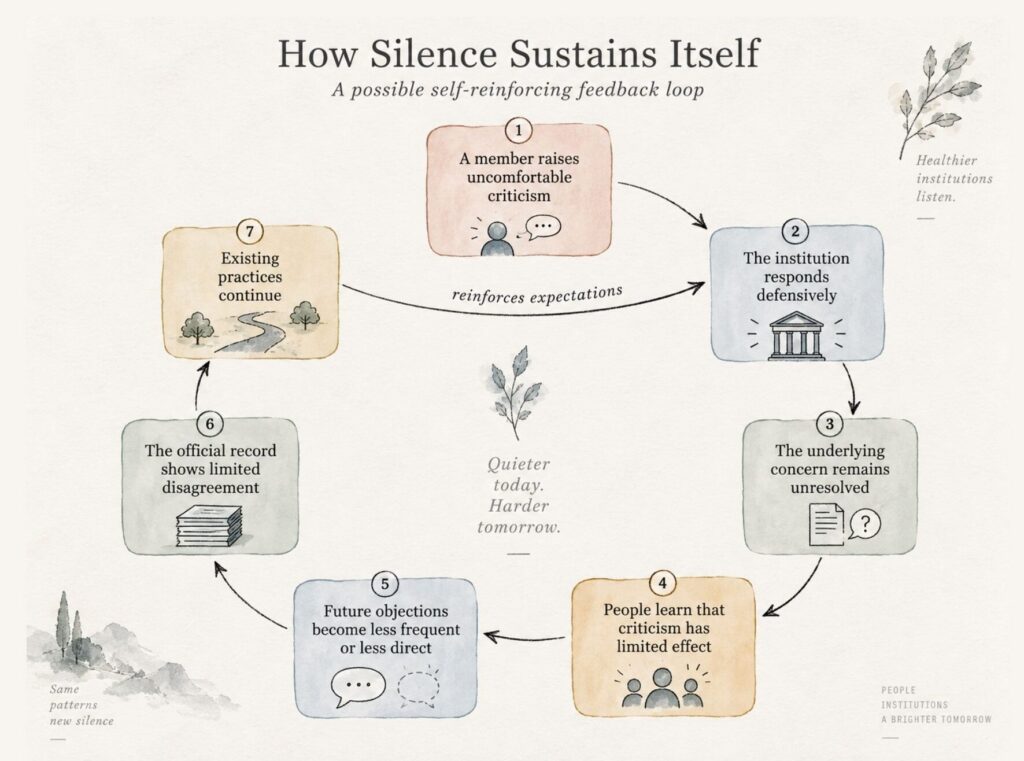
The silence loop describes what people learn from the institution’s response. A second loop helps explain why those defending the institution may become more determined to preserve its arrangements as the criticism grows.
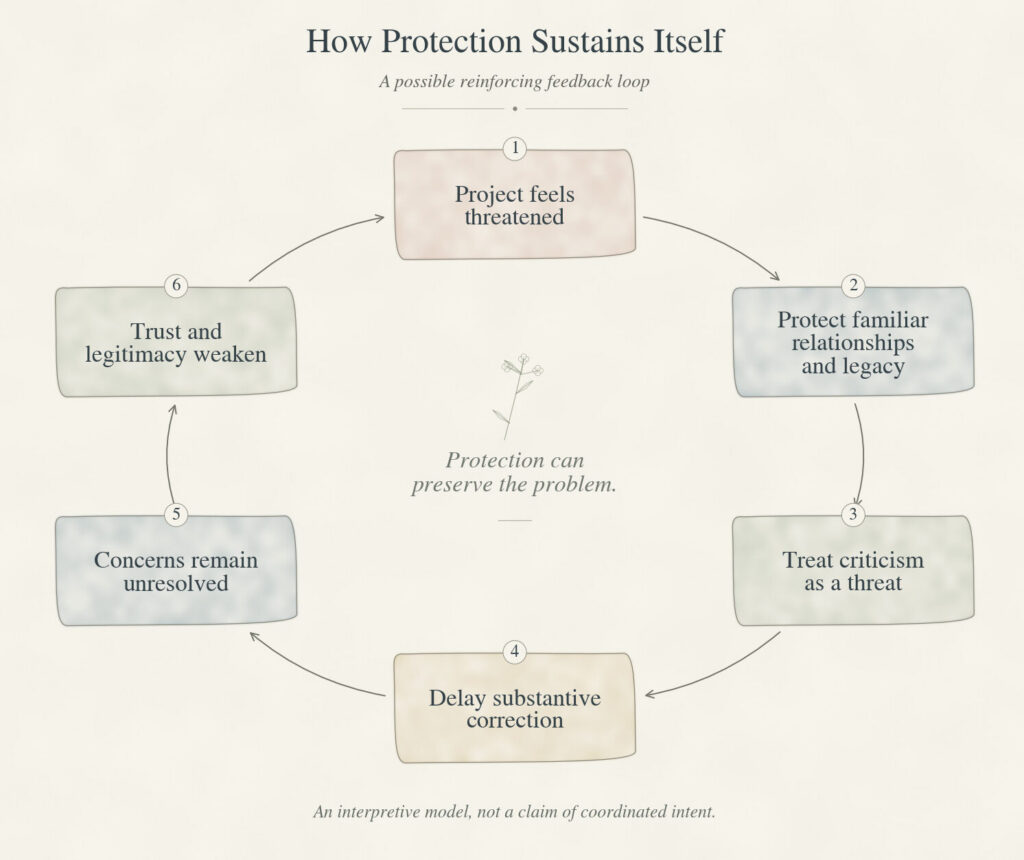
The two loops reinforce each other. Inside the institution, the cost of pursuing a concern discourages others from persisting. The resulting quiet can be mistaken for agreement. Outside it, unresolved problems can damage trust and make the project more vulnerable, encouraging its defenders to close ranks again. The institution receives less corrective information just when it most needs to learn.
The first loop makes speaking expensive. The second makes correction feel dangerous. Together, they can turn an invitation to participate into an invitation to bless what has already been decided.
Systems thinker Donella Meadows explored these distinctions in Leverage Points: Places to Intervene in a System. Her Thinking in Systems has a permanent place beside me at my desk because I am a big nerd.
This is also one of those occasions when my ADHD earns its keep. Associative and lateral thinking and pattern recognition are something of a love language for my neurotype. Give my brain a Sustainability Council, four versions of a mandate and a few carefully worded explanations, and it starts drawing arrows. Or forty-plus years of ÅHS history and Lagting transcripts. Nor does it wait for permission.
By the time somebody irritably insists these are all separate issues, I have probably already mapped the field, its incentives and its leverage points.
But there is something exhausting and profoundly lonely about repeatedly ending up as Cassandra. You can see exactly where things are heading, but explaining it makes you the immediate problem when powerful people prefer comfort and denial. Because they can afford it. Others cannot.
Later, when the consequences arrive, there may be considerable enthusiasm for discussing lessons learned, without acknowledging that you pointed out the issue in advance.
Being proved right generally means we have reached the expensive part, and I get to help clean up. I would much, much rather be wrong and get my afternoon back.
Remind them that you warned them, and suddenly you are being divisive or not focused on moving forward. Apparently, learning lessons requires everyone to agree that nobody could possibly have known.
Companies spend millions on early-warning systems. They pay people like me to recognise patterns, connect signals and identify trouble before it becomes costly. Put that capacity in a dashboard and a state might deem it an investment in resilience.
Put it in an American woman at the conference table sharing inconvenient truths and suddenly we need to discuss her tone and that she is not from here.
Cassandra did not need a workshop on constructive communication. Somebody just fucking needed to look inside the bloody horse.
So here I am.
Welcome to hell.
Donella Meadows’s work on leverage points helps explain why a new procedure may leave this pattern intact. Information flows and rules matter, but so do the goals they serve and the assumptions through which people interpret them. Changing a rule can redistribute power. It can also make an existing priority easier to pursue.
Meadows distinguished relatively shallow interventions, such as changing numerical parameters, from deeper changes involving information flows, rules, institutional goals and the paradigms from which those systems emerge. But if the priority is preserving familiar arrangements, administrative activity can become a substitute for institutional change. The paperwork has done its ten thousand steps. Power has not left its chair.
The deeper point is not that the formal arrangements are unimportant.
It is that their effects depend enormously upon the culture and assumptions within which they operate.
A Council can introduce a new procedure for receiving criticism.
But if the prevailing expectation remains that criticism should not significantly disturb familiar arrangements, the procedure may accomplish very little other than symbolic output.
An institution can promise transparency.
But if the information required for independent scrutiny is controlled by the people whose decisions are under scrutiny, transparency may remain more impressive as a word than as a practice.
A Council can be composed of individuals with considerable professional integrity.
But if its members learn that questioning familiar arrangements produces defensiveness, discomfort or social consequences, the institution may gradually receive less of the independent judgment it was established to gather in the first place.
This produces a potentially self-reinforcing pattern.
Someone raises a concern.
The institution responds by explaining or defending its existing approach.
The underlying concern remains unresolved.
Other members observe the exchange.
They learn something—not necessarily about whether the criticism was correct, but about what happens when it is raised.
Next time, some may choose their words more carefully. Others may decide the effort is not worthwhile. People like me tend to withdraw while we still have our sanity and before someone hands us a mop and calls it an exciting opportunity to contribute.
The room becomes quieter.
The institution experiences fewer objections.
The resulting calm can then be mistaken for evidence that the arrangements are functioning well.
The objections have diminished. The problems have generously agreed to remain.
And the circle of life begins again. Same lions. Fresh volunteers.
Minna Hellström’s intervention matters because it interrupts that process. By distinguishing the Council’s achievements from its handling of criticism, she makes it harder to claim that valuing the work requires endorsing everything done in its name. A Council created to gather independent judgment ought to find that useful.
A commitment to free thinking cannot be evaluated by asking only whether members are technically allowed to express an opinion.
The more meaningful question is whether the institution has the capacity to learn from information that challenges its assumptions.
Because there is a difference between organisational stability and organisational learning.
The system can also become extremely efficient at absorbing criticism without allowing criticism to influence its behaviour.
That is not necessarily resilience or continuity.
It may simply be a highly developed capacity for self-preservation.
And an institution truly concerned with sustainability ought to willingly recognise the difference.
Changing Åland may require decades.
Reconsidering how a meeting is conducted should, one hopes, be achievable before 2051.
And ten years into the agenda, there is an even more basic question.
What is this Council now for?
The institution was established in 2016 to help build a shared sustainability agenda. A decade later, much of that work has entered the ordinary activities of government, municipalities, businesses and civil society according to comments from the Lagting and elsewhere.
That is an achievement worth recognising.
But the arrangements needed to create a movement are not necessarily the arrangements needed to govern its implementation.
An institution can succeed in its original task and still require fundamental reconsideration.
On 7 September, Lantråd Katrin Sjögren publicly acknowledged that the Council constitutes only a small part of Åland’s sustainability work. She also observed that if the Council were discontinued, there would no longer be a need for its secretary.
Quite so.
The Agenda exists to serve Åland.
The Council exists to serve the Agenda.
The Secretary exists to serve the Council.
I often wonder if we may have become slightly confused about the direction in which the service is supposed to flow.
If the Council were discontinued, Åland would still have environmental challenges, social inequalities, economic decisions, people who need somewhere to belong and a future that will arrive regardless of whether anyone has approved the agenda.
There would definitely be a need for sustainability work.
What requires examination is which functions genuinely need this particular institution in its current form and what distinctive value its representative structure continues to provide.
An institution’s survival is not, in itself, evidence of its continuing necessity.
Continuity can be valuable when it preserves something worth sustaining. It becomes considerably less impressive when the original purpose quietly gives way to keeping its founders indispensable.
At €5,411.97 per month for its Secretary, this would seem an especially reasonable question to ask about the continuing organisational arrangements.
The money, after all, is real.
Even if the minutes are not yet available.
The project that is on ice, except where it isn’t
Everyone Can Flourish has achieved an unusual form of resilience: the international publication has been cancelled, the collaboration is on ice, and the website is still explaining how to govern.
This initiative was presented to the Council. Its February 2026 protocol included an appendix outlining a proposed strategy group, naming international institutional partners, describing an anticipated White Paper and announcing plans for an international website.
The Council noted the presentation for information. That was not blanket approval of every subsequent activity or use of material. It was not an institutional memory wipe either. The project and its proposed governance arrangements were explicitly put before the body now in a position to ask what became of them.
In the Lagting debate on 7 September, Premier Katrin Sjögren went further than acknowledging a stalled international initiative. Responding to a question about Everyone Can Flourish, she said:
Det är inte en viktig del.
(In English: “It is not an important part.”)
The most important sustainability work, she explained, happened at home. Her wider defence invoked Åland’s established cooperation with Finnish and Nordic partners.
Quite the demotion for an initiative the government had previously presented as an important future element of Åland’s external policy. Its importance was considerable while it belonged to the future. The past appears to be another department.
We can certainly continue working with our neighbours. Being able to carry on without a project is not the same as having accounted for its collapse.
Meanwhile, the ECF website remains online. During the summer, it shed language explicitly describing the project as an institutional collaboration. It now presents Everyone Can Flourish as a long-term initiative and the website as a resource. Yet it also continues to describe Åland as an incubator, provide an intellectual and practical governance framework of dubious provenance, and identify the Everyone Can Flourish Project in its copyright notice.
The public presentation has remained substantively unchanged since the August revisions we documented. Calling it a resource has settled what to call the website. It has not settled who answers for what it publishes.
If the important work is local or Nordic, Swedish should do nicely, as John Eriksson helpfully reminded my lawyer. Apparently, the international project is dispensable, but its English-language website is not. For anyone wishing to explain the local work to an international audience, Bärkraft.ax already maintains an English-language section, although its homepage does not currently link to it. Perhaps international outreach could begin with a hyperlink?
None of these changes in description answers the administrative question: who currently authorises and takes responsibility for the initiative’s public representation? What is its relationship to Åland’s public institutions now that the arrangements originally presented have changed?
“On ice” is a temperature, not a governance arrangement. An organisation should be able to explain who is responsible for its public representations, particularly when the arrangements and partners originally described have changed.
I have already examined the authorship dispute in The Phantom Steps Forward and Good Question. I Don’t Know. There is no need to reproduce the entire affair to ask who is responsible for what continues in its name.
The Council has enough information to ask that question. Another affirmation that dialogue is important would be an impressively elaborate way of avoiding the answer.
A project offering a framework for responsible governance should be able to identify who governs it. Preferably before advising everyone else.
When the system becomes the thing being sustained
This brings us back to the deeper problem.
Institutions are extraordinarily good at describing the values they wish to embody.
They are often rather less enthusiastic about examining the habits that prevent those values from governing their actual conduct.
A mandate can promise free thinking.
A sustainability strategy can celebrate belonging.
A political party can champion equality.
A government can affirm the importance of democratic legitimacy, public trust and human flourishing.
All these commitments may be sincerely held.
But sincerity does not eliminate the need for structures that make them meaningful when applying them becomes uncomfortable.
Nor does producing another document necessarily change the institutional culture that gave rise to the problem.
If criticism is treated primarily as a reputational threat, a revised mandate may simply establish a more elaborate procedure for managing reputational threats.
If the underlying goal is to preserve familiar arrangements, information that challenges those arrangements may be interpreted as something to contain rather than something to learn from.

If loyalty becomes more important than independent judgment, the Council can acquire as many representatives as it likes without necessarily becoming more representative in practice.
And if an institution begins measuring its success by its ability to survive criticism rather than respond to it, something fundamental has shifted.
The institution’s continued existence has become a goal in itself.
This is where culture becomes a deeper leverage point than another adjustment to the organisation chart.
Not because formal accountability is unimportant, but because formal accountability can be hollowed out by the assumptions governing how it is used.
A healthy institution does not need everyone to agree.
It needs the ability to recognise disagreement, distinguish sound criticism from unsound criticism, preserve the information necessary to assess decisions, and change course when the evidence requires it.
It also needs the capacity to tolerate the deeply inconvenient possibility that someone lower in the hierarchy, newer to the room, or less personally invested in existing arrangements may know something important.
Reality is notoriously careless about the seating plan and title distribution.
That is not a threat to good governance. That is what good governance is supposed to make possible.
And this is why I find the Council such an interesting case. It is not just another committee.
It was created to help a society imagine and undertake transformation.
Its members represent different sectors precisely because the world cannot be understood from one position. Its mandate acknowledges the value of free thinking. Its vision promises a society in which everyone can flourish.
What a marvellous opportunity, then, to demonstrate that the institution itself can learn from people who disagree with it.
Or, failing that, to provide an unusually detailed case study of why cultural transformation remains necessary.
Ten years is a perfectly good reason for cake. The case for another ten requires something more substantial.
The key question is whether its current arrangements continue to serve the purpose for which it was established. And if they do not, whether the Council is capable of finding that out without treating the discovery as an act of treason.
I do not propose here to supply another comprehensive reform programme. I could quite easily, but I have already donated rather more intellectual labour to Åland’s sustainability work than my bank account considers sustainable. There are several well-paid people whose responsibilities include examining these arrangements. What I would like to see is evidence that an unwelcome contribution can change something they do.
I merely intend to keep helpfully asking what those arrangements are accomplishing.
Which brings us, once again, to the minutes.
And the winner is…
I do not yet know what the 23 September protocol will say.
Perhaps it will even acknowledge the criticism.
Fingers crossed. Thoughts and prayers. We have exhausted the secular options.
Perhaps it will clarify the distinctions between the Council’s advisory role, the government’s employer authority and the responsibilities of the secretariat.
Perhaps it will demonstrate that the Council has taken the opportunity to examine its own governance with the seriousness such questions deserve.
I would welcome that. It is entirely possible to criticise an institution and still want it to succeed. Wanting an institution to succeed is an excellent reason to insist that it confront its problems.
I am grateful that Minna Hellström spoke publicly about her experience. Not because one Council member’s account resolves every question, but because she was willing to make an independent judgment visible.
I would like to think we have reached a stage in Åland’s democratic development where recognising that something is wrong does not require everyone to spend three months discussing whether the person who noticed it could have been nicer about the discovery.
An institution created to represent society’s diversity should not be surprised when that diversity includes disagreement about the institution itself.
Others may disagree with Minna’s take.
And they should be able to.
That is, after all, kind of part of the point.
But disagreement with criticism is not the same thing as responding to it. And defending an institution’s achievements is not the same thing as establishing that its current arrangements are sound.
We should all be able to agree that the Development and Sustainability Agenda exists to serve Åland. The Council exists to serve the Agenda. Its secretariat exists to support that work.
If scrutiny of the secretariat threatens the Council, and scrutiny of the Council threatens sustainability itself, accountability has apparently become an environmental hazard. Please offset your next critique by planting a tree.
The future remains open to transformation. The arrangements for deciding it appear rather less negotiable. One begins to wonder what, precisely, is being sustained.
Ten years of achievements do not answer whether the present arrangements remain fit for their purpose. They make an honest and independent examination worthwhile. An institution established to support transformation should be able to reconsider its own role without classifying self-reflection as an extinction event.
This is about whether the Council is capable of learning from the things its members have had to pluck up the courage to say. It is not an attempt to abolish the future.
The 23 September protocol may yet show that the Council has engaged seriously with the questions before it.
But success will not be defined in a protocol that records that everyone had an opportunity to speak. The record needs to let us follow what happened to the substance: which concern received a substantive answer, how it affected the decision, and who accepted responsibility for what remains unresolved. Otherwise, the meeting has converted disagreement into a document without establishing that the institution learned anything from it.
So, by all means, enjoy the bingo card. Appreciate the administrative craftsmanship. Make a cup of coffee. Just remember that the prize is not a protocol in which everyone sounds agreeable. It is an institution in which being right can matter, even when the wrong person notices first.
Åland has spent ten years discussing how to create a society in which everyone can flourish.
Surely we can manage one in which someone is allowed to have a point.
Everyone can agree. But somebody has to be allowed to be right.
And if the matter requires further clarification, I trust it will be duly noted.
Comments